Ch. P - Fundamental Concepts of Algebra
Blitzer - College Algebra 8th Edition
Blitzer8th EditionCollege AlgebraISBN: 9780136970514Not the one you use?Change textbook
Chapter 1, Problem 49

In Exercises 47 - 49, add or subtract terms whenever possible. 4√72 - 2√48

Verified step by step guidance
1
Start by simplifying each square root term separately. Break down the numbers inside the radicals into their prime factors or perfect squares. For example, express 72 as a product of a perfect square and another number: \(72 = 36 \times 2\).
Rewrite the square roots using the property \(\sqrt{a \times b} = \sqrt{a} \times \sqrt{b}\). So, \(\sqrt{72} = \sqrt{36 \times 2} = \sqrt{36} \times \sqrt{2}\) and \(\sqrt{48} = \sqrt{16 \times 3} = \sqrt{16} \times \sqrt{3}\).
Calculate the square roots of the perfect squares: \(\sqrt{36} = 6\) and \(\sqrt{16} = 4\). Substitute these back into the expression to get \(4 \times 6 \sqrt{2} - 2 \times 4 \sqrt{3}\).
Multiply the coefficients outside the radicals: \(4 \times 6 = 24\) and \(2 \times 4 = 8\). So the expression becomes \(24 \sqrt{2} - 8 \sqrt{3}\).
Since \(\sqrt{2}\) and \(\sqrt{3}\) are unlike terms (different radicals), you cannot combine them further. The simplified expression is \(24 \sqrt{2} - 8 \sqrt{3}\).

Verified video answer for a similar problem:

This video solution was recommended by our tutors as helpful for the problem above.
Video duration:
3m
Was this helpful?

Key Concepts

Here are the essential concepts you must grasp in order to answer the question correctly.

Simplifying Radicals

Simplifying radicals involves expressing the radicand (the number inside the square root) as a product of perfect squares and other factors. This allows you to take the square root of the perfect square separately, simplifying the expression. For example, √72 can be rewritten as √(36×2) = 6√2.
Recommended video:
Guided course
5:48
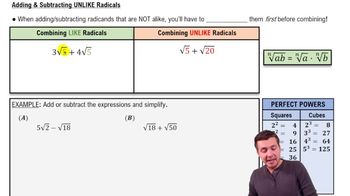
Adding & Subtracting Unlike Radicals by Simplifying

Like Radicals

Like radicals have the same radicand and index, which means they can be combined through addition or subtraction. For instance, 4√2 and 2√2 are like radicals and can be combined as (4 - 2)√2 = 2√2. Identifying like radicals is essential for simplifying expressions involving roots.
Recommended video:
Guided course
03:50
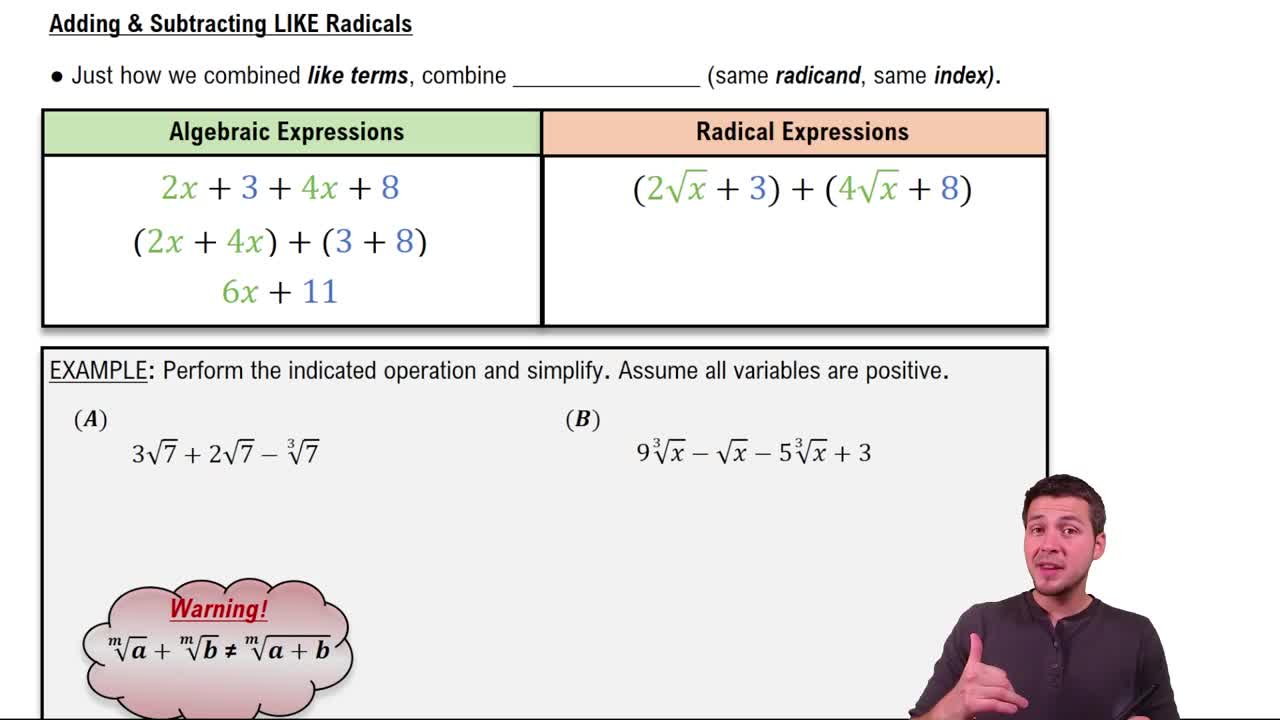
Adding & Subtracting Like Radicals

Combining Like Terms

Combining like terms means adding or subtracting coefficients of terms that have the same variable or radical part. After simplifying radicals, you combine terms with identical radicals by performing arithmetic on their coefficients. This step reduces the expression to its simplest form.
Recommended video:
5:22
Combinations