In Exercises 47–54, find each cube root.
___
³√−27
Verified step by step guidance
1
Identify the expression: We need to find the cube root of \(-27\).
Recall the definition of a cube root: The cube root of a number \(x\) is a number \(y\) such that \(y^3 = x\).
Apply the cube root to the given number: We are looking for a number \(y\) such that \(y^3 = -27\).
Consider the properties of cube roots: Since \(-27\) is negative, the cube root will also be negative because the cube of a negative number is negative.
Find the integer whose cube is \(-27\): Determine which integer, when cubed, results in \(-27\).
Verified video answer for a similar problem:
This video solution was recommended by our tutors as helpful for the problem above.
Video duration:
1m
Play a video:
0 Comments
Key Concepts
Here are the essential concepts you must grasp in order to answer the question correctly.
Cube Roots
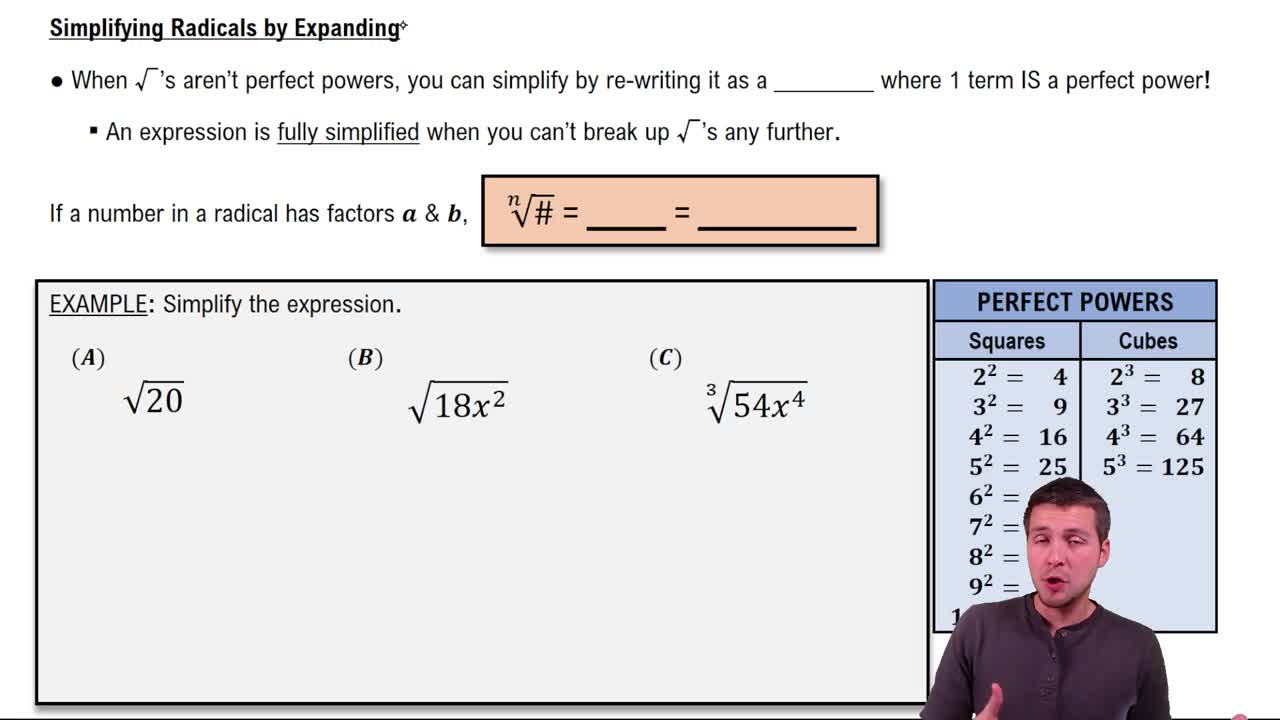
A cube root of a number is a value that, when multiplied by itself three times, gives the original number. For example, the cube root of -27 is -3, since (-3) × (-3) × (-3) = -27. Understanding cube roots is essential for solving equations involving cubic functions and for simplifying expressions.
When dealing with odd roots, such as cube roots, negative numbers have real roots. This is in contrast to even roots, where negative numbers do not yield real results. For instance, the cube root of -27 is a real number (-3), which highlights the unique properties of odd roots in algebra.
Radical notation is a way to express roots using the radical symbol (√). For cube roots, it is denoted as ³√. Understanding how to interpret and manipulate radical expressions is crucial for solving problems involving roots, as it allows for simplification and the application of algebraic rules.

 1:27 minutes
 Verified step by step guidance
 02:20
02:20