Show that each polynomial function has a real zero as described in parts (a) and (b). In Exercises 31 and 32, also work part (c). ƒ(x)=6x^4+13x^3-11x^2-3x+5 no zero greater than 1
Table of contents
- 0. Review of Algebra4h 18m
- 1. Equations & Inequalities3h 18m
- 2. Graphs of Equations1h 43m
- 3. Functions2h 17m
- 4. Polynomial Functions1h 44m
- 5. Rational Functions1h 23m
- 6. Exponential & Logarithmic Functions2h 28m
- 7. Systems of Equations & Matrices4h 5m
- 8. Conic Sections2h 23m
- 9. Sequences, Series, & Induction1h 22m
- 10. Combinatorics & Probability1h 45m
4. Polynomial Functions
Zeros of Polynomial Functions
Problem 55
Textbook Question
Find a polynomial function ƒ(x) of degree 3 with real coefficients that satisfies the given conditions. Zeros of -2, 1, and 0; ƒ(-1)=-1
Verified step by step guidance1
Identify the zeros of the polynomial function. Since the zeros are -2, 1, and 0, the factors of the polynomial are \((x + 2)\), \((x - 1)\), and \(x\) respectively.
Write the general form of the polynomial function as \(f(x) = a \cdot x \cdot (x + 2) \cdot (x - 1)\), where \(a\) is a real number coefficient to be determined.
Use the given condition \(f(-1) = -1\) to find the value of \(a\). Substitute \(x = -1\) into the polynomial: \(f(-1) = a \cdot (-1) \cdot (-1 + 2) \cdot (-1 - 1)\).
Simplify the expression from the substitution to get an equation in terms of \(a\): \(f(-1) = a \cdot (-1) \cdot 1 \cdot (-2) = 2a\).
Set the simplified expression equal to the given value \(-1\) and solve for \(a\): \$2a = -1\(, then find \)a\(. Once \)a\( is found, write the final polynomial function \)f(x)\( by substituting \)a$ back into the general form.
Verified video answer for a similar problem:This video solution was recommended by our tutors as helpful for the problem above
Video duration:
8mPlay a video:
Was this helpful?
Key Concepts
Here are the essential concepts you must grasp in order to answer the question correctly.
Polynomial Functions and Degree
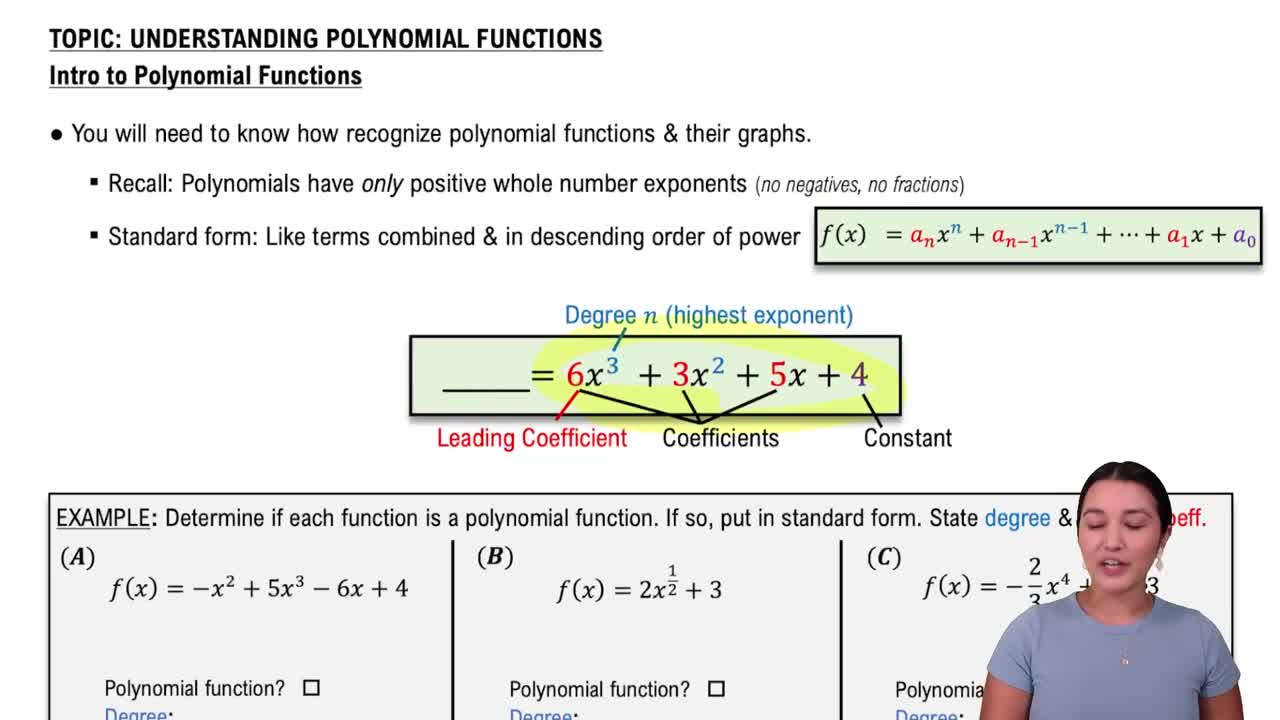
A polynomial function is an expression consisting of variables and coefficients combined using addition, subtraction, and multiplication, with non-negative integer exponents. The degree of a polynomial is the highest exponent of the variable, which determines the general shape and number of roots of the function. For this problem, the polynomial must be cubic (degree 3).
Recommended video:
Introduction to Polynomial Functions
Zeros of a Polynomial
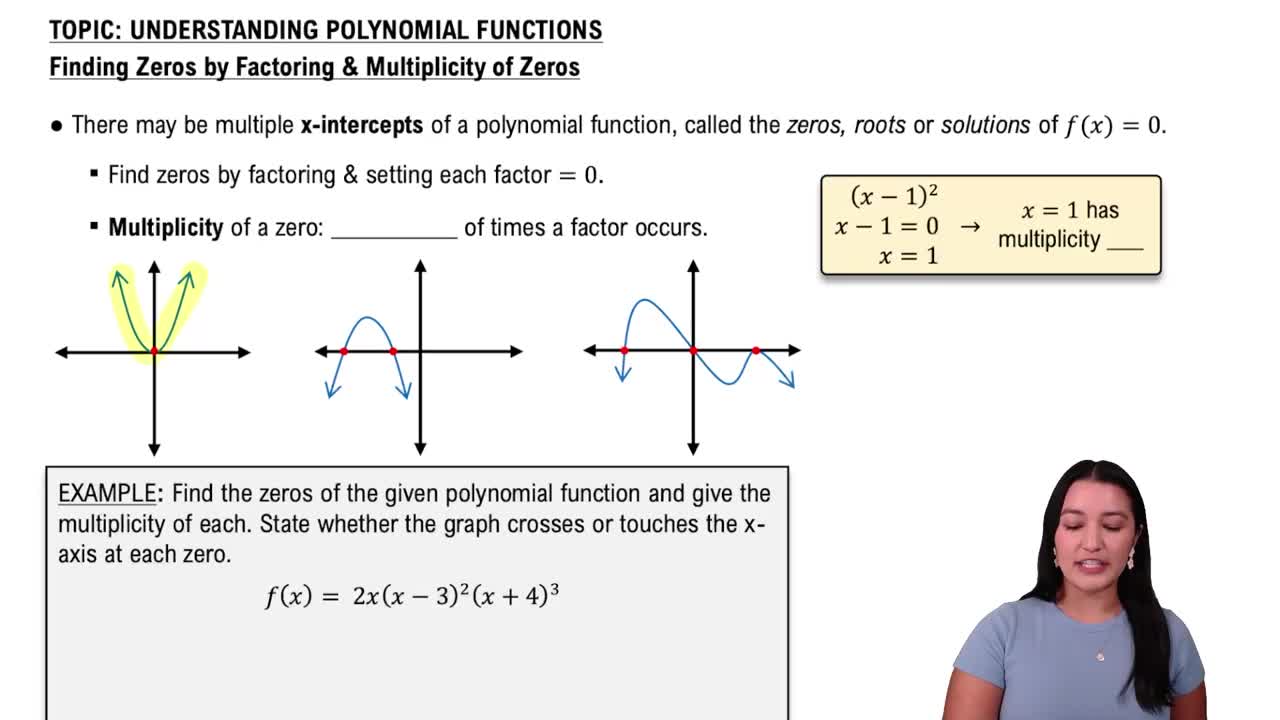
Zeros (or roots) of a polynomial are the values of x for which the function equals zero. If a polynomial has real coefficients and zeros at -2, 1, and 0, then (x + 2), (x - 1), and x are factors of the polynomial. The polynomial can be expressed as a product of these factors, possibly multiplied by a constant.
Recommended video:
Finding Zeros & Their Multiplicity
Using a Point to Find the Leading Coefficient
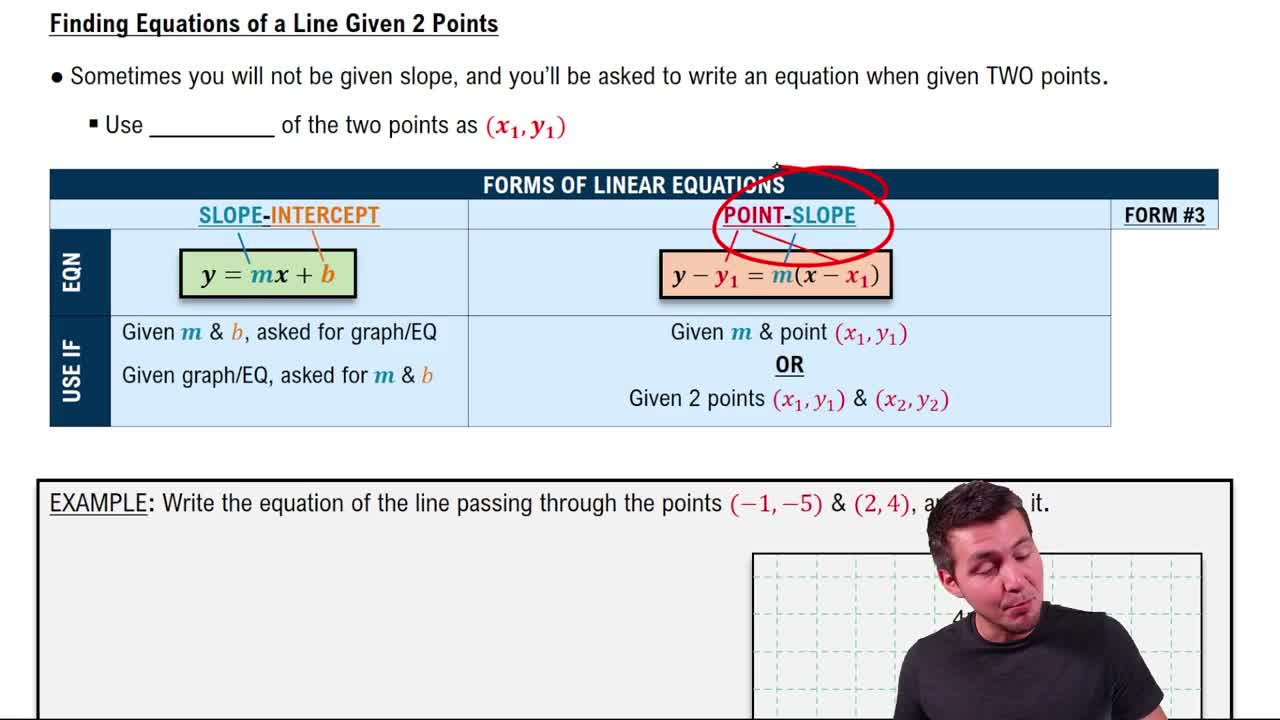
Given a point on the polynomial, such as ƒ(-1) = -1, you can substitute x = -1 into the factored form to solve for the unknown leading coefficient. This step ensures the polynomial not only has the correct zeros but also passes through the specified point, fully determining the function.
Recommended video:
Guided course
Finding Equations of Lines Given Two Points
Related Videos
Related Practice
Textbook Question
336
views