Graph the line passing through the given point and having the indicated slope. Plot twopoints on the line. See Example 7. through (3, -4), m = - 1/3
Verified step by step guidance
1
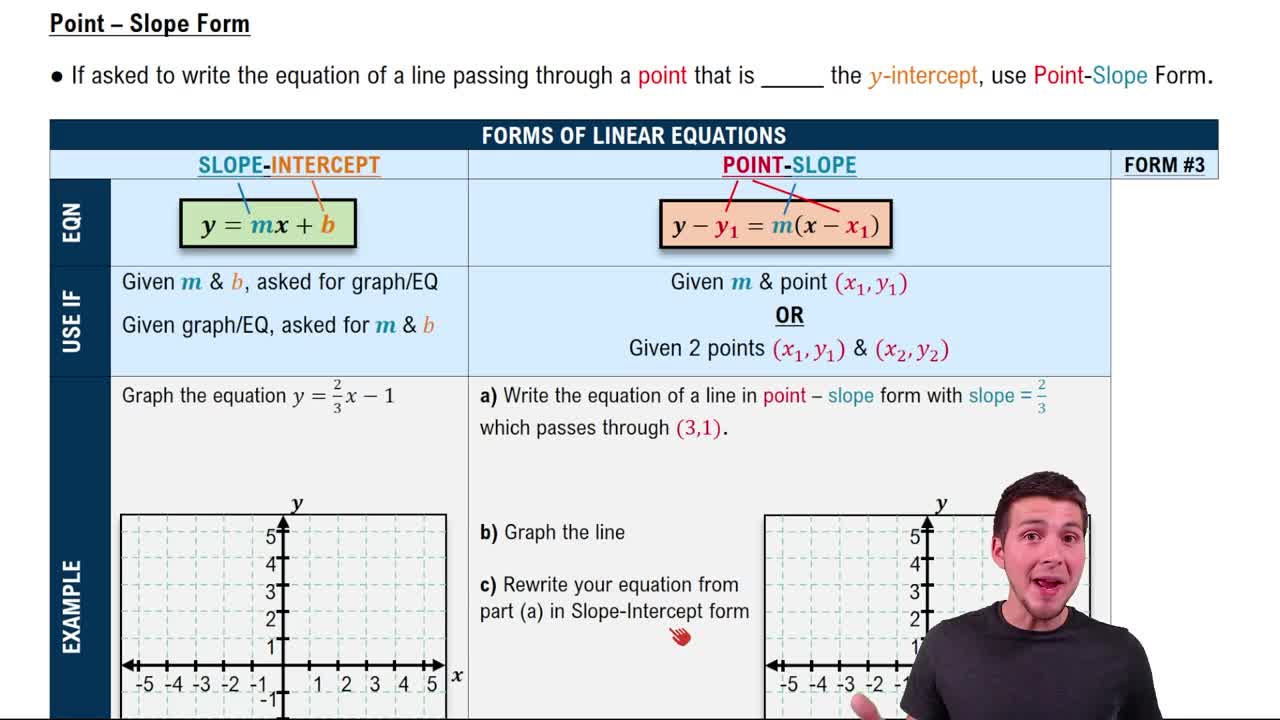
Identify the point-slope form of a line equation: \( y - y_1 = m(x - x_1) \), where \((x_1, y_1)\) is a point on the line and \(m\) is the slope.
Substitute the given point \((3, -4)\) and slope \(m = -\frac{1}{3}\) into the point-slope form equation: \( y + 4 = -\frac{1}{3}(x - 3) \).
Simplify the equation to get it into slope-intercept form \(y = mx + b\).
Choose another value for \(x\) to find a second point on the line. For example, let \(x = 0\) and solve for \(y\).
Plot the points \((3, -4)\) and the second point found in the previous step on a graph, and draw the line through these points.
Verified video answer for a similar problem:
This video solution was recommended by our tutors as helpful for the problem above
Video duration:
6m
Play a video:
Was this helpful?
Key Concepts
Here are the essential concepts you must grasp in order to answer the question correctly.
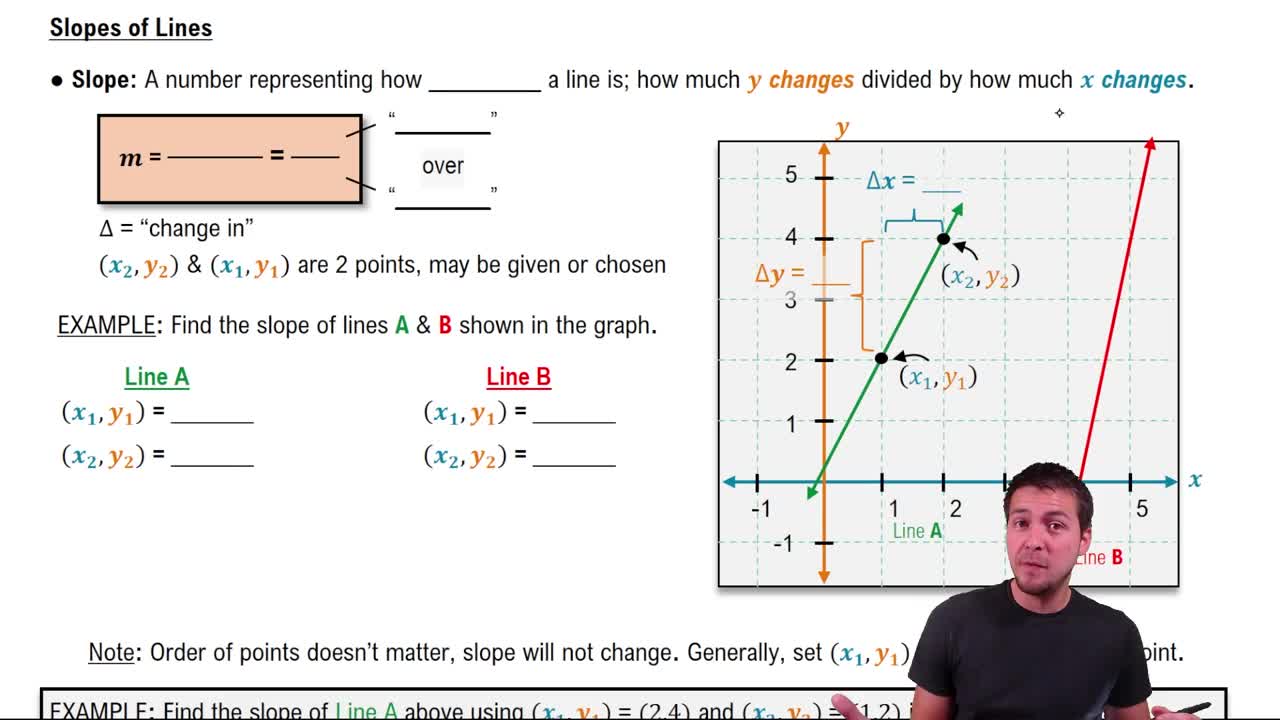
Slope-Intercept Form
The slope-intercept form of a linear equation is expressed as y = mx + b, where m represents the slope and b is the y-intercept. This form is useful for quickly identifying the slope of a line and where it crosses the y-axis. Understanding this format allows students to easily graph lines by starting at the y-intercept and using the slope to find additional points.
The point-slope form of a linear equation is given by y - y1 = m(x - x1), where (x1, y1) is a specific point on the line and m is the slope. This form is particularly helpful when you know a point on the line and the slope, as it allows you to derive the equation of the line directly. It is a practical tool for graphing lines when starting from a known point.
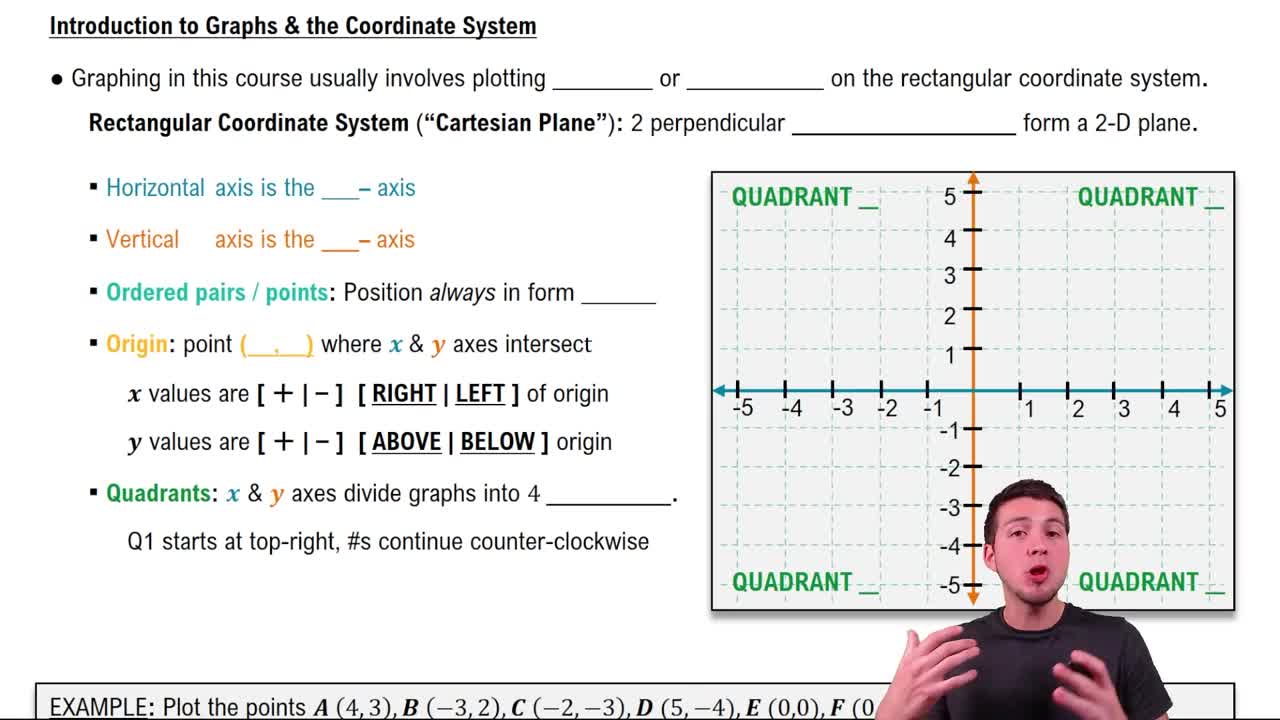
Graphing linear equations involves plotting points on a coordinate plane that satisfy the equation of the line. To graph a line, you typically need at least two points, which can be found using the slope and a known point. By connecting these points, you create a visual representation of the linear relationship, which helps in understanding the behavior of the equation across different values.