Graph the line passing through the given point and having the indicated slope. Plot twopoints on the line. See Example 7. through (-2, 8), m = 2/5
Verified step by step guidance
1
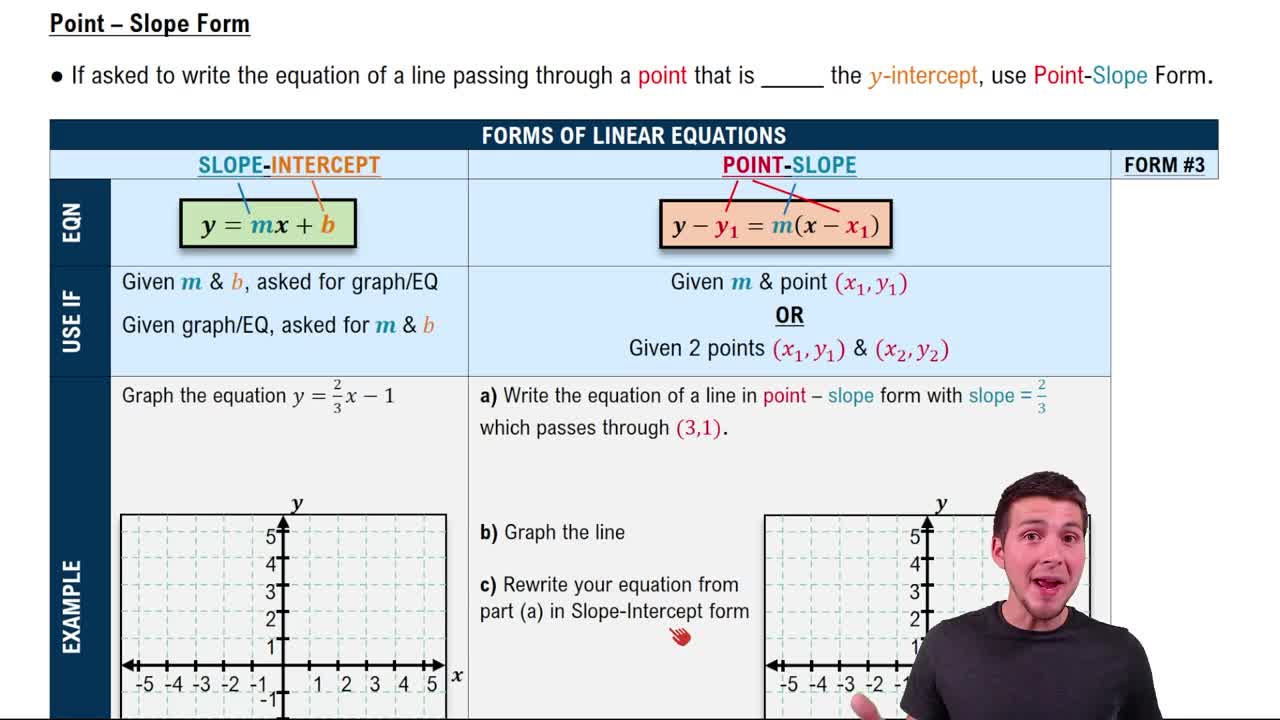
Identify the point-slope form of a line equation: \( y - y_1 = m(x - x_1) \), where \((x_1, y_1)\) is a point on the line and \(m\) is the slope.
Substitute the given point \((-2, 8)\) and the slope \(m = \frac{2}{5}\) into the point-slope form equation: \( y - 8 = \frac{2}{5}(x + 2) \).
Simplify the equation to the slope-intercept form \(y = mx + b\) by distributing the slope and solving for \(y\): \( y = \frac{2}{5}x + \frac{4}{5} + 8 \).
Combine like terms to find the y-intercept \(b\): \( y = \frac{2}{5}x + b \).
Choose another value for \(x\) to find a second point on the line. For example, let \(x = 0\) and solve for \(y\) using the equation from step 4.
Verified video answer for a similar problem:
This video solution was recommended by our tutors as helpful for the problem above
Video duration:
4m
Play a video:
Was this helpful?
Key Concepts
Here are the essential concepts you must grasp in order to answer the question correctly.
Slope-Intercept Form
The slope-intercept form of a linear equation is expressed as y = mx + b, where m represents the slope and b is the y-intercept. This form is useful for quickly identifying the slope of a line and where it crosses the y-axis. Understanding this format allows students to easily graph lines and determine their behavior.
The point-slope form of a linear equation is given by y - y1 = m(x - x1), where (x1, y1) is a specific point on the line and m is the slope. This form is particularly useful when you know a point on the line and the slope, as it allows you to derive the equation of the line directly. It simplifies the process of graphing by focusing on a known point.
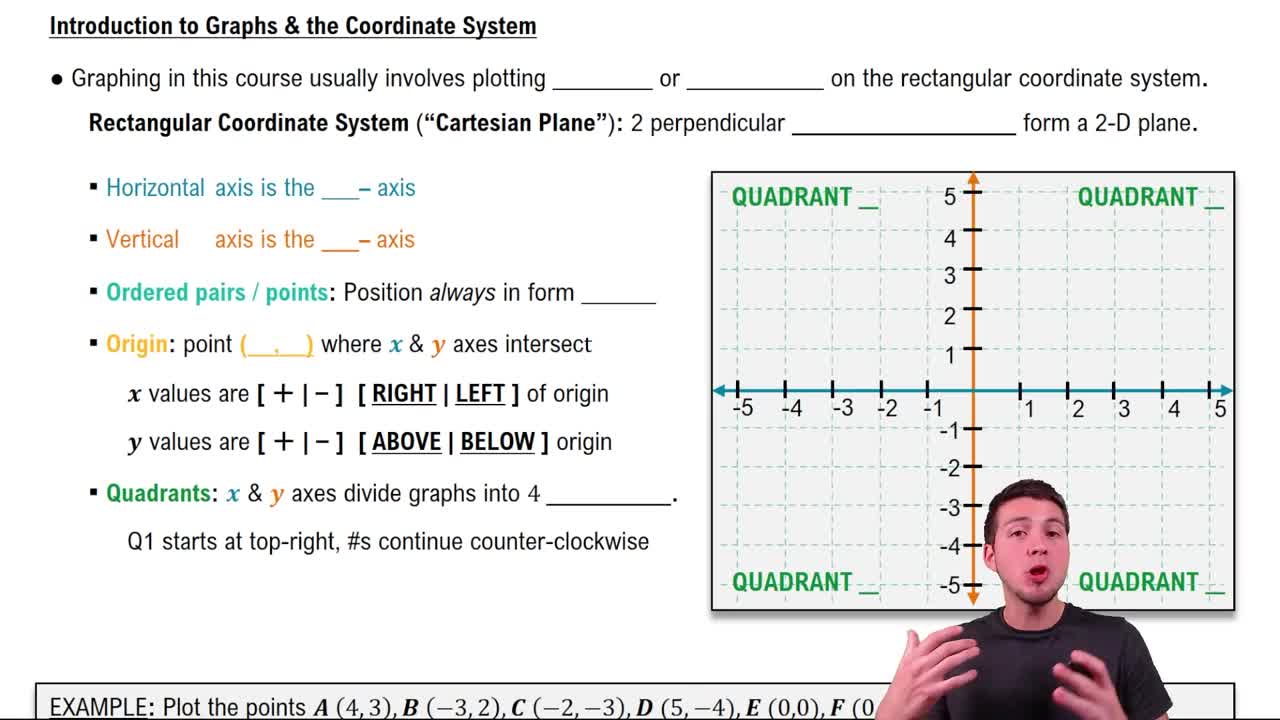
Graphing linear equations involves plotting points on a coordinate plane that satisfy the equation of the line. To graph a line, you can start from a known point and use the slope to find additional points. The slope indicates the rise over run, helping to determine how steep the line is and in which direction it moves, which is essential for accurately representing the line visually.