Solve each problem. Give the maximum number of turning points of the graph of each function. ƒ(x)=4x^3-6x^2+2
Table of contents
- 0. Review of Algebra4h 18m
- 1. Equations & Inequalities3h 18m
- 2. Graphs of Equations1h 43m
- 3. Functions2h 17m
- 4. Polynomial Functions1h 44m
- 5. Rational Functions1h 23m
- 6. Exponential & Logarithmic Functions2h 28m
- 7. Systems of Equations & Matrices4h 5m
- 8. Conic Sections2h 23m
- 9. Sequences, Series, & Induction1h 22m
- 10. Combinatorics & Probability1h 45m
4. Polynomial Functions
Zeros of Polynomial Functions
Problem 53
Textbook Question
Exercises 53–60 show incomplete graphs of given polynomial functions. a) Find all the zeros of each function. b) Without using a graphing utility, draw a complete graph of the function. f(x)=−x3+x2+16x−16
Verified step by step guidance1
Identify the polynomial function given: .
To find the zeros of the function, set and solve the cubic equation .
Look for rational roots using the Rational Root Theorem, which suggests testing factors of the constant term (±1, ±2, ±4, ±8, ±16) as possible zeros.
Use synthetic division or polynomial division to test each candidate root. When a root is found, factor it out to reduce the cubic to a quadratic.
Solve the resulting quadratic equation using factoring, completing the square, or the quadratic formula to find the remaining zeros. These zeros will help in sketching the complete graph.
Verified video answer for a similar problem:This video solution was recommended by our tutors as helpful for the problem above
Video duration:
6mPlay a video:
Was this helpful?
Key Concepts
Here are the essential concepts you must grasp in order to answer the question correctly.
Finding Zeros of Polynomial Functions
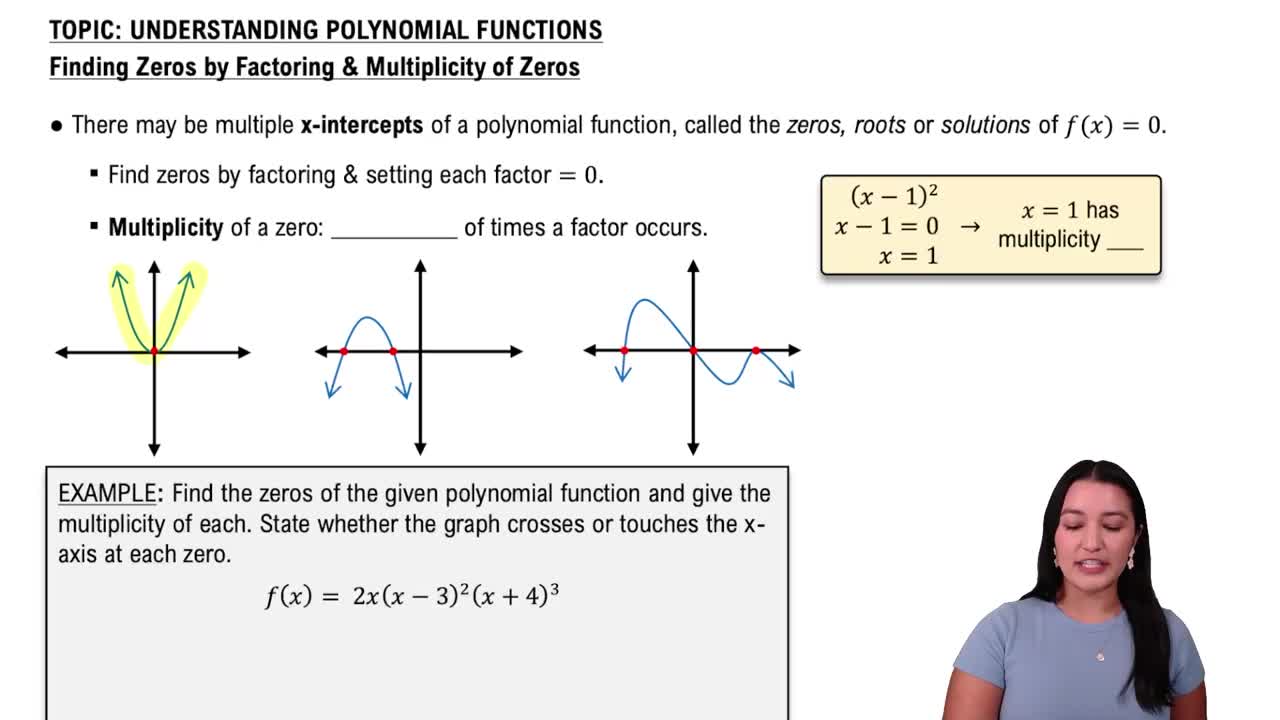
Zeros of a polynomial are the values of x for which the function equals zero. To find them, set f(x) = 0 and solve the resulting equation using factoring, synthetic division, or the Rational Root Theorem. These zeros correspond to the x-intercepts of the graph.
Recommended video:
Finding Zeros & Their Multiplicity
Polynomial Function Behavior and End Behavior
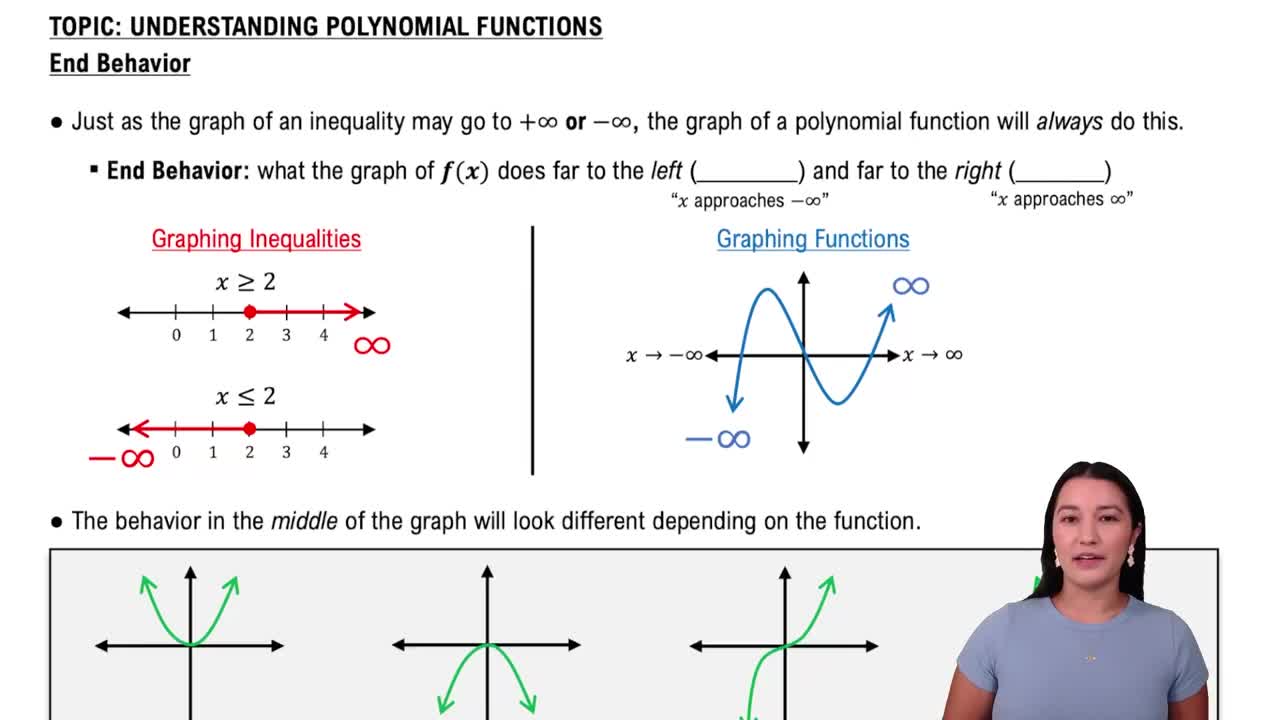
The degree and leading coefficient of a polynomial determine its end behavior, or how the graph behaves as x approaches positive or negative infinity. For example, a cubic with a negative leading coefficient falls to the right and rises to the left, guiding the overall shape of the graph.
Recommended video:
End Behavior of Polynomial Functions
Sketching Polynomial Graphs Without Technology
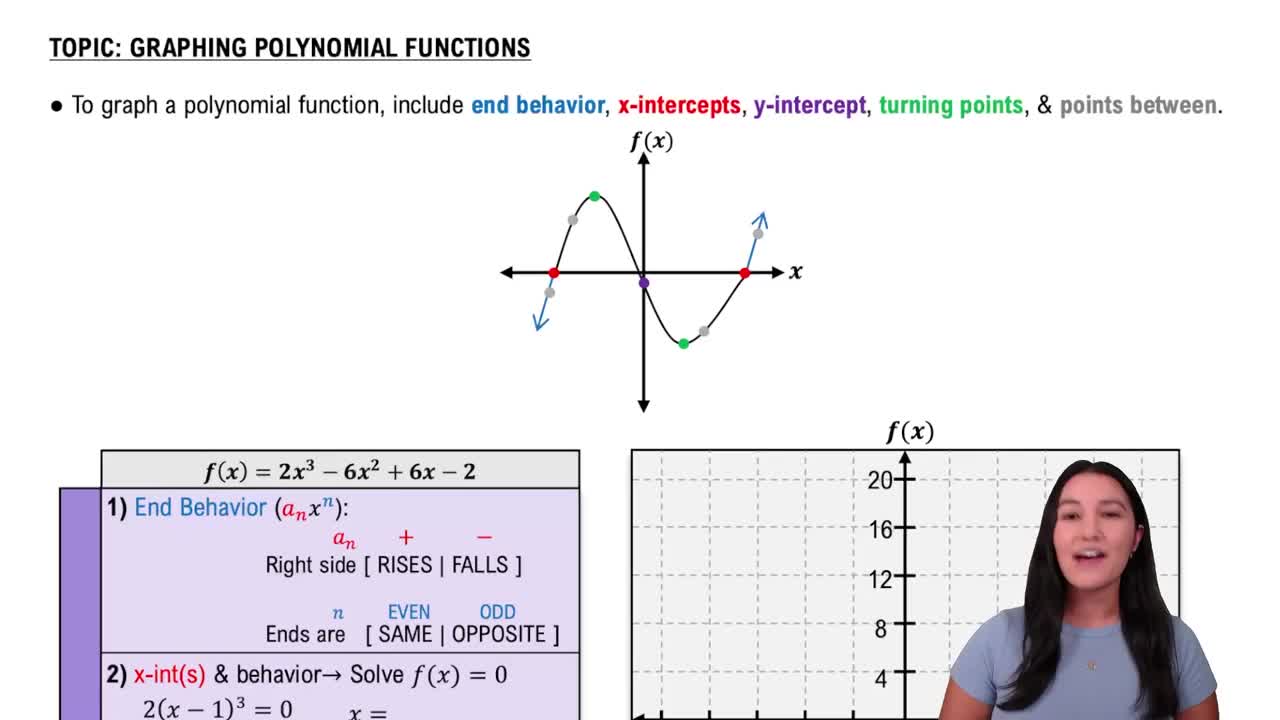
To sketch a polynomial graph by hand, identify zeros, determine their multiplicities, analyze end behavior, and find key points such as local maxima and minima using derivatives or sign changes. This approach helps create an accurate, complete graph without graphing utilities.
Recommended video:
Graphing Polynomial Functions
Related Videos
Related Practice
Textbook Question
403
views