In Exercises 33–38, use Descartes's Rule of Signs to determine the possible number of positive and negative real zeros for each given function. f(x)=5x3−3x2+3x−1
Table of contents
- 0. Review of Algebra4h 18m
- 1. Equations & Inequalities3h 18m
- 2. Graphs of Equations1h 43m
- 3. Functions2h 17m
- 4. Polynomial Functions1h 44m
- 5. Rational Functions1h 23m
- 6. Exponential & Logarithmic Functions2h 28m
- 7. Systems of Equations & Matrices4h 5m
- 8. Conic Sections2h 23m
- 9. Sequences, Series, & Induction1h 22m
- 10. Combinatorics & Probability1h 45m
4. Polynomial Functions
Zeros of Polynomial Functions
Problem 42b
Textbook Question
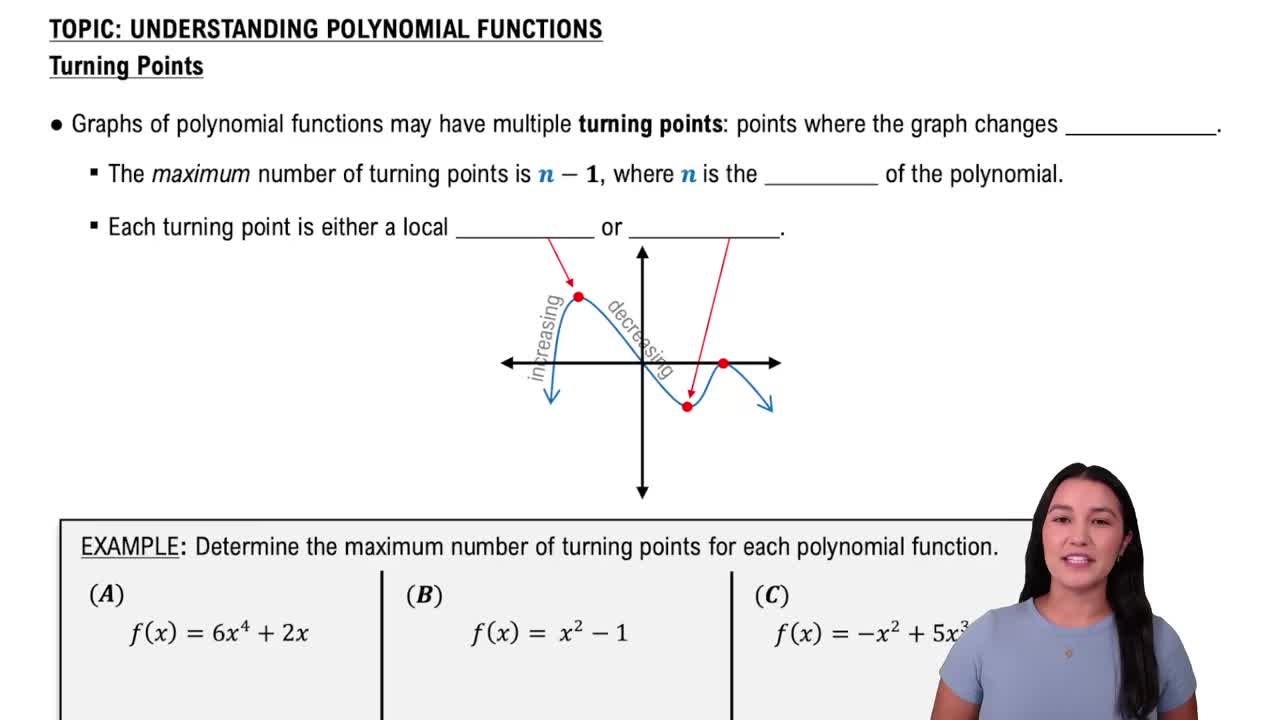
Solve each problem. Give the maximum number of turning points of the graph of each function. ƒ(x)=4x^3-6x^2+2
Verified step by step guidance1
Identify the degree of the polynomial function. The given function is \(f(x) = 4x^3 - 6x^2 + 2\), which is a cubic polynomial of degree 3.
Recall the rule for the maximum number of turning points of a polynomial function: it is at most one less than the degree of the polynomial. So, for a polynomial of degree \(n\), the maximum number of turning points is \(n - 1\).
Apply this rule to the given function. Since the degree is 3, the maximum number of turning points is \$3 - 1$.
Understand that turning points correspond to local maxima or minima, which occur where the first derivative changes sign. To find these points, you would take the derivative \(f'(x)\) and solve for critical points.
Although not required to find the exact turning points here, knowing the maximum number helps in graphing and understanding the behavior of the function.
Verified video answer for a similar problem:This video solution was recommended by our tutors as helpful for the problem above
Video duration:
1mPlay a video:
Was this helpful?
Key Concepts
Here are the essential concepts you must grasp in order to answer the question correctly.
Turning Points of a Polynomial Function
Turning points are points on the graph where the function changes direction from increasing to decreasing or vice versa. For polynomial functions, these correspond to local maxima or minima, where the slope of the tangent (derivative) is zero.
Recommended video:
Maximum Turning Points of a Polynomial Function
Degree of a Polynomial and Maximum Turning Points
The maximum number of turning points of a polynomial function is at most one less than its degree. For example, a cubic function (degree 3) can have up to 2 turning points.
Recommended video:
Maximum Turning Points of a Polynomial Function
Using the Derivative to Find Turning Points
The derivative of a function gives the slope of the tangent line. Setting the derivative equal to zero helps find critical points, which are candidates for turning points. Analyzing these points determines the actual turning points on the graph.
Recommended video:
Maximum Turning Points of a Polynomial Function
Related Videos
Related Practice
Textbook Question
277
views