Recognize that the expression given is ∜{(5 + 2m)^4}. This is a fourth root of a power.
Understand that taking the fourth root of something raised to the fourth power will simplify the expression. In general, ∜{x^4} = x, assuming x is non-negative.
Apply this property to the expression: ∜{(5 + 2m)^4} simplifies to 5 + 2m.
Verify that the simplification is valid by considering the domain of the expression. Since we are dealing with real numbers, ensure that 5 + 2m is non-negative.
Conclude that the root of the expression is simply the base of the power, which is 5 + 2m, under the assumption that it is non-negative.
Verified video answer for a similar problem:
This video solution was recommended by our tutors as helpful for the problem above
Video duration:
1m
Play a video:
Was this helpful?
Key Concepts
Here are the essential concepts you must grasp in order to answer the question correctly.
Roots and Radicals
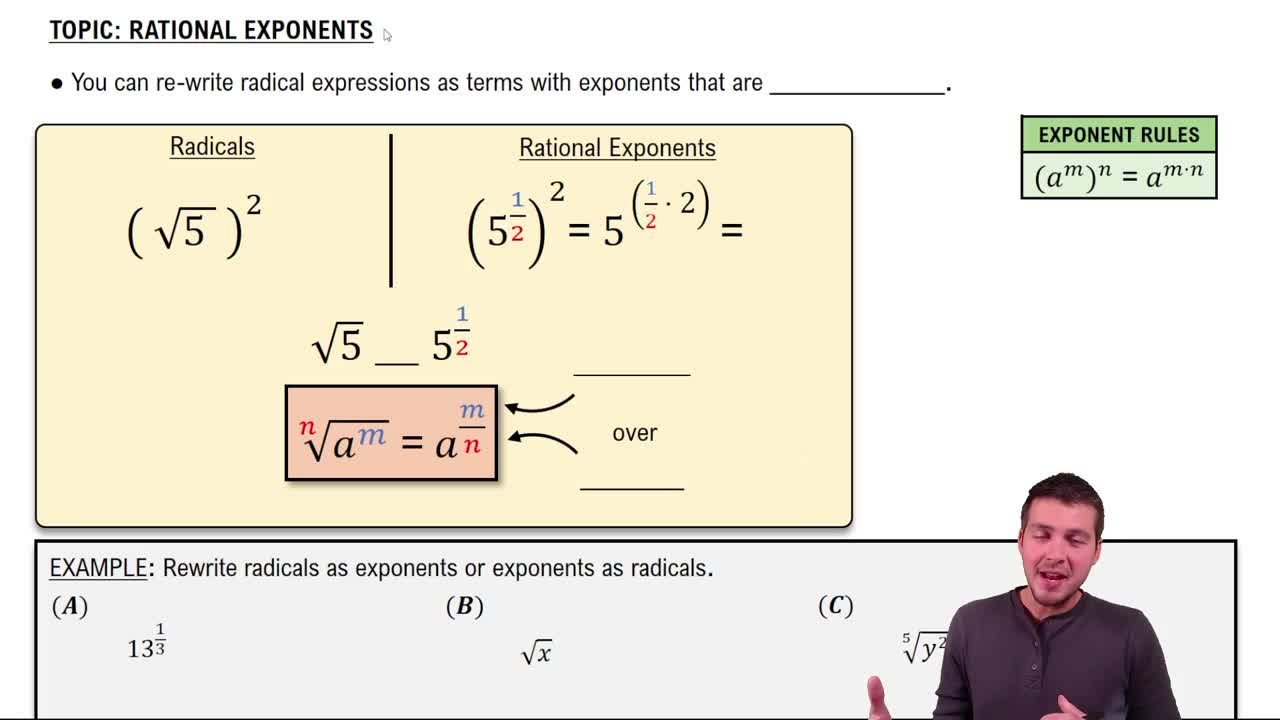
Roots and radicals involve the operation of extracting a root from a number or expression. The nth root of a number 'a' is a value 'b' such that b^n = a. In this context, the fourth root (∜) indicates that we are looking for a number that, when raised to the fourth power, equals the expression inside the radical.
Exponents represent repeated multiplication of a base number. For example, in (5 + 2m)⁴, the expression is raised to the fourth power, meaning (5 + 2m) is multiplied by itself four times. Understanding how to manipulate exponents is crucial for simplifying expressions and solving equations involving powers.
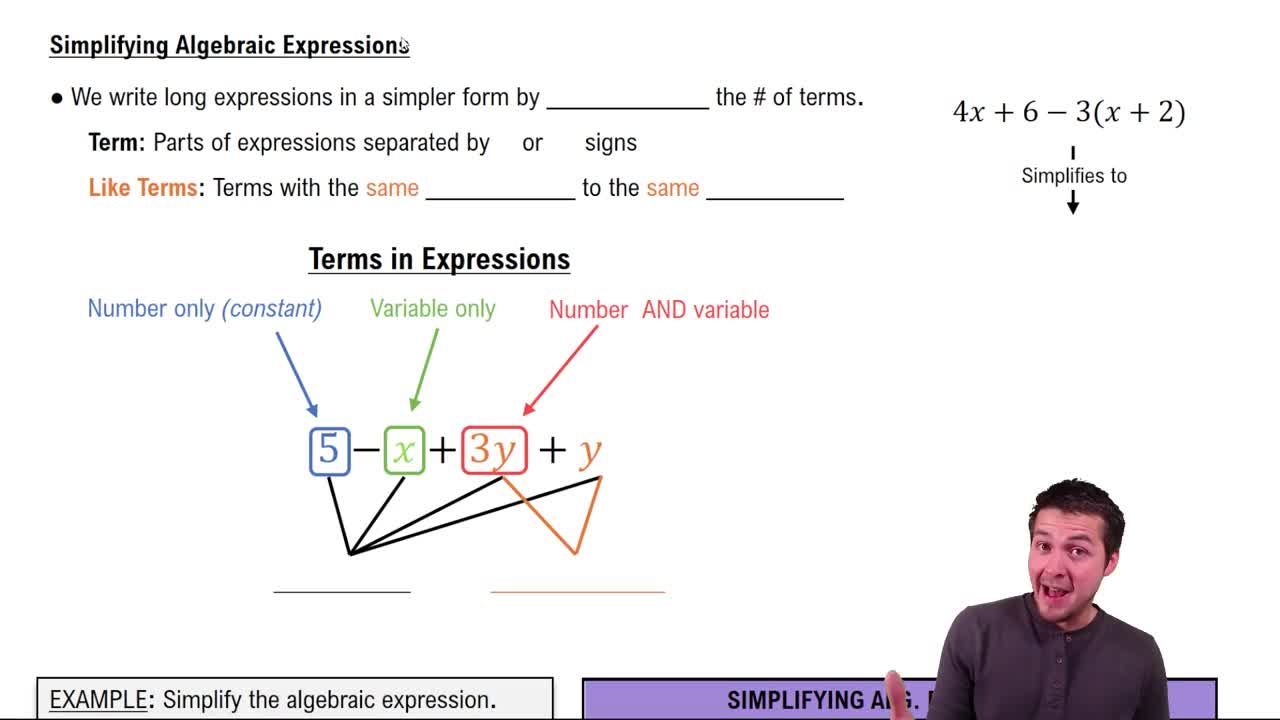
Simplifying expressions involves reducing them to their most basic form while maintaining equivalence. This includes combining like terms, applying the distributive property, and reducing fractions. In the given problem, simplifying (5 + 2m)⁴ before taking the fourth root is essential for finding the roots accurately.