In Exercises 29–44, simplify using the quotient rule.
______
⁴√13y⁷/x¹²
Verified step by step guidance
1
Identify the expression under the radical: \( \frac{13y^7}{x^{12}} \).
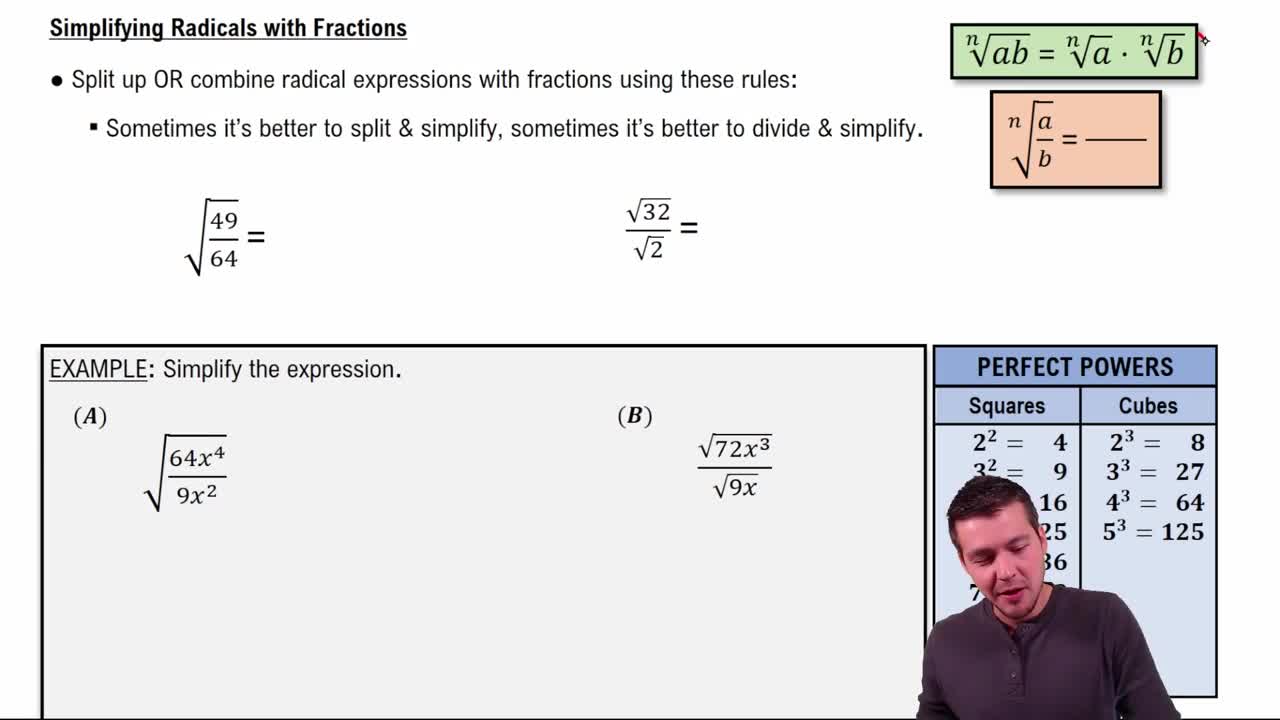
Apply the quotient rule for radicals: \( \sqrt[n]{\frac{a}{b}} = \frac{\sqrt[n]{a}}{\sqrt[n]{b}} \).
Rewrite the expression as \( \frac{\sqrt[4]{13y^7}}{\sqrt[4]{x^{12}}} \).
Simplify the denominator: \( \sqrt[4]{x^{12}} = x^{12/4} = x^3 \).
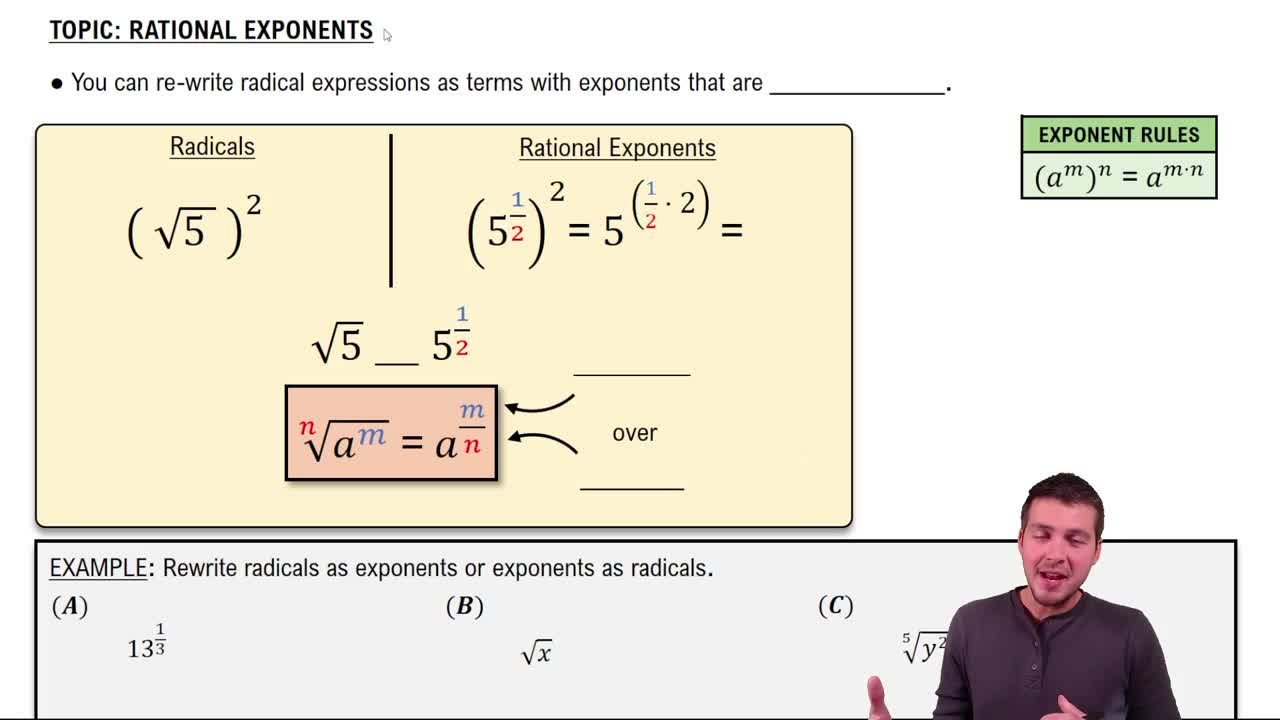
Simplify the numerator: \( \sqrt[4]{y^7} = y^{7/4} \), and leave \( \sqrt[4]{13} \) as is, since 13 is not a perfect fourth power.
Verified video answer for a similar problem:
This video solution was recommended by our tutors as helpful for the problem above.
Video duration:
4m
Play a video:
0 Comments
Key Concepts
Here are the essential concepts you must grasp in order to answer the question correctly.
Quotient Rule
The quotient rule is a fundamental principle in calculus used to differentiate functions that are expressed as the ratio of two other functions. It states that if you have a function f(x) = g(x)/h(x), the derivative f'(x) can be found using the formula f'(x) = (g'(x)h(x) - g(x)h'(x)) / (h(x))². Understanding this rule is essential for simplifying expressions involving division of functions.
Radical expressions involve roots, such as square roots or higher roots like cube roots and fourth roots. In the given expression, the fourth root is represented as ⁴√, which indicates that we are looking for a number that, when raised to the fourth power, equals the expression inside. Simplifying radical expressions often requires applying properties of exponents and understanding how to manipulate roots.
Exponents are a way to express repeated multiplication of a number by itself. Key properties include the product of powers (a^m * a^n = a^(m+n)), the quotient of powers (a^m / a^n = a^(m-n)), and power of a power ( (a^m)^n = a^(m*n)). These properties are crucial for simplifying expressions involving variables raised to powers, especially when combined with roots and fractions.

 4:55 minutes
 Verified step by step guidance
 3:49
3:49