insert step 5: Simplify the expression by canceling out common factors in the numerator and the denominator.
Verified video answer for a similar problem:
This video solution was recommended by our tutors as helpful for the problem above
Video duration:
2m
Play a video:
Was this helpful?
Key Concepts
Here are the essential concepts you must grasp in order to answer the question correctly.
Radical Expressions
Radical expressions involve roots, such as square roots, cube roots, etc. In this context, we are dealing with square roots, which represent the value that, when multiplied by itself, gives the original number. Understanding how to manipulate these expressions is crucial for simplifying and dividing them effectively.
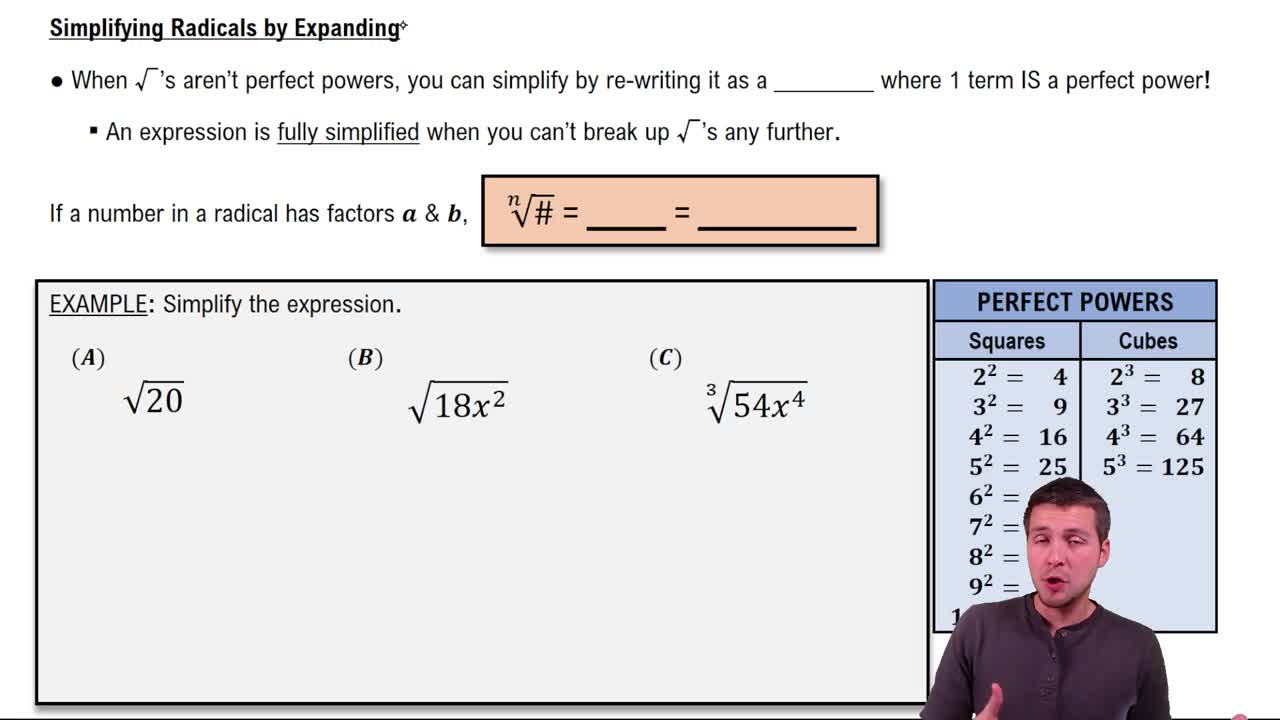
Simplifying radicals involves reducing the expression to its simplest form. This often includes factoring out perfect squares from under the radical sign. For example, √200 can be simplified by recognizing that 200 = 100 × 2, allowing us to express √200 as 10√2.
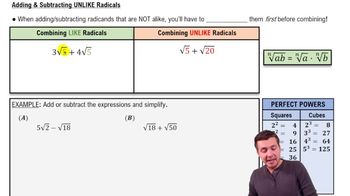
Adding & Subtracting Unlike Radicals by Simplifying
Division of Radicals
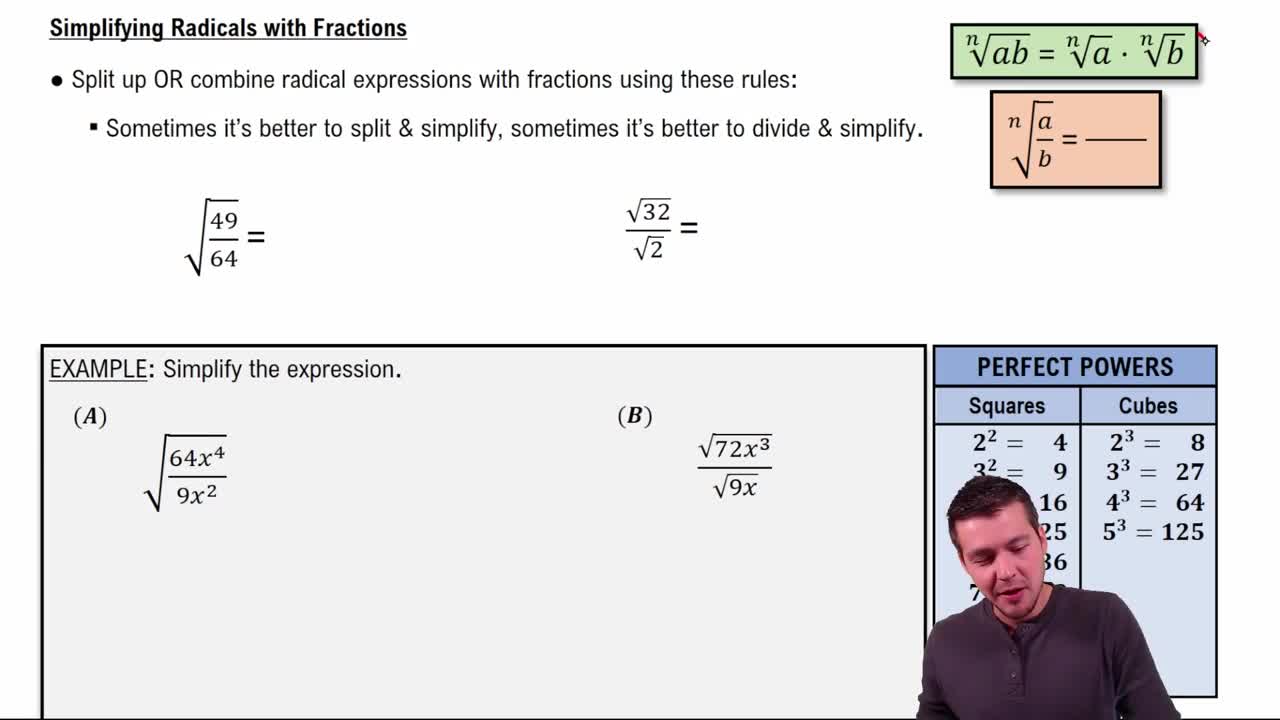
Dividing radical expressions requires applying the properties of radicals, particularly the quotient rule, which states that √a / √b = √(a/b). This means we can simplify the division of two square roots by combining them under a single radical, provided that the denominator is not zero.