In Exercises 39–64, rationalize each denominator.
1
-----
³√3
Verified step by step guidance
1
Identify the problem: You need to rationalize the denominator of the expression \( \frac{1}{\sqrt[3]{3}} \).
To rationalize a cube root in the denominator, multiply both the numerator and the denominator by the square of the cube root. In this case, multiply by \( \sqrt[3]{3^2} = \sqrt[3]{9} \).
Write the expression as \( \frac{1}{\sqrt[3]{3}} \times \frac{\sqrt[3]{9}}{\sqrt[3]{9}} \).
Simplify the denominator: \( \sqrt[3]{3} \times \sqrt[3]{9} = \sqrt[3]{27} \).
Since \( \sqrt[3]{27} = 3 \), the expression becomes \( \frac{\sqrt[3]{9}}{3} \).
Verified video answer for a similar problem:
This video solution was recommended by our tutors as helpful for the problem above.
Video duration:
2m
Play a video:
0 Comments
Key Concepts
Here are the essential concepts you must grasp in order to answer the question correctly.
Rationalizing the Denominator
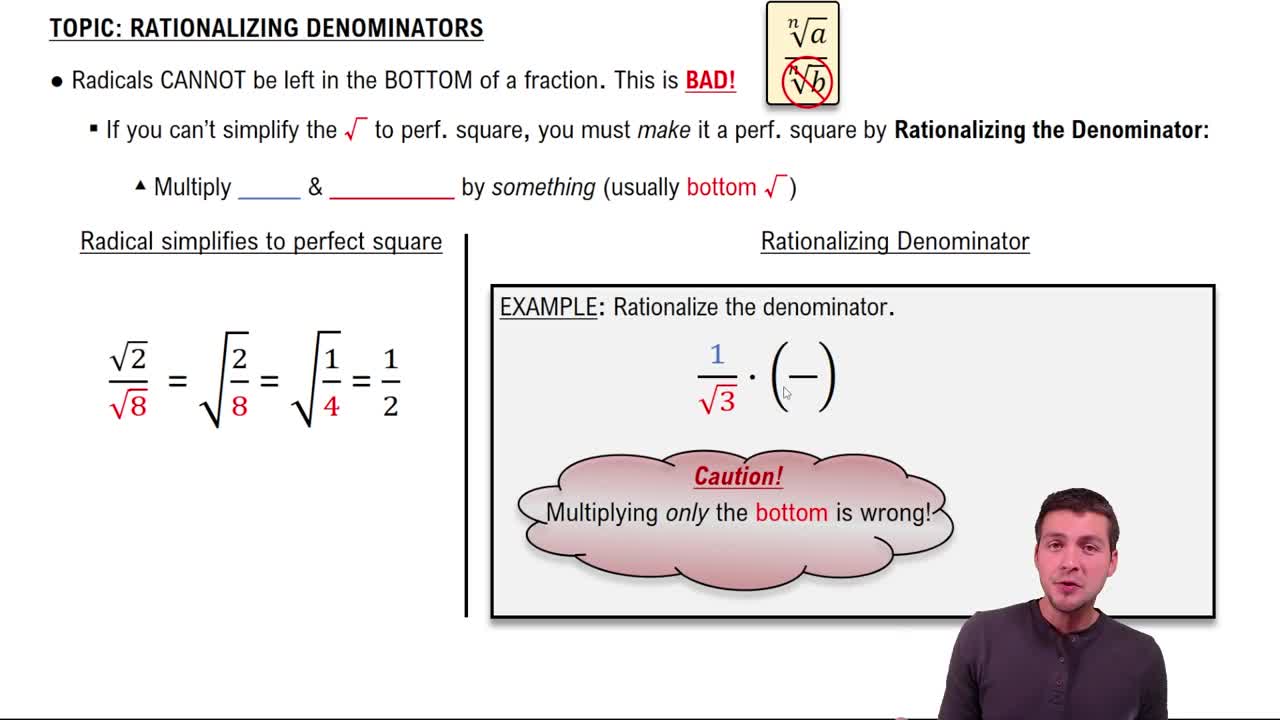
Rationalizing the denominator involves rewriting a fraction so that the denominator is a rational number. This is often necessary when the denominator contains a radical, such as a square root or cube root. The goal is to eliminate the radical from the denominator, making the expression easier to work with and understand.
A cube root of a number 'a' is a value 'b' such that b³ = a. In the context of rationalizing denominators, cube roots can complicate expressions, as they are not as straightforward as square roots. Understanding how to manipulate cube roots is essential for effectively rationalizing expressions that involve them.
When rationalizing denominators that involve roots, one common technique is to multiply both the numerator and denominator by a form of the conjugate. For cube roots, this may involve using a specific factor that, when multiplied, will eliminate the radical in the denominator. This method is crucial for simplifying expressions while maintaining their value.

 2:57 minutes
 Verified step by step guidance
 02:58
02:58