Begin by graphing the standard cubic function, f(x) = x³. Then use transformations of this graph to graph the given function. g(x) = x³-3
Table of contents
- 0. Review of Algebra4h 18m
- 1. Equations & Inequalities3h 18m
- 2. Graphs of Equations1h 43m
- 3. Functions2h 17m
- 4. Polynomial Functions1h 44m
- 5. Rational Functions1h 23m
- 6. Exponential & Logarithmic Functions2h 28m
- 7. Systems of Equations & Matrices4h 5m
- 8. Conic Sections2h 23m
- 9. Sequences, Series, & Induction1h 22m
- 10. Combinatorics & Probability1h 45m
3. Functions
Transformations
Problem 99
Textbook Question
Begin by graphing the standard cubic function, f(x) = x³. Then use transformations of this graph to graph the given function. h(x) = -x³
Verified step by step guidance1
Start by identifying the standard cubic function, f(x) = x³. This function has a characteristic S-shaped curve that passes through the origin (0, 0), with the left side decreasing and the right side increasing symmetrically.
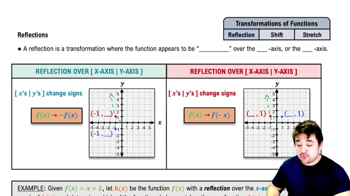
Next, analyze the given function, h(x) = -x³. The negative sign in front of x³ indicates a reflection of the graph of f(x) = x³ across the x-axis. This means that the portions of the graph that were above the x-axis will now be below it, and vice versa.
To graph h(x) = -x³, begin by plotting key points from the standard cubic function, such as (-2, -8), (-1, -1), (0, 0), (1, 1), and (2, 8). Reflect these points across the x-axis to get the corresponding points for h(x). For example, (1, 1) becomes (1, -1), and (-2, -8) becomes (-2, 8).
Draw a smooth curve through the reflected points, ensuring that the graph maintains the same general S-shape as the standard cubic function but flipped vertically.
Finally, verify the transformation by checking additional points or using a graphing tool to confirm that the graph of h(x) = -x³ is indeed the reflection of f(x) = x³ across the x-axis.
Verified video answer for a similar problem:This video solution was recommended by our tutors as helpful for the problem above
Video duration:
4mPlay a video:
Was this helpful?
Key Concepts
Here are the essential concepts you must grasp in order to answer the question correctly.
Cubic Functions
A cubic function is a polynomial function of degree three, typically expressed in the form f(x) = ax³ + bx² + cx + d. The standard cubic function, f(x) = x³, has a characteristic S-shaped curve that passes through the origin and extends infinitely in both directions. Understanding the basic shape and properties of cubic functions is essential for analyzing transformations.
Recommended video:
Function Composition
Graph Transformations
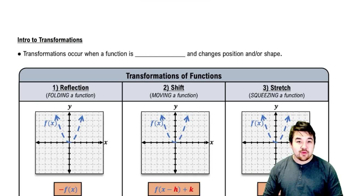
Graph transformations involve altering the position or shape of a graph through various operations, such as translations, reflections, stretches, and compressions. For example, the function h(x) = -x³ represents a reflection of the standard cubic function across the x-axis. Recognizing how these transformations affect the graph is crucial for accurately sketching the transformed function.
Recommended video:
Intro to Transformations
Reflection Across the X-Axis
Reflection across the x-axis occurs when a graph is flipped over the x-axis, resulting in a change of sign for the y-values of the function. In the case of h(x) = -x³, every point (x, y) on the graph of f(x) = x³ is transformed to (x, -y). This concept is vital for understanding how the original cubic function's shape is altered when applying a negative coefficient.
Recommended video:
Reflections of Functions
Watch next
Master Intro to Transformations with a bite sized video explanation from Patrick
Start learningRelated Videos
Related Practice
Textbook Question
570
views