Let ƒ(x) = 3x -4. Find an equation for each reflection of the graph of ƒ(x). across the x-axis
Table of contents
- 0. Review of Algebra4h 18m
- 1. Equations & Inequalities3h 18m
- 2. Graphs of Equations1h 43m
- 3. Functions2h 17m
- 4. Polynomial Functions1h 44m
- 5. Rational Functions1h 23m
- 6. Exponential & Logarithmic Functions2h 28m
- 7. Systems of Equations & Matrices4h 5m
- 8. Conic Sections2h 23m
- 9. Sequences, Series, & Induction1h 22m
- 10. Combinatorics & Probability1h 45m
3. Functions
Transformations
Problem 101a
Textbook Question
The graph of a function ƒ is shown in the figure. Sketch the graph of each function defined as follows.

(a) y = ƒ(x) +3
Verified step by step guidance1
Identify the original function ƒ(x) from the graph, noting key points such as (-8, 0), (-4, 8), (0, 0), (8, -4), and (16, 0).
Understand that the transformation y = ƒ(x) + 3 means you add 3 to the output (y-values) of the original function for every x.
Apply this vertical shift by adding 3 to the y-coordinate of each key point: for example, (-8, 0) becomes (-8, 0 + 3), (-4, 8) becomes (-4, 8 + 3), and so on.
Plot the new points on the graph using the adjusted y-values: (-8, 3), (-4, 11), (0, 3), (8, -1), and (16, 3).
Sketch the new graph by connecting these points smoothly, maintaining the original shape but shifted upward by 3 units.
Verified video answer for a similar problem:This video solution was recommended by our tutors as helpful for the problem above
Video duration:
1mPlay a video:
Was this helpful?
Key Concepts
Here are the essential concepts you must grasp in order to answer the question correctly.
Function Transformation
Function transformation involves changing the graph of a function by shifting, stretching, compressing, or reflecting it. In this problem, adding a constant to the function, such as y = ƒ(x) + 3, shifts the graph vertically upward by 3 units without altering its shape.
Recommended video:
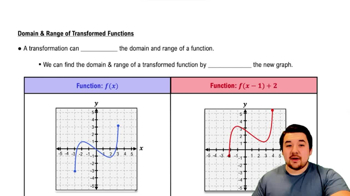
Domain & Range of Transformed Functions
Vertical Shift
A vertical shift moves the entire graph of a function up or down along the y-axis. For y = ƒ(x) + 3, every point (x, y) on the original graph moves to (x, y + 3), increasing the y-coordinate by 3. This shift does not affect the x-values or the shape of the graph.
Recommended video:
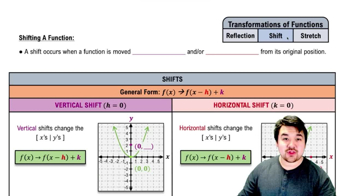
Shifts of Functions
Graph Interpretation
Interpreting a graph requires understanding key points and their coordinates. The given graph shows specific points of ƒ(x), which helps in sketching the transformed graph by applying the vertical shift to each point, ensuring accuracy in the new graph's shape and position.
Recommended video:
Guided course
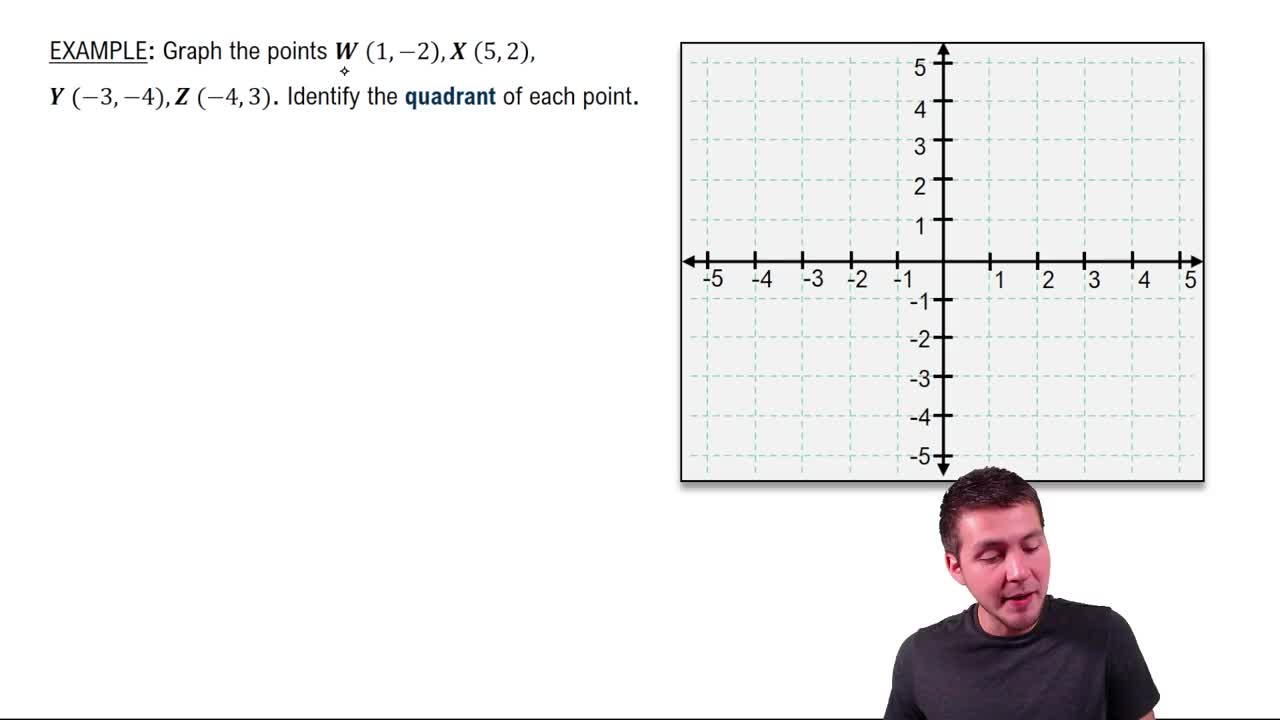
Graphs and Coordinates - Example
Watch next
Master Intro to Transformations with a bite sized video explanation from Patrick
Start learningRelated Videos
Related Practice
Textbook Question
742
views