Recognize that the expression \( \sqrt[6]{x^6} \) represents the sixth root of \( x^6 \).
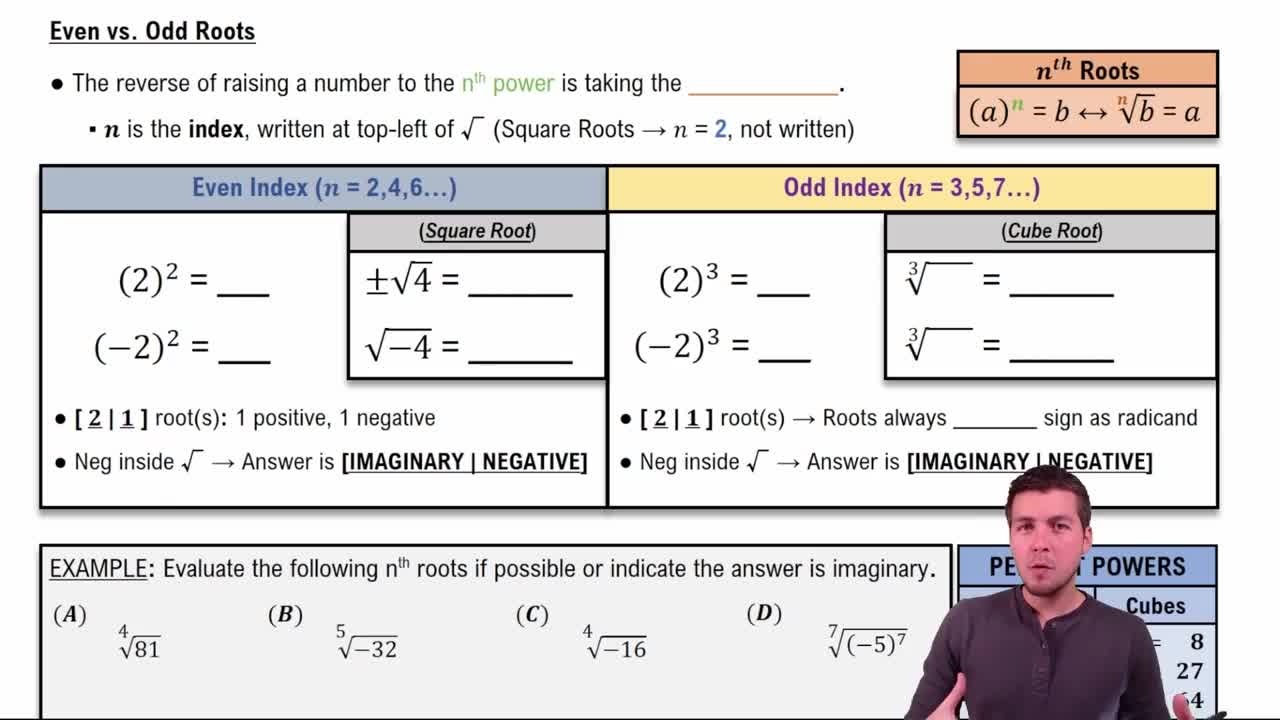
Recall the property of radicals and exponents: \( \sqrt[n]{a^n} = |a| \) when \( n \) is even.
Apply this property to the given expression: \( \sqrt[6]{x^6} = |x| \).
Understand that the absolute value is used because the sixth root of a number raised to the sixth power is the absolute value of the original number.
Conclude that the root of \( x^6 \) when taking the sixth root is \( |x| \).
Verified video answer for a similar problem:
This video solution was recommended by our tutors as helpful for the problem above
Video duration:
54s
Play a video:
Was this helpful?
Key Concepts
Here are the essential concepts you must grasp in order to answer the question correctly.
Radicals
Radicals are expressions that involve roots, such as square roots, cube roots, and higher-order roots. The notation ⁶√x^6 indicates the sixth root of x raised to the sixth power. Understanding how to manipulate and simplify radical expressions is essential for solving problems involving roots.
Exponents represent repeated multiplication of a number by itself. In the expression x^6, the exponent 6 indicates that x is multiplied by itself six times. When dealing with roots, the relationship between exponents and roots is crucial, as the nth root of a number can be expressed as raising that number to the power of 1/n.
Simplifying radicals involves reducing a radical expression to its simplest form. For example, ⁶√x^6 simplifies to x, since the sixth root of x^6 is x itself. This concept is important for finding roots efficiently and understanding the properties of exponents and roots in algebra.