In Exercises 39–54, rewrite each expression with a positive rational exponent. Simplify, if possible.
27^-⅓
Verified step by step guidance
1
Identify the expression: \(27^{-\frac{1}{3}}\).
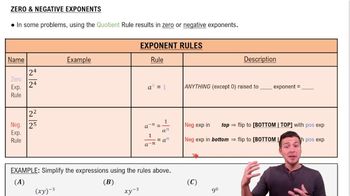
Recall that a negative exponent indicates the reciprocal of the base raised to the positive exponent. Thus, \(a^{-n} = \frac{1}{a^n}\).
Apply this rule to the expression: \(27^{-\frac{1}{3}} = \frac{1}{27^{\frac{1}{3}}}\).
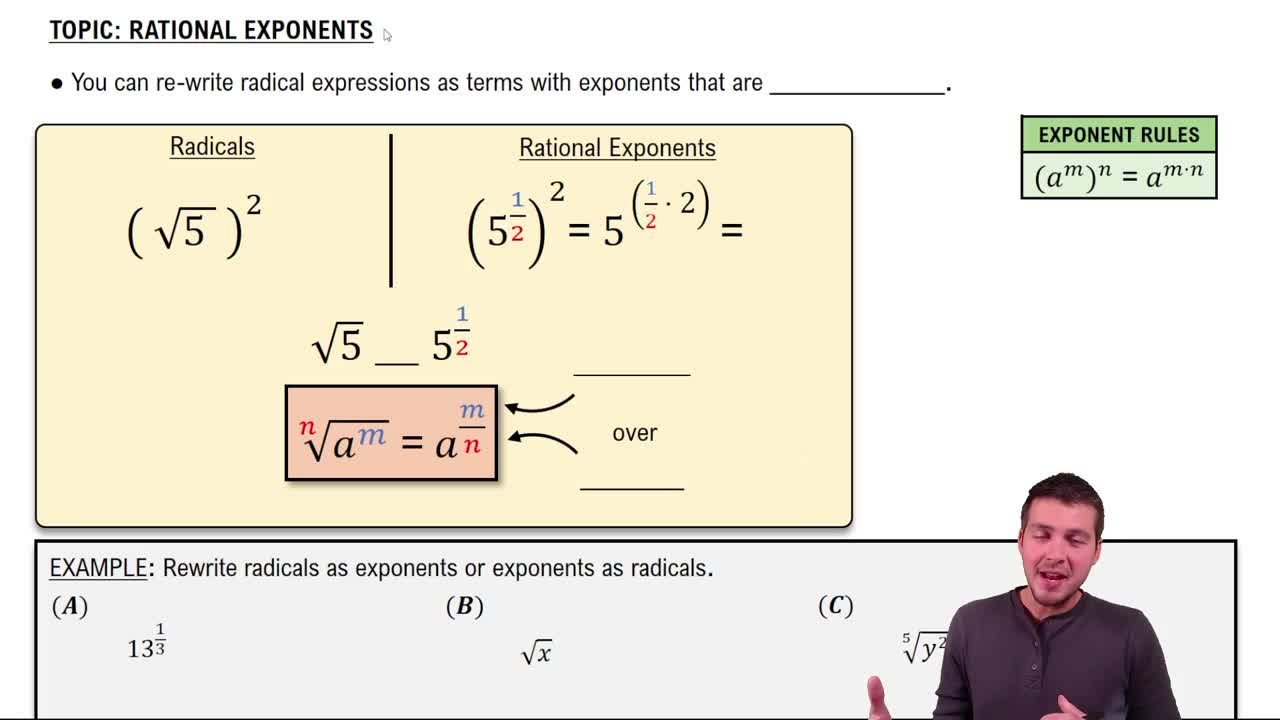
Recognize that \(27^{\frac{1}{3}}\) represents the cube root of 27.
Rewrite the expression as \(\frac{1}{\sqrt[3]{27}}\).
Verified video answer for a similar problem:
This video solution was recommended by our tutors as helpful for the problem above.
Video duration:
2m
Play a video:
0 Comments
Key Concepts
Here are the essential concepts you must grasp in order to answer the question correctly.
Negative Exponents
A negative exponent indicates the reciprocal of the base raised to the absolute value of the exponent. For example, a term like a^-n can be rewritten as 1/a^n. This concept is essential for transforming expressions with negative exponents into a more manageable form.
Rational exponents express roots in exponential form. An exponent of the form 1/n indicates the nth root of a number. For instance, a^(1/n) is equivalent to the nth root of a. Understanding this concept allows for rewriting expressions involving roots as exponents, facilitating simplification.
Simplification involves reducing expressions to their simplest form, often by combining like terms or applying exponent rules. This includes using properties such as a^m * a^n = a^(m+n) and (a^m)^n = a^(m*n). Mastery of these rules is crucial for effectively simplifying expressions with exponents.

 2:34 minutes
 Verified step by step guidance
 6:37
6:37