In Exercises 33–46, simplify each expression._____−√100x⁶
Verified step by step guidance
1
Identify the expression under the square root: \( \sqrt{100x^6} \).
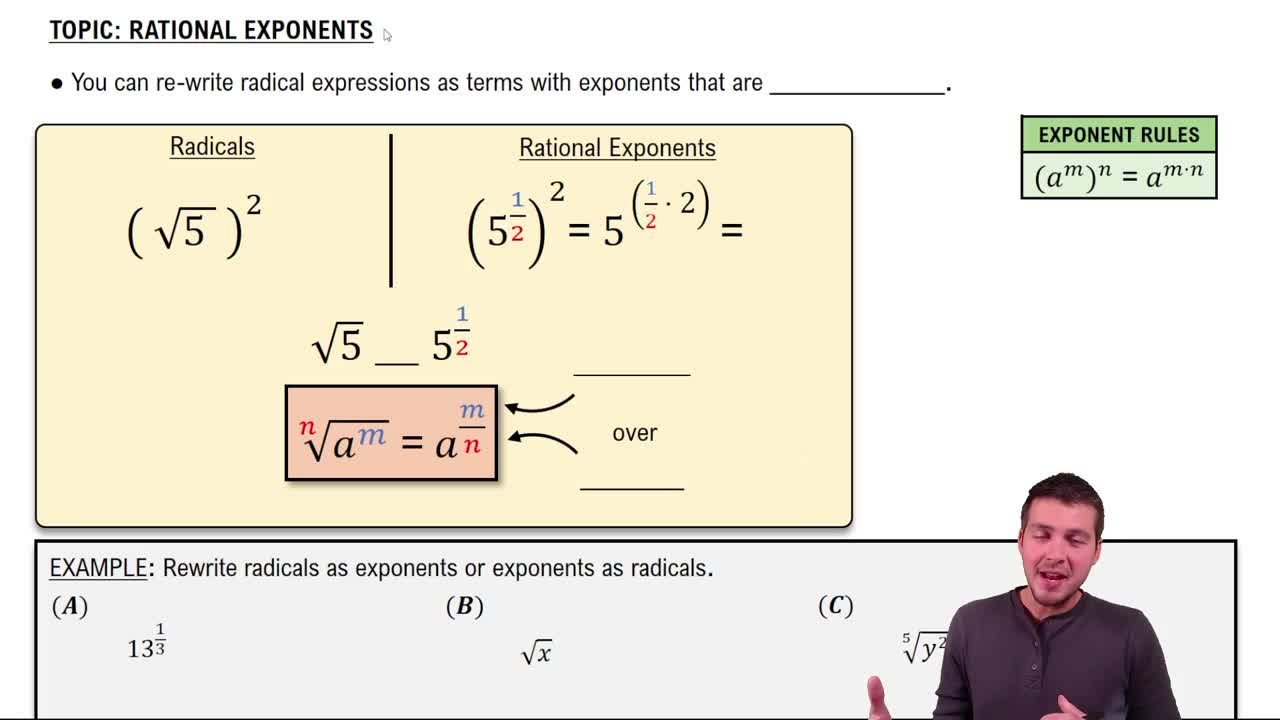
Recognize that \( 100x^6 \) can be rewritten as \( (10x^3)^2 \) because \( 10^2 = 100 \) and \( (x^3)^2 = x^6 \).
Apply the property of square roots: \( \sqrt{a^2} = |a| \), which means \( \sqrt{(10x^3)^2} = |10x^3| \).
Since the original expression is \( -\sqrt{100x^6} \), apply the negative sign to the result: \( -|10x^3| \).
Consider the absolute value: \( |10x^3| = 10|x^3| \), so the expression simplifies to \( -10|x^3| \).
Verified video answer for a similar problem:
This video solution was recommended by our tutors as helpful for the problem above
Video duration:
2m
Play a video:
Was this helpful?
Key Concepts
Here are the essential concepts you must grasp in order to answer the question correctly.
Square Roots
A square root of a number is a value that, when multiplied by itself, gives the original number. For example, the square root of 100 is 10, since 10 × 10 = 100. In algebra, understanding how to simplify square roots, especially with variables, is crucial for solving expressions effectively.
Exponents represent repeated multiplication of a base number. The property of exponents states that x^a * x^b = x^(a+b) and x^a / x^b = x^(a-b). When simplifying expressions involving variables raised to powers, it is essential to apply these properties correctly to combine or reduce terms.
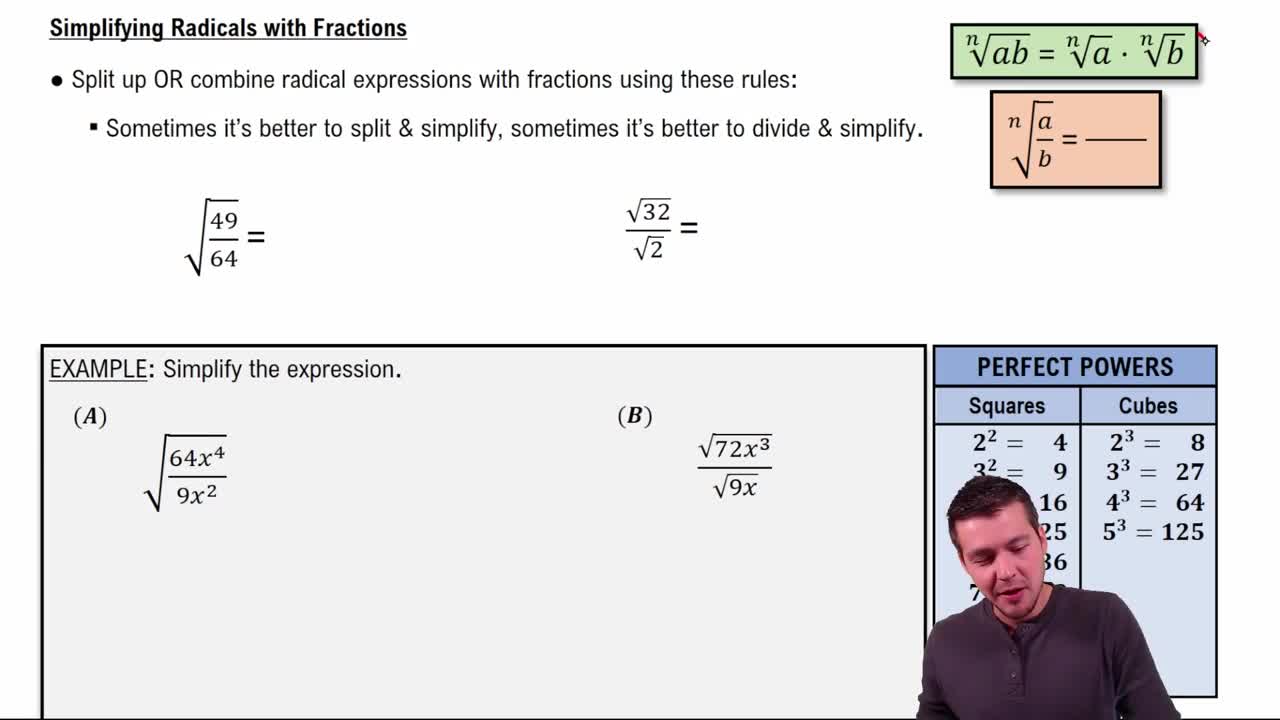
Simplifying radical expressions involves reducing the expression to its simplest form, which often includes factoring out perfect squares from under the radical. For instance, √(x^6) simplifies to x^3, as x^3 * x^3 = x^6. This process is vital for making expressions easier to work with in algebra.