A new car worth \$36,000 is depreciating in value by \$4000 per year. a. Write a formula that models the car's value, y, in dollars, after x years. b. Use the formula from part (a) to determine after how many years the car's value will be \$12,000. c. Graph the formula from part (a) in the first quadrant of a rectangular coordinate system. Then show your solution to part (b) on the graph.
Table of contents
- 0. Review of Algebra4h 18m
- 1. Equations & Inequalities3h 18m
- 2. Graphs of Equations1h 43m
- 3. Functions2h 17m
- 4. Polynomial Functions1h 44m
- 5. Rational Functions1h 23m
- 6. Exponential & Logarithmic Functions2h 28m
- 7. Systems of Equations & Matrices4h 5m
- 8. Conic Sections2h 23m
- 9. Sequences, Series, & Induction1h 22m
- 10. Combinatorics & Probability1h 45m
2. Graphs of Equations
Two-Variable Equations
Problem 19a
Textbook Question
Graph each equation in Exercises 13 - 28. Let x = - 3, - 2, - 1, 0, 1, 2, 3
y = -(1/2)x
Verified step by step guidance1
Start by understanding the equation y = -(1/2)x. This is a linear equation where the slope is -1/2 and the y-intercept is 0. The slope indicates that for every 1 unit increase in x, y decreases by 1/2.
Create a table of values for the given x-values: x = -3, -2, -1, 0, 1, 2, 3. For each x-value, substitute it into the equation y = -(1/2)x to calculate the corresponding y-value.
For example, when x = -3, substitute into the equation: y = -(1/2)(-3). Simplify to find the y-value. Repeat this process for all other x-values.
Once you have the table of x and y values, plot these points on a coordinate plane. Each point will have coordinates (x, y) based on your calculations.
After plotting all the points, draw a straight line through them. This line represents the graph of the equation y = -(1/2)x. Ensure the line extends in both directions and label the axes appropriately.
Verified video answer for a similar problem:This video solution was recommended by our tutors as helpful for the problem above
Video duration:
1mPlay a video:
Was this helpful?
Key Concepts
Here are the essential concepts you must grasp in order to answer the question correctly.
Linear Equations
A linear equation is an algebraic expression that represents a straight line when graphed on a coordinate plane. It typically takes the form y = mx + b, where m is the slope and b is the y-intercept. Understanding linear equations is essential for graphing, as it allows students to identify the relationship between the variables and predict the behavior of the line.
Recommended video:
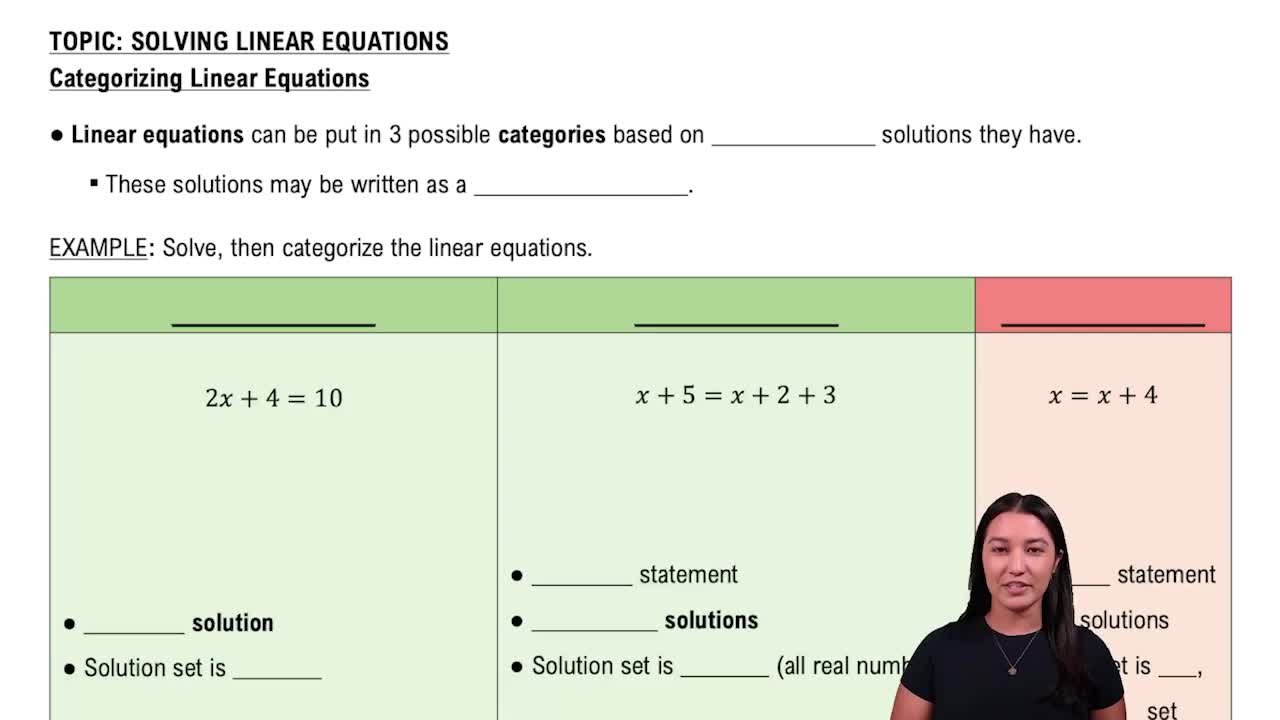
Categorizing Linear Equations
Slope and Y-Intercept
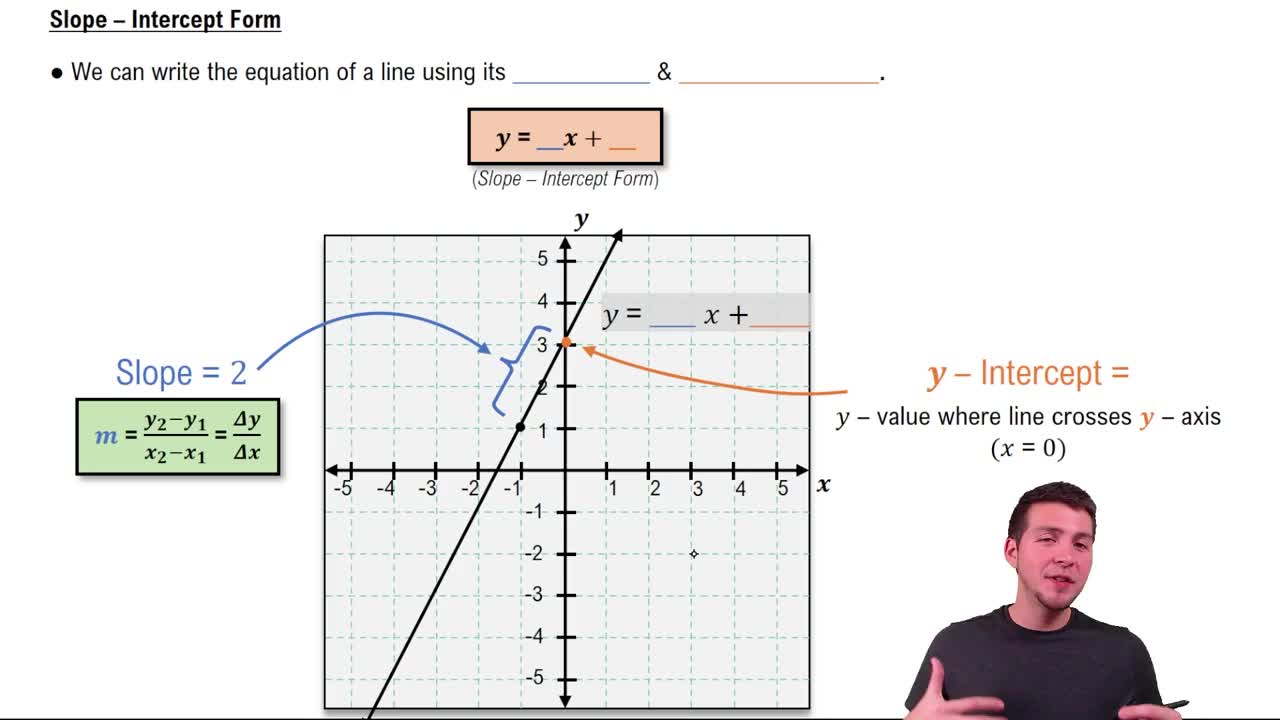
The slope of a line indicates its steepness and direction, calculated as the change in y over the change in x (rise/run). The y-intercept is the point where the line crosses the y-axis, represented by the value of y when x is zero. In the equation y = -(1/2)x, the slope is -1/2, indicating a downward slope, and the y-intercept is 0, meaning the line passes through the origin.
Recommended video:
Guided course
Slope-Intercept Form
Graphing Points
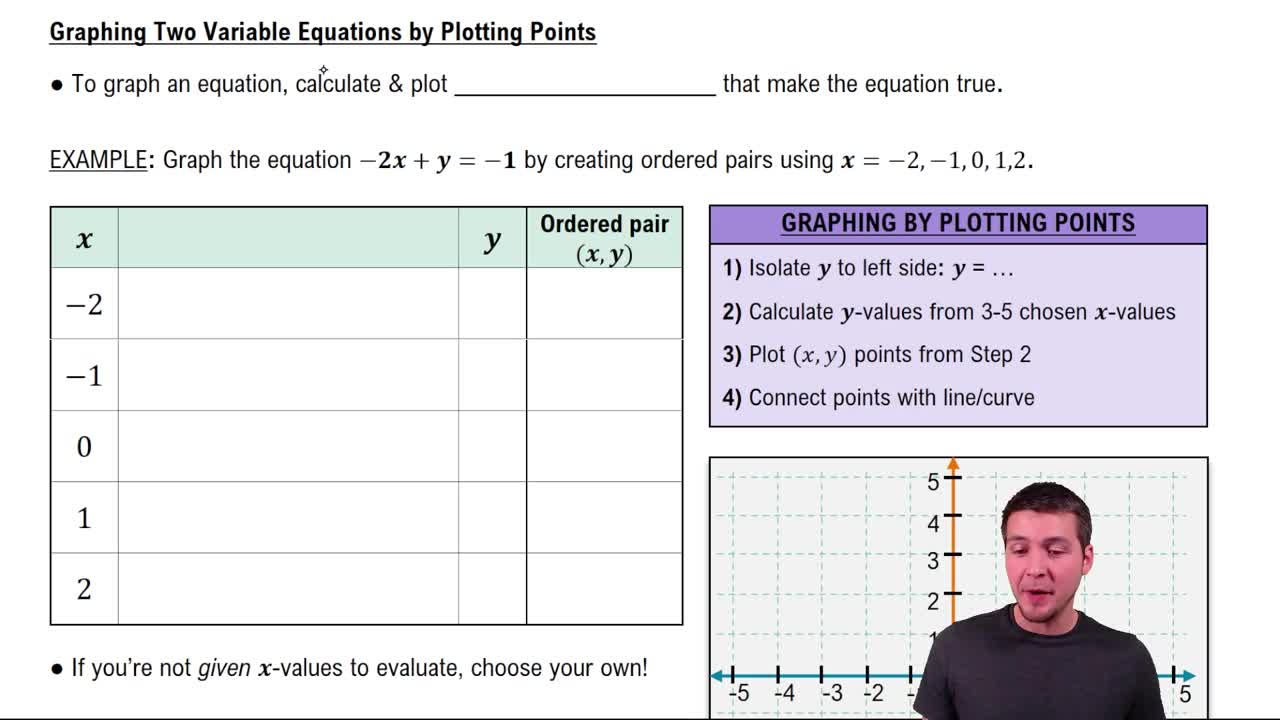
Graphing points involves plotting specific coordinates (x, y) on a Cartesian plane to visualize the relationship defined by an equation. For the equation y = -(1/2)x, substituting values for x (like -3, -2, -1, 0, 1, 2, 3) allows us to calculate corresponding y values, which can then be plotted to form the line. This process is crucial for understanding how changes in x affect y.
Recommended video:
Guided course
Graphing Equations of Two Variables by Plotting Points
Watch next
Master Equations with Two Variables with a bite sized video explanation from Patrick
Start learningRelated Videos
Related Practice
Textbook Question
435
views