In Exercises 1–38, solve each radical equation.
2(x - 1)¹/³ = (x² + 2x)¹/³
Verified step by step guidance
1
Step 1: Recognize that both sides of the equation are cube roots. To eliminate the cube roots, cube both sides of the equation: \((2(x - 1)^{1/3})^3 = ((x^2 + 2x)^{1/3})^3\).
Step 2: Simplify both sides of the equation. The left side becomes \(2^3(x - 1) = 8(x - 1)\) and the right side becomes \(x^2 + 2x\).
Step 3: Set the simplified expressions equal to each other: \(8(x - 1) = x^2 + 2x\).
Step 4: Expand and simplify the equation: \(8x - 8 = x^2 + 2x\).
Step 5: Rearrange the equation to form a standard quadratic equation: \(x^2 + 2x - 8x + 8 = 0\), which simplifies to \(x^2 - 6x + 8 = 0\).
Verified video answer for a similar problem:
This video solution was recommended by our tutors as helpful for the problem above.
Video duration:
6m
Play a video:
0 Comments
Key Concepts
Here are the essential concepts you must grasp in order to answer the question correctly.
Radical Equations
Radical equations are equations that involve roots, such as square roots or cube roots. To solve these equations, one typically isolates the radical on one side and then raises both sides of the equation to the power that eliminates the root. This process may introduce extraneous solutions, so it's important to check all potential solutions in the original equation.
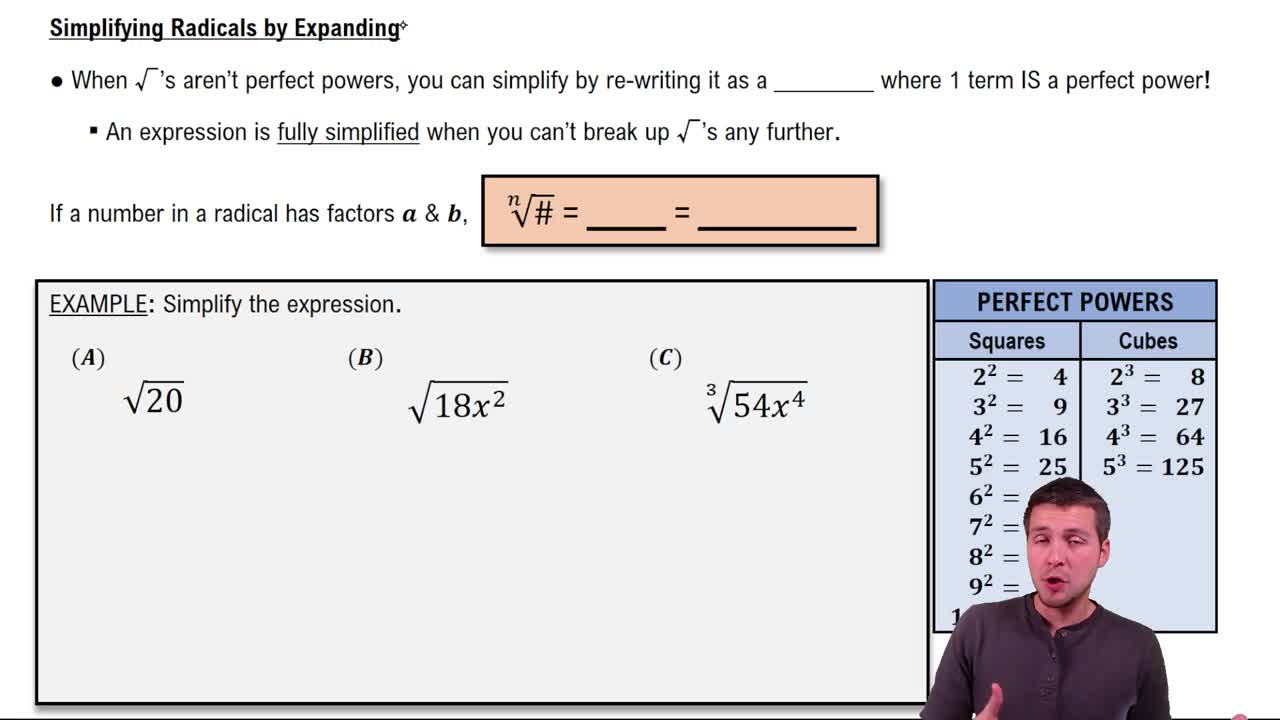
Cube roots are a specific type of radical where the root is of degree three. The cube root of a number 'a' is a value 'b' such that b³ = a. In the context of the given equation, understanding how to manipulate cube roots is essential for isolating variables and simplifying expressions to find solutions.
Isolating variables is a fundamental algebraic technique used to solve equations. This involves rearranging the equation to get the variable of interest on one side by itself. In the context of radical equations, isolating the radical expression allows for easier manipulation and simplification, leading to the solution of the equation.

 6:14 minutes
 Verified step by step guidance
 05:20
05:20