Ch. 1 - Equations and Inequalities
Lial - College Algebra 13th Edition
Lial13th EditionCollege AlgebraISBN: 9780136881063Not the one you use?Change textbook
Chapter 2, Problem 45

Height of a Projectile A projectile is launched from ground level with an initial velocity of v0 feet per second. Neglecting air resistance, its height in feet t seconds after launch is given by s=-16t2+v0t. In each exercise, find the time(s) that the projectile will (a) reach a height of 80 ft and (b) return to the ground for the given value of v0. Round answers to the nearest hundredth if necessary. v0=32

Verified step by step guidance
1
Start with the given height function for the projectile: \(s = -16t^2 + v_0 t\), where \(v_0 = 32\) feet per second. Substitute \(v_0\) into the equation to get \(s = -16t^2 + 32t\).
For part (a), set the height \(s\) equal to 80 feet to find the time(s) when the projectile reaches this height: \(-16t^2 + 32t = 80\).
Rearrange the equation to standard quadratic form: \(-16t^2 + 32t - 80 = 0\). To simplify, divide the entire equation by -16, resulting in \(t^2 - 2t + 5 = 0\).
Use the quadratic formula to solve for \(t\): \(t = \frac{-b \pm \sqrt{b^2 - 4ac}}{2a}\), where \(a=1\), \(b=-2\), and \(c=5\). Calculate the discriminant \(b^2 - 4ac\) to determine the nature of the roots.
For part (b), find the time when the projectile returns to the ground by setting \(s=0\): \(-16t^2 + 32t = 0\). Factor the equation and solve for \(t\) to find the time(s) when the height is zero.

Verified video answer for a similar problem:

This video solution was recommended by our tutors as helpful for the problem above.
Video duration:
7m
Was this helpful?

Key Concepts

Here are the essential concepts you must grasp in order to answer the question correctly.

Quadratic Functions and Their Graphs

A quadratic function is a polynomial of degree two, typically written as f(t) = at^2 + bt + c. Its graph is a parabola that opens upward if a > 0 and downward if a < 0. In projectile motion, the height function is quadratic, representing the path of the projectile over time.
Recommended video:
5:26
Graphs of Logarithmic Functions

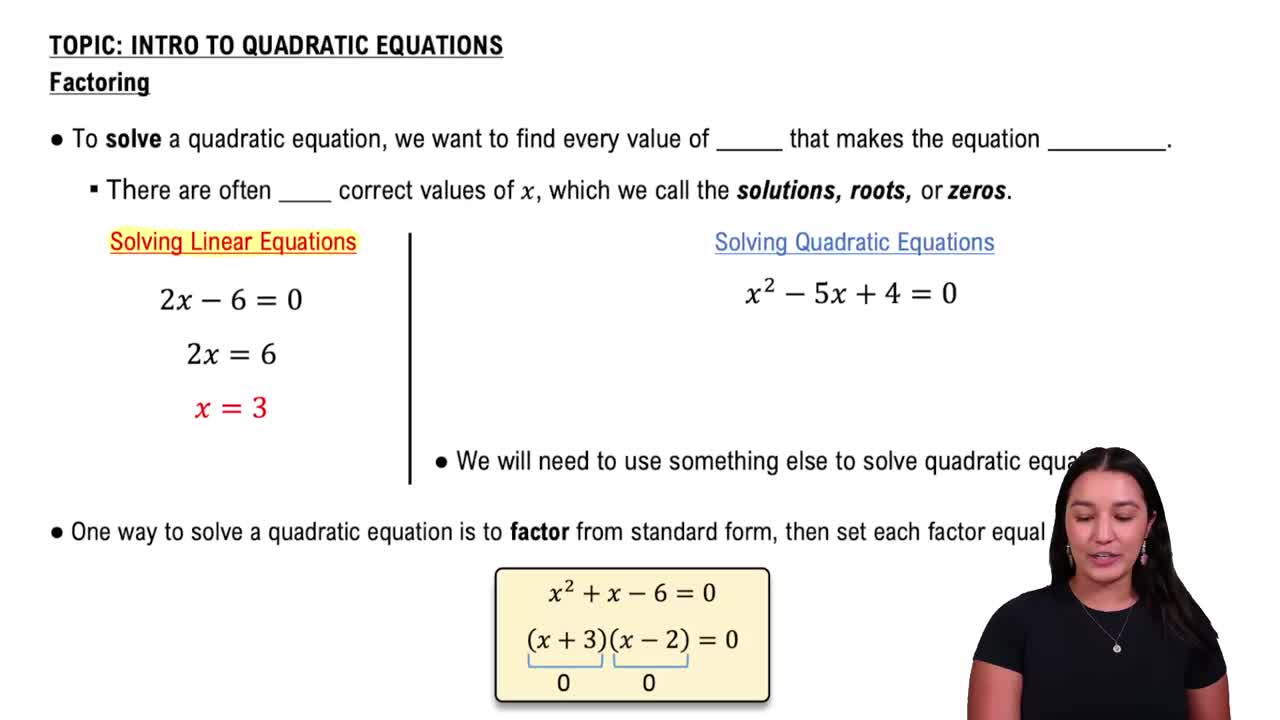
Solving Quadratic Equations

To find specific times when the projectile reaches a certain height, you solve quadratic equations by setting the height function equal to that value. Methods include factoring, completing the square, or using the quadratic formula, which provides the roots (solutions) representing time values.
Recommended video:
06:08
Solving Quadratic Equations by Factoring

Interpreting Solutions in Context

The solutions to the quadratic equation correspond to meaningful times: when the projectile reaches a given height and when it returns to the ground (height zero). Negative time values are not physically meaningful here, so only positive solutions are considered, and rounding is applied as needed.
Recommended video:
2:57
Probability of Non-Mutually Exclusive Events Example