Solve each equation. -2x² +11x = -21
Table of contents
- 0. Review of Algebra4h 18m
- 1. Equations & Inequalities3h 18m
- 2. Graphs of Equations1h 43m
- 3. Functions2h 17m
- 4. Polynomial Functions1h 44m
- 5. Rational Functions1h 23m
- 6. Exponential & Logarithmic Functions2h 28m
- 7. Systems of Equations & Matrices4h 5m
- 8. Conic Sections2h 23m
- 9. Sequences, Series, & Induction1h 22m
- 10. Combinatorics & Probability1h 45m
1. Equations & Inequalities
The Square Root Property
Problem 41
Textbook Question
Length of a Walkway A nature conservancy group decides to construct a raised wooden walkway through a wetland area. To enclose the most interesting part of the wetlands, the walkway will have the shape of a right triangle with one leg 700 yd longer than the other and the hypotenuse 100 yd longer than the longer leg. Find the total length of the walkway.
Verified step by step guidance1
Let the length of the shorter leg of the right triangle be represented by the variable \(x\) (in yards).
Since one leg is 700 yards longer than the other, the longer leg can be expressed as \(x + 700\).
The hypotenuse is 100 yards longer than the longer leg, so it can be written as \((x + 700) + 100 = x + 800\).
Apply the Pythagorean theorem, which states that in a right triangle, the square of the hypotenuse equals the sum of the squares of the legs:
\[ (\text{hypotenuse})^2 = (\text{shorter leg})^2 + (\text{longer leg})^2 \]
Substitute the expressions:
\[ (x + 800)^2 = x^2 + (x + 700)^2 \]
Expand both sides of the equation, simplify, and solve the resulting quadratic equation for \(x\). Once \(x\) is found, calculate the lengths of the legs and hypotenuse, then add them together to find the total length of the walkway.
Verified video answer for a similar problem:This video solution was recommended by our tutors as helpful for the problem above
Video duration:
6mPlay a video:
Was this helpful?
Key Concepts
Here are the essential concepts you must grasp in order to answer the question correctly.
Right Triangle Properties
A right triangle has one 90-degree angle, and its sides follow the Pythagorean theorem. The two legs are perpendicular, and the hypotenuse is the longest side opposite the right angle. Understanding these properties helps relate the sides algebraically.
Recommended video:
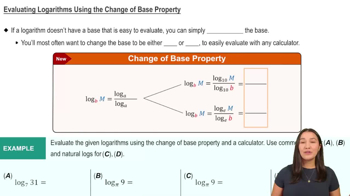
Change of Base Property
Pythagorean Theorem
This theorem states that in a right triangle, the square of the hypotenuse equals the sum of the squares of the legs (a² + b² = c²). It allows us to set up an equation relating the sides, which is essential for solving unknown lengths.
Algebraic Expressions and Equations
Translating the problem's conditions into algebraic expressions (e.g., one leg is 700 yd longer than the other) enables forming equations. Solving these equations finds the unknown side lengths, which can then be summed to find the total walkway length.
Recommended video:
Guided course
Introduction to Algebraic Expressions
Watch next
Master Solving Quadratic Equations by the Square Root Property with a bite sized video explanation from Patrick
Start learningRelated Videos
Related Practice
Textbook Question
723
views