In Exercises 1–20, use radical notation to rewrite each expression. Simplify, if possible.
81^3/2
Verified step by step guidance
1
Identify the expression given: \(81^{3/2}\).
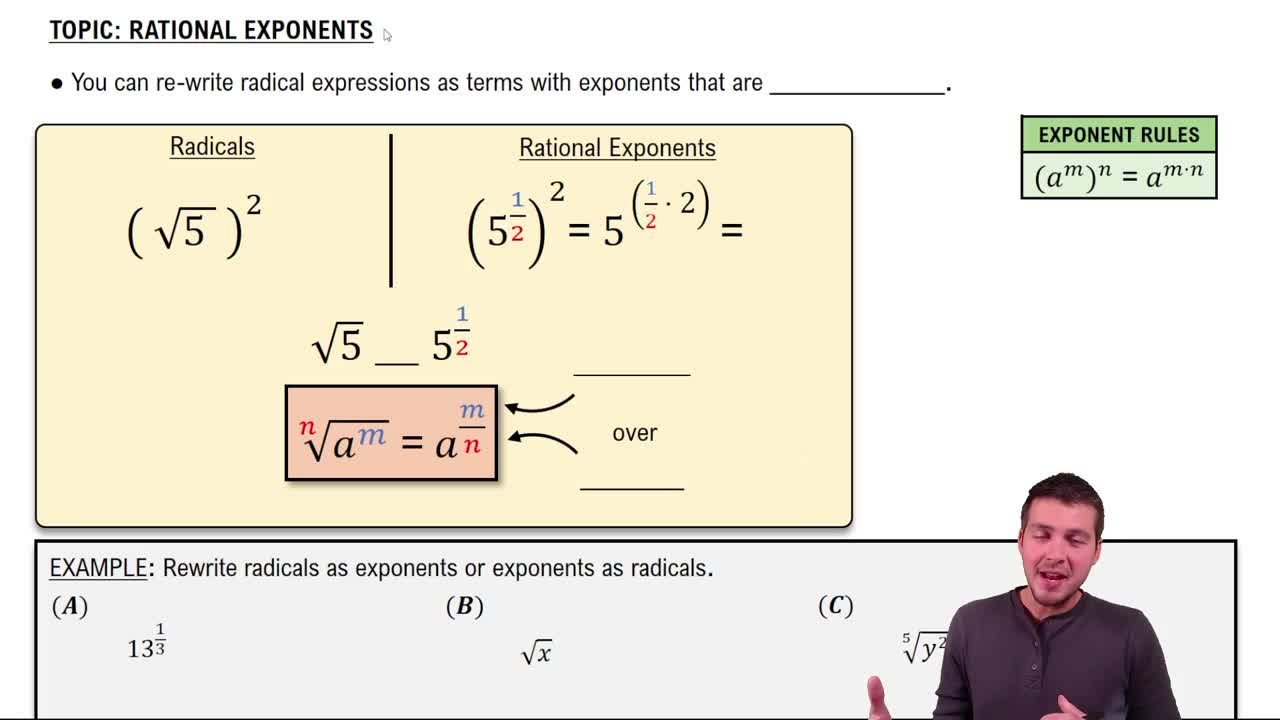
Recognize that the expression is in the form of \(a^{m/n}\), where \(a = 81\), \(m = 3\), and \(n = 2\).
Rewrite the expression using radical notation: \(\sqrt[n]{a^m}\), which becomes \(\sqrt{81^3}\).
Simplify the expression inside the radical: \$81^3$ can be rewritten as $(81^{1/2})^3$.
Calculate \(81^{1/2}\), which is the square root of 81, and then raise the result to the power of 3.
Verified video answer for a similar problem:
This video solution was recommended by our tutors as helpful for the problem above.
Video duration:
3m
Play a video:
0 Comments
Key Concepts
Here are the essential concepts you must grasp in order to answer the question correctly.
Radical Notation
Radical notation is a way to express roots of numbers using the radical symbol (√). For example, the square root of a number 'x' is written as √x. In the context of exponents, a fractional exponent indicates both a power and a root; for instance, x^(1/n) represents the nth root of x.
Exponents are a shorthand way to express repeated multiplication of a number by itself. A fractional exponent, such as 3/2, indicates that the base should be raised to the power of 3 and then the result should be taken to the square root. This duality allows for simplification of expressions involving roots and powers.
Simplification involves rewriting an expression in a more manageable or concise form. This can include combining like terms, reducing fractions, or applying properties of exponents and radicals. In the case of the expression 81^(3/2), simplification would involve calculating the square root of 81 and then raising the result to the third power.

 3:54 minutes
 Verified step by step guidance
 05:20
05:20