In this Exercise Set, assume that all variables represent positive real numbers.In Exercises 1–10, add or subtract as indicated._ _ _ _6√7 - ³√x + 2√7 + 5³√x
Verified step by step guidance
1
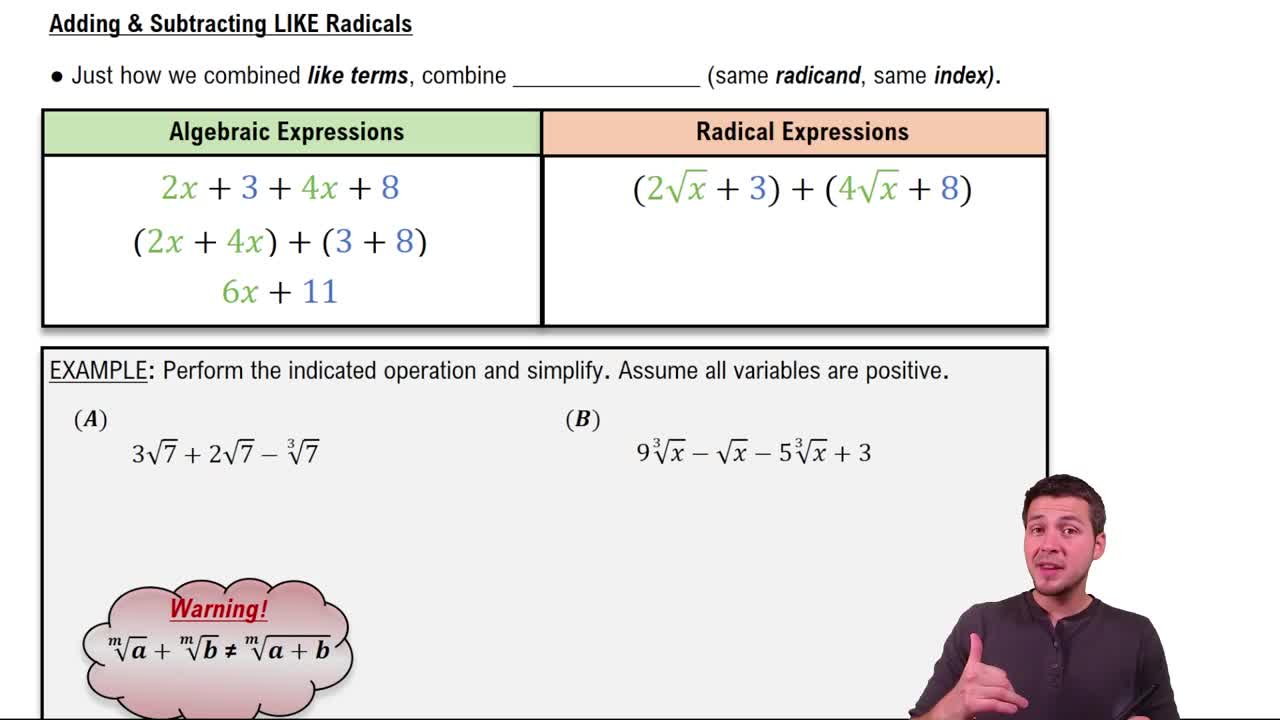
Identify like terms in the expression: \(6\sqrt{7}\) and \(2\sqrt{7}\) are like terms, and \(-\sqrt[3]{x}\) and \(5\sqrt[3]{x}\) are like terms.
Combine the like terms involving \(\sqrt{7}\): \(6\sqrt{7} + 2\sqrt{7}\).
Combine the like terms involving \(\sqrt[3]{x}\): \(-\sqrt[3]{x} + 5\sqrt[3]{x}\).
Simplify each set of like terms separately.
Write the final expression by combining the simplified terms.
Verified video answer for a similar problem:
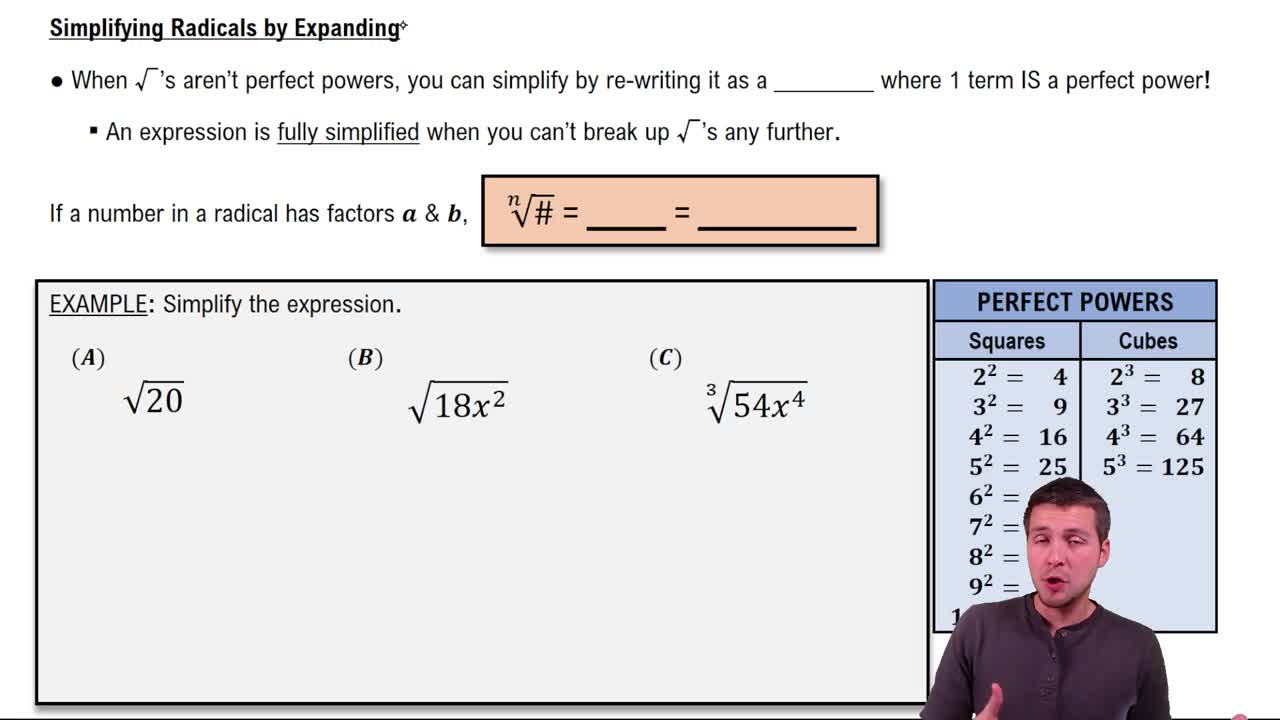
This video solution was recommended by our tutors as helpful for the problem above
Video duration:
4m
Play a video:
Was this helpful?
Key Concepts
Here are the essential concepts you must grasp in order to answer the question correctly.
Radicals
Radicals are expressions that involve roots, such as square roots (√) and cube roots (³√). They represent the inverse operation of exponentiation. Understanding how to simplify and manipulate radical expressions is crucial for performing operations like addition and subtraction, especially when combining like terms.
Like terms are terms in an algebraic expression that have the same variable raised to the same power. For example, 6√7 and 2√7 are like terms because they both contain the radical √7. Identifying and combining like terms is essential for simplifying expressions and performing arithmetic operations correctly.
Combining radicals involves adding or subtracting radical expressions that are like terms. This process requires recognizing which terms can be combined based on their radical components. For instance, in the expression 6√7 + 2√7, you can combine them to get 8√7, while terms with different radicals, like ³√x, remain separate.