Graph functions f and g in the same rectangular coordinate system. Graph and give equations of all asymptotes. If applicable, use a graphing utility to confirm your hand-drawn graphs. f(x) = (½)x and g(x) = (½)x-1 + 1
Table of contents
- 0. Review of Algebra4h 18m
- 1. Equations & Inequalities3h 18m
- 2. Graphs of Equations1h 43m
- 3. Functions2h 17m
- 4. Polynomial Functions1h 44m
- 5. Rational Functions1h 23m
- 6. Exponential & Logarithmic Functions2h 28m
- 7. Systems of Equations & Matrices4h 5m
- 8. Conic Sections2h 23m
- 9. Sequences, Series, & Induction1h 22m
- 10. Combinatorics & Probability1h 45m
6. Exponential & Logarithmic Functions
Introduction to Exponential Functions
Problem 55
Textbook Question
Use the compound interest formulas A = P (1+ r/n)nt and A =Pert to solve exercises 53-56. Round answers to the nearest cent. Suppose that you have \$12,000 to invest. Which investment yields the greater return over 3 years: 0.96% compounded monthly or 0.95% compounded continuously?
Verified step by step guidance1
Identify the given values: the principal amount \(P = 12000\), the time period \(t = 3\) years, the interest rates \(r_1 = 0.0096\) (0.96%) for monthly compounding, and \(r_2 = 0.0095\) (0.95%) for continuous compounding.
For the investment compounded monthly, use the formula \(A = P \left(1 + \frac{r}{n}\right)^{nt}\), where \(n = 12\) (months per year). Substitute the values to get \(A_1 = 12000 \left(1 + \frac{0.0096}{12}\right)^{12 \times 3}\).
For the investment compounded continuously, use the formula \(A = Pe^{rt}\). Substitute the values to get \(A_2 = 12000 \times e^{0.0095 \times 3}\).
Calculate the expressions inside the parentheses and exponents separately for both formulas, but do not compute the final numerical values yet.
Compare the two amounts \(A_1\) and \(A_2\) after evaluating the expressions to determine which investment yields the greater return over 3 years.
Verified video answer for a similar problem:This video solution was recommended by our tutors as helpful for the problem above
Video duration:
3mPlay a video:
Was this helpful?
Key Concepts
Here are the essential concepts you must grasp in order to answer the question correctly.
Compound Interest Formula (Periodic Compounding)
This formula, A = P(1 + r/n)^(nt), calculates the amount of money accumulated after interest is compounded periodically. Here, P is the principal, r is the annual interest rate, n is the number of compounding periods per year, and t is the time in years. It helps determine the future value of an investment with discrete compounding intervals.
Recommended video:
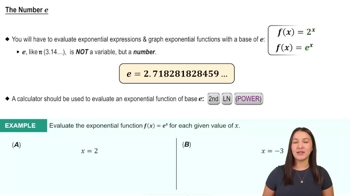
The Number e
Continuous Compounding Formula
The formula A = Pe^(rt) models interest compounded continuously, where e is Euler’s number (~2.718). This represents the limit of compounding frequency increasing indefinitely. It is used to find the future value when interest is added constantly, providing a slightly higher return than periodic compounding at the same rate.
Recommended video:
Solving Quadratic Equations Using The Quadratic Formula
Comparing Investment Returns
To determine which investment yields a greater return, calculate the final amounts using both compounding methods with the given rates and time. Comparing these results shows which option grows the principal more. Rounding to the nearest cent ensures practical financial interpretation.
Recommended video:
Guided course
Example 3
Watch next
Master Exponential Functions with a bite sized video explanation from Patrick
Start learningRelated Videos
Related Practice
Textbook Question
569
views