Solve each inequality. Give the solution set in interval notation. | 7 - 3x | > 4
Verified step by step guidance
1
Identify the inequality involving the absolute value: \(|7 - 3x| > 4\). Recall that for an absolute value inequality \(|A| > B\), where \(B > 0\), the solution splits into two cases: \(A > B\) or \(A < -B\).
Set up the two inequalities based on the definition:
1) \$7 - 3x > 4$
2) \$7 - 3x < -4$
Solve the first inequality \$7 - 3x > 4\( by isolating \)x\(:
Subtract 7 from both sides: \)-3x > 4 - 7$
Simplify the right side: \(-3x > -3\)
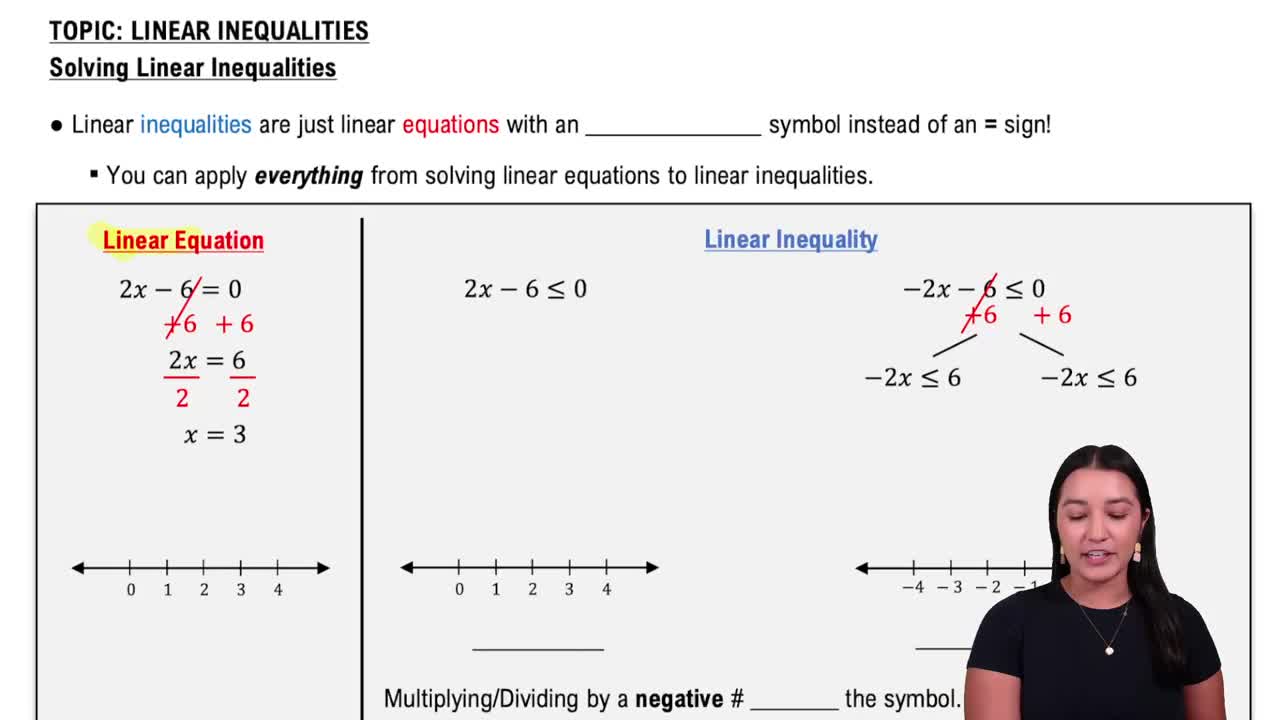
Divide both sides by \(-3\), remembering to reverse the inequality sign because you are dividing by a negative number: \(x < 1\)
Solve the second inequality \$7 - 3x < -4\( similarly:
Subtract 7 from both sides: \)-3x < -4 - 7$
Simplify the right side: \(-3x < -11\)
Divide both sides by \(-3\), reversing the inequality sign: \(x > \frac{11}{3}\)
Combine the two solution sets from the inequalities: \(x < 1\) or \(x > \frac{11}{3}\). Express this solution in interval notation as \((-\infty, 1) \cup \left(\frac{11}{3}, \infty\right)\).
Verified video answer for a similar problem:
This video solution was recommended by our tutors as helpful for the problem above
Video duration:
2m
Play a video:
0 Comments
Key Concepts
Here are the essential concepts you must grasp in order to answer the question correctly.
Absolute Value Inequalities
Absolute value inequalities involve expressions within absolute value bars, representing distance from zero. To solve |A| > B, where B > 0, split into two cases: A > B or A < -B. This approach helps convert the inequality into simpler linear inequalities.
Linear inequalities are solved by isolating the variable using inverse operations like addition, subtraction, multiplication, or division. When multiplying or dividing by a negative number, the inequality sign reverses. Solutions are expressed as ranges or intervals.
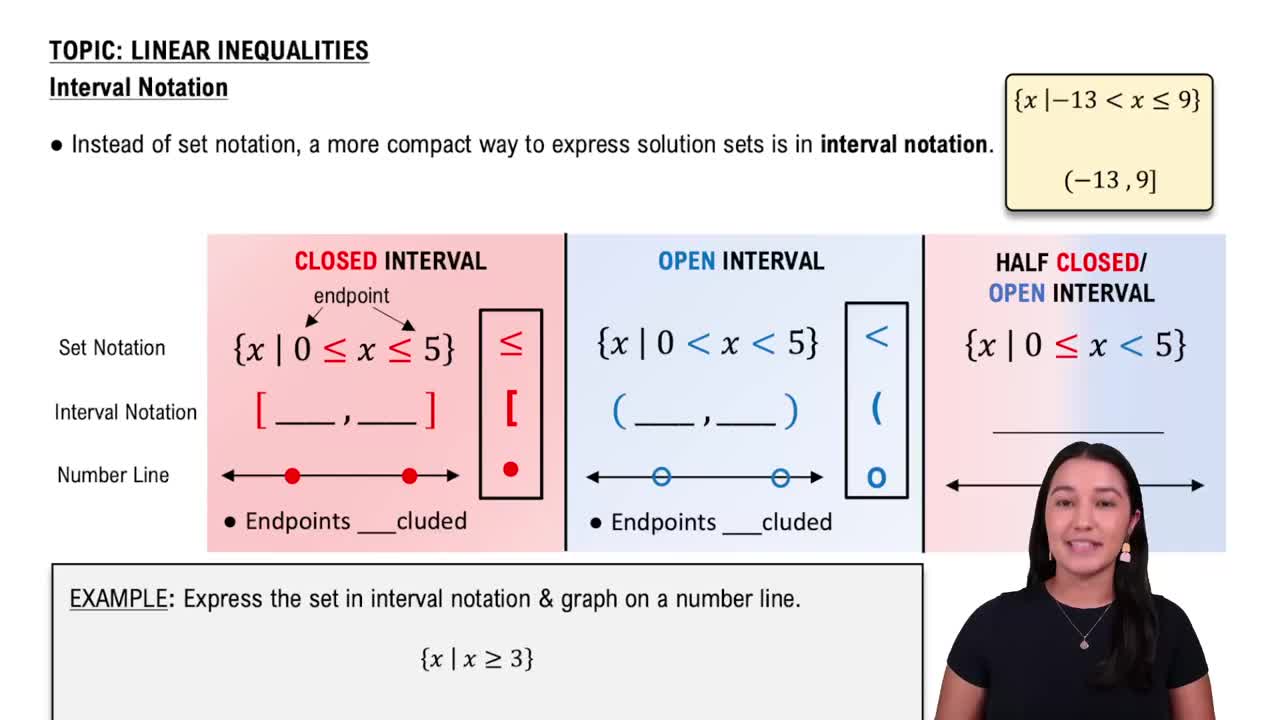
Interval notation is a concise way to represent solution sets of inequalities using parentheses and brackets. Parentheses indicate values not included (open interval), while brackets include endpoints (closed interval). It clearly shows all values satisfying the inequality.

 2:26 minutes
 Verified step by step guidance
 06:07
06:07