Based ONLY on the maximum number of turning points, which of the following graphs could NOT be the graph of the given function?
Table of contents
- 0. Review of Algebra4h 18m
- 1. Equations & Inequalities3h 18m
- 2. Graphs of Equations1h 43m
- 3. Functions2h 17m
- 4. Polynomial Functions1h 44m
- 5. Rational Functions1h 23m
- 6. Exponential & Logarithmic Functions2h 28m
- 7. Systems of Equations & Matrices4h 5m
- 8. Conic Sections2h 23m
- 9. Sequences, Series, & Induction1h 22m
- 10. Combinatorics & Probability1h 45m
4. Polynomial Functions
Understanding Polynomial Functions
Problem 5
Textbook Question
Determine which functions are polynomial functions. For those that are, identify the degree.
Verified step by step guidance1
Recall that a polynomial function is a function of the form \(h(x) = a_n x^n + a_{n-1} x^{n-1} + \cdots + a_1 x + a_0\), where each exponent \(n, n-1, \ldots, 1, 0\) is a whole number (non-negative integer), and the coefficients \(a_i\) are real numbers.
Examine the given function: \(h(x) = 7x^3 + 2x^2 + \frac{1}{x}\). Notice that the first two terms, \$7x^3\( and \)2x^2$, have exponents 3 and 2, which are whole numbers.
Look closely at the term \(\frac{1}{x}\). This can be rewritten as \(x^{-1}\), which has an exponent of \(-1\), a negative integer.
Since polynomial functions cannot have negative exponents, the presence of \(x^{-1}\) means \(h(x)\) is not a polynomial function.
Therefore, \(h(x)\) is not a polynomial function, and identifying the degree does not apply in this case.
Verified video answer for a similar problem:This video solution was recommended by our tutors as helpful for the problem above
Video duration:
1mPlay a video:
Was this helpful?
Key Concepts
Here are the essential concepts you must grasp in order to answer the question correctly.
Polynomial Functions
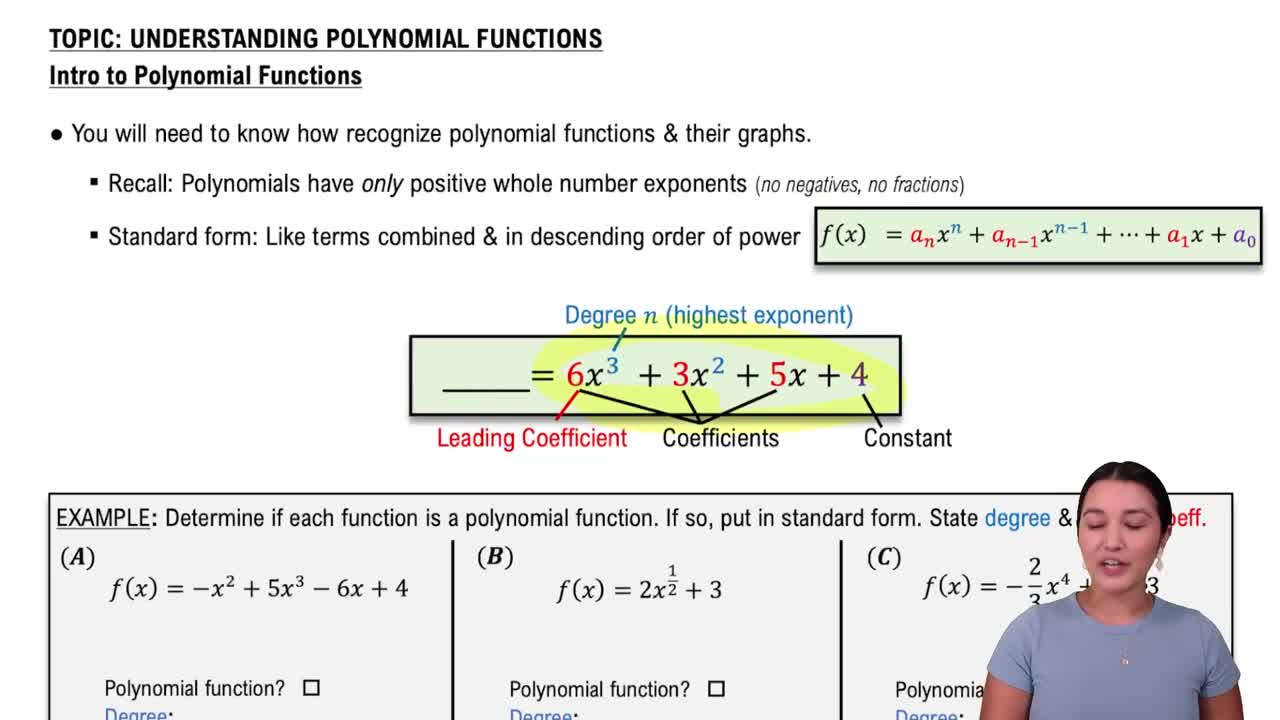
A polynomial function is a function that can be expressed as a sum of terms consisting of variables raised to non-negative integer powers multiplied by coefficients. It has the general form f(x) = a_n x^n + a_{n-1} x^{n-1} + ... + a_1 x + a_0, where n is a whole number and coefficients are real numbers.
Recommended video:
Introduction to Polynomial Functions
Degree of a Polynomial
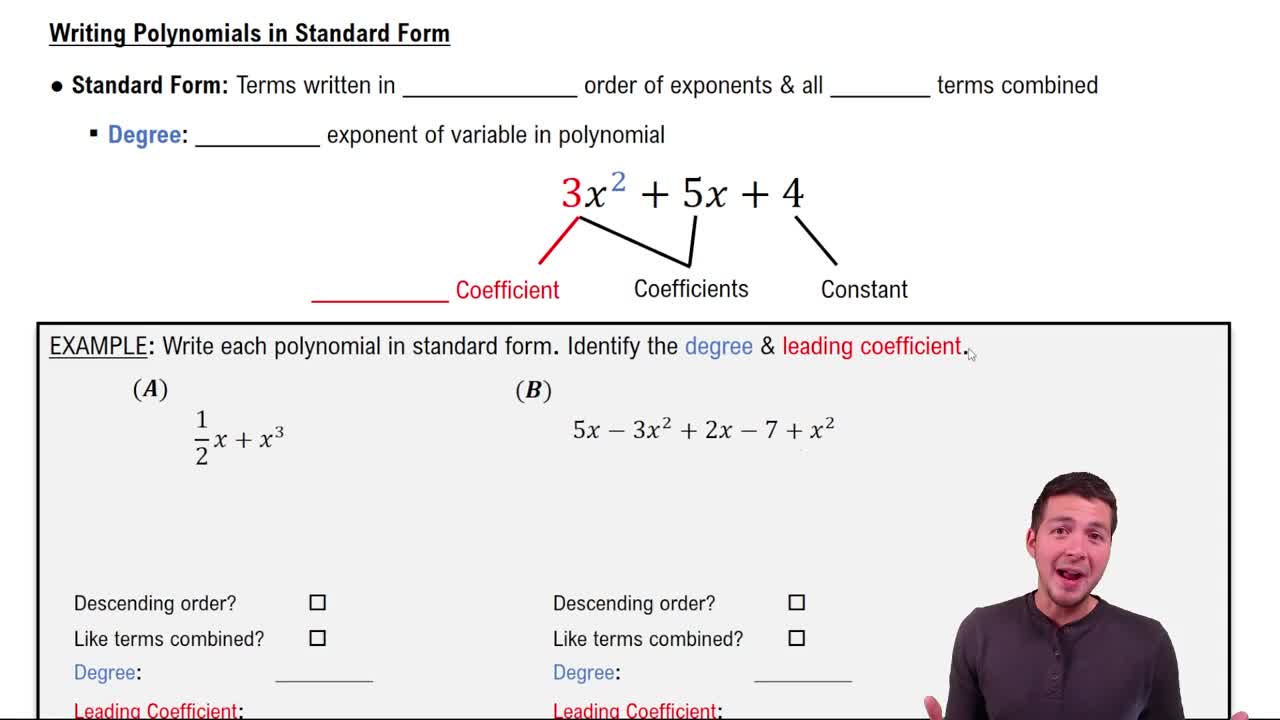
The degree of a polynomial is the highest power of the variable in the polynomial with a non-zero coefficient. It indicates the polynomial's order and affects the shape and behavior of its graph. For example, in 7x^3 + 2x^2 + 1, the degree is 3.
Recommended video:
Guided course
Standard Form of Polynomials
Non-Polynomial Terms
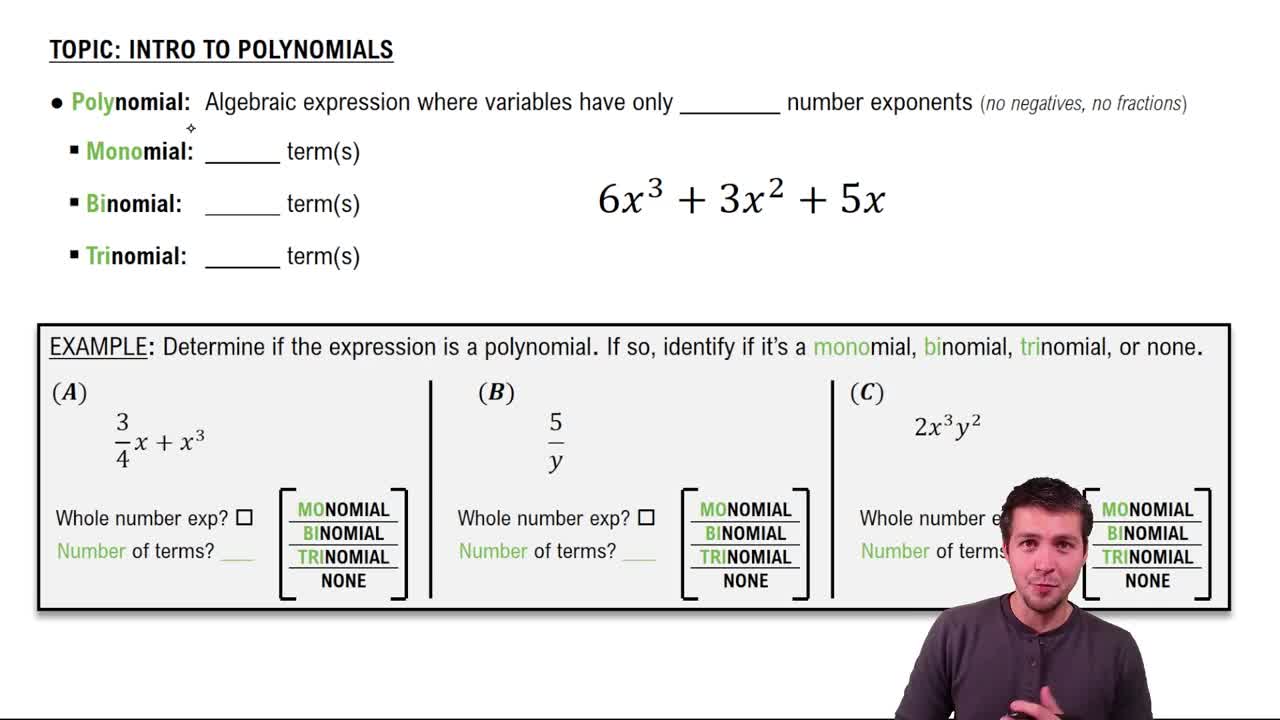
Terms with variables in the denominator or with negative or fractional exponents are not part of polynomial functions. For instance, the term 1/x can be rewritten as x^(-1), which disqualifies the function from being a polynomial because polynomials require non-negative integer exponents.
Recommended video:
Guided course
Introduction to Polynomials
Watch next
Master Introduction to Polynomial Functions with a bite sized video explanation from Patrick
Start learningRelated Videos
Related Practice
Multiple Choice
580
views
1
rank