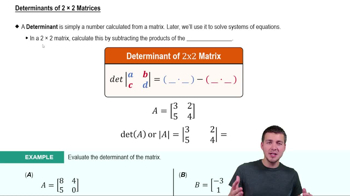
Use the determinant theorems to evaluate each determinant.
Verified step by step guidance
1
Identify the size and structure of the given determinant matrix (e.g., 2x2, 3x3) to determine which determinant theorems and properties apply.
Recall key determinant theorems such as: the determinant of a triangular matrix is the product of its diagonal entries, swapping two rows multiplies the determinant by -1, multiplying a row by a scalar multiplies the determinant by that scalar, and adding a multiple of one row to another row does not change the determinant.
Apply row operations to simplify the matrix if needed, using the determinant theorems to keep track of how these operations affect the determinant value.
Calculate the determinant of the simplified matrix by expanding along a row or column, or by using the product of diagonal entries if the matrix is triangular.
Combine all the effects of the row operations and the determinant calculation to find the determinant of the original matrix.
Verified video answer for a similar problem:
This video solution was recommended by our tutors as helpful for the problem above
Video duration:
3m
Play a video:
Was this helpful?
Key Concepts
Here are the essential concepts you must grasp in order to answer the question correctly.
Determinant of a Matrix
The determinant is a scalar value computed from a square matrix that provides important properties such as invertibility. It can be calculated using cofactor expansion or row operations, and it helps determine if a matrix is singular or nonsingular.
Determinant theorems include rules like the effect of row swaps, scalar multiplication of rows, and adding multiples of one row to another on the determinant's value. These theorems simplify determinant calculation by allowing transformations without recalculating from scratch.
Working through examples, such as Example 4 referenced, helps illustrate how determinant theorems are applied step-by-step. This practice clarifies the process of simplifying matrices and efficiently evaluating determinants.