In Exercises 1–20, use the product rule to multiply.
__ ___
√5x ⋅ √11y
Verified step by step guidance
1
Recognize that the expression involves multiplying two square roots: \( \sqrt{5x} \) and \( \sqrt{11y} \).
Apply the product rule for square roots, which states that \( \sqrt{a} \cdot \sqrt{b} = \sqrt{a \cdot b} \).
Multiply the expressions inside the square roots: \( 5x \cdot 11y \).
Combine the multiplication inside the square root: \( \sqrt{(5 \cdot 11) \cdot (x \cdot y)} \).
Simplify the expression inside the square root: \( \sqrt{55xy} \).
Verified video answer for a similar problem:
This video solution was recommended by our tutors as helpful for the problem above.
Video duration:
1m
Play a video:
0 Comments
Key Concepts
Here are the essential concepts you must grasp in order to answer the question correctly.
Product Rule
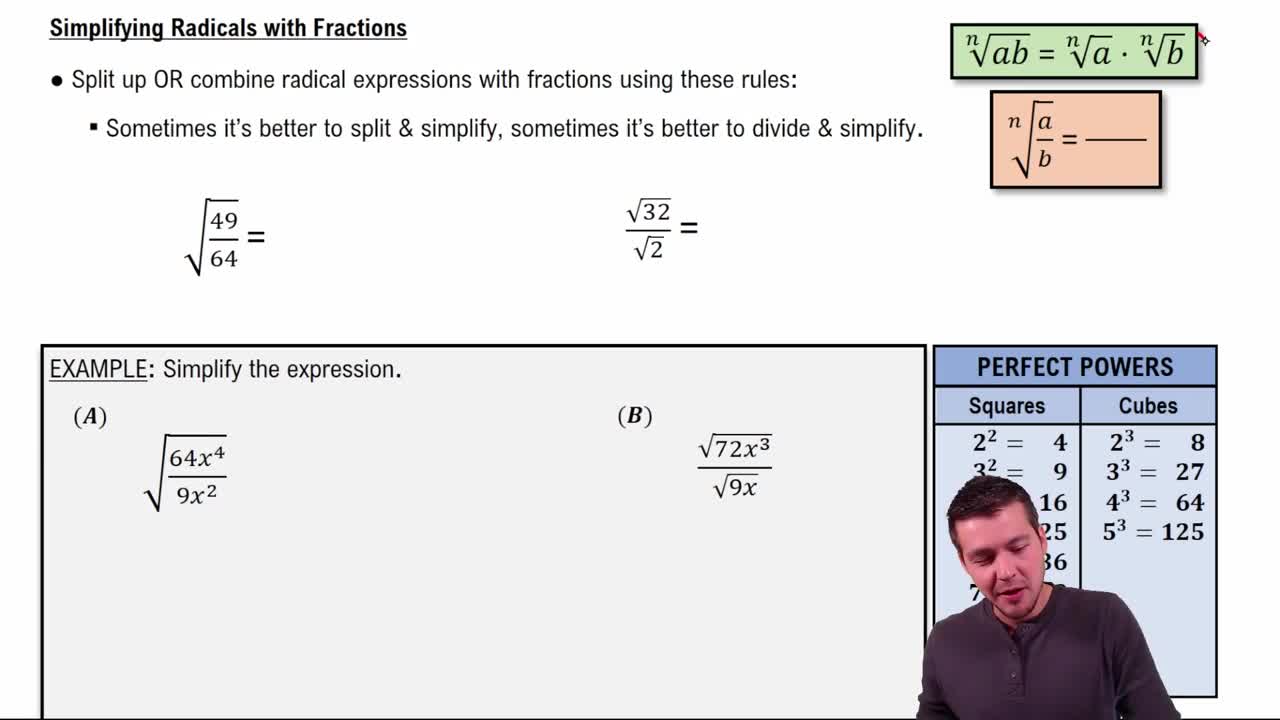
The product rule is a fundamental property of multiplication that states when multiplying two square roots, the product can be expressed as the square root of the product of the two numbers. For example, √a ⋅ √b = √(a*b). This rule simplifies calculations involving square roots and is essential for solving problems that require multiplying radical expressions.
A square root of a number x is a value that, when multiplied by itself, gives x. Square roots are denoted by the radical symbol (√). Understanding how to manipulate square roots, including simplifying them and applying the product rule, is crucial in algebra, especially when dealing with expressions involving variables and constants.
Simplifying radical expressions involves reducing them to their simplest form, which often includes factoring out perfect squares from under the radical. This process makes calculations easier and helps in further operations. For instance, √(a*b) can often be simplified to √a * √b, which is a key step in applying the product rule effectively.

 1:50 minutes
 Verified step by step guidance
 3:49
3:49