In Exercises 1–8, find the domain of each rational function. f(x)=5x/(x−4)
Table of contents
- 0. Review of Algebra4h 18m
- 1. Equations & Inequalities3h 18m
- 2. Graphs of Equations1h 43m
- 3. Functions2h 17m
- 4. Polynomial Functions1h 44m
- 5. Rational Functions1h 23m
- 6. Exponential & Logarithmic Functions2h 28m
- 7. Systems of Equations & Matrices4h 5m
- 8. Conic Sections2h 23m
- 9. Sequences, Series, & Induction1h 22m
- 10. Combinatorics & Probability1h 45m
5. Rational Functions
Asymptotes
Struggling with College Algebra?
Join thousands of students who trust us to help them ace their exams!Watch the first videoMultiple Choice
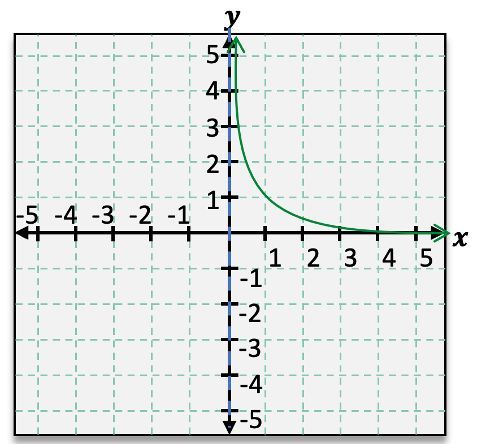
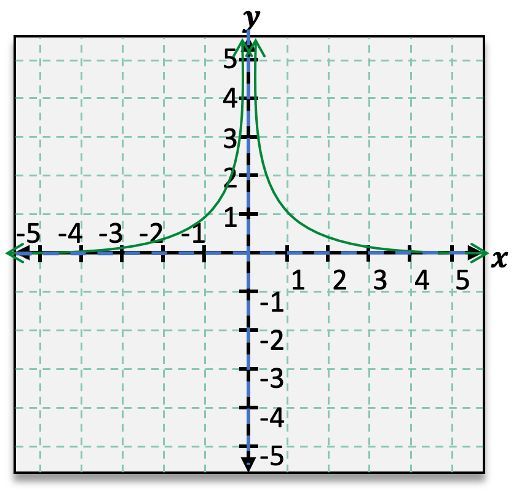
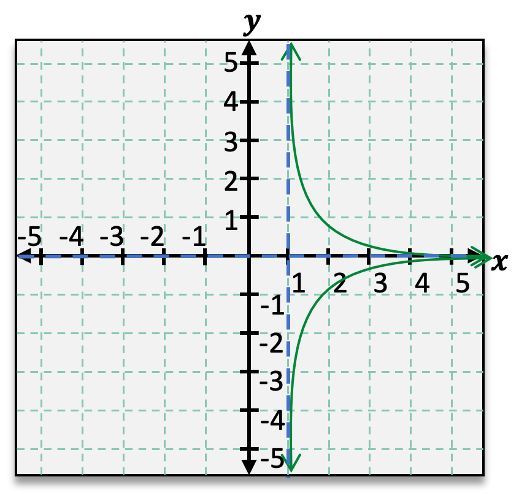
Sketch the graph of the function f(x)=x21. Identify the asymptotes on the graph.
A
Vertical Asymptote: x=0, Horizontal Asymptote: None
B
Vertical Asymptote: x=0, Horizontal Asymptote: y=0
C
Vertical Asymptote: x=0, Horizontal Asymptote: y=0
D
Vertical Asymptote: x=1 , Horizontal Asymptote: y=0
Verified step by step guidance1
The function given is \( f(x) = \frac{1}{x^2} \). This is a rational function where the numerator is a constant and the denominator is a quadratic expression.
Identify the vertical asymptote by setting the denominator equal to zero. Since the denominator is \( x^2 \), set \( x^2 = 0 \). Solving this gives \( x = 0 \). Therefore, there is a vertical asymptote at \( x = 0 \).
To find the horizontal asymptote, consider the behavior of \( f(x) \) as \( x \) approaches infinity. As \( x \to \infty \) or \( x \to -\infty \), \( \frac{1}{x^2} \to 0 \). Thus, the horizontal asymptote is \( y = 0 \).
The graph of \( f(x) = \frac{1}{x^2} \) is symmetric about the y-axis because it is an even function. This means the graph will look the same on both sides of the y-axis.
In the graph, as \( x \) approaches 0 from the positive or negative side, \( f(x) \) approaches infinity, confirming the vertical asymptote at \( x = 0 \). As \( x \) moves away from zero in either direction, \( f(x) \) approaches zero, confirming the horizontal asymptote at \( y = 0 \).
Watch next
Master Introduction to Asymptotes with a bite sized video explanation from Patrick
Start learningRelated Videos
Related Practice
Textbook Question
674
views

