Write each root using exponents and evaluate. ∛-125
Verified step by step guidance
1
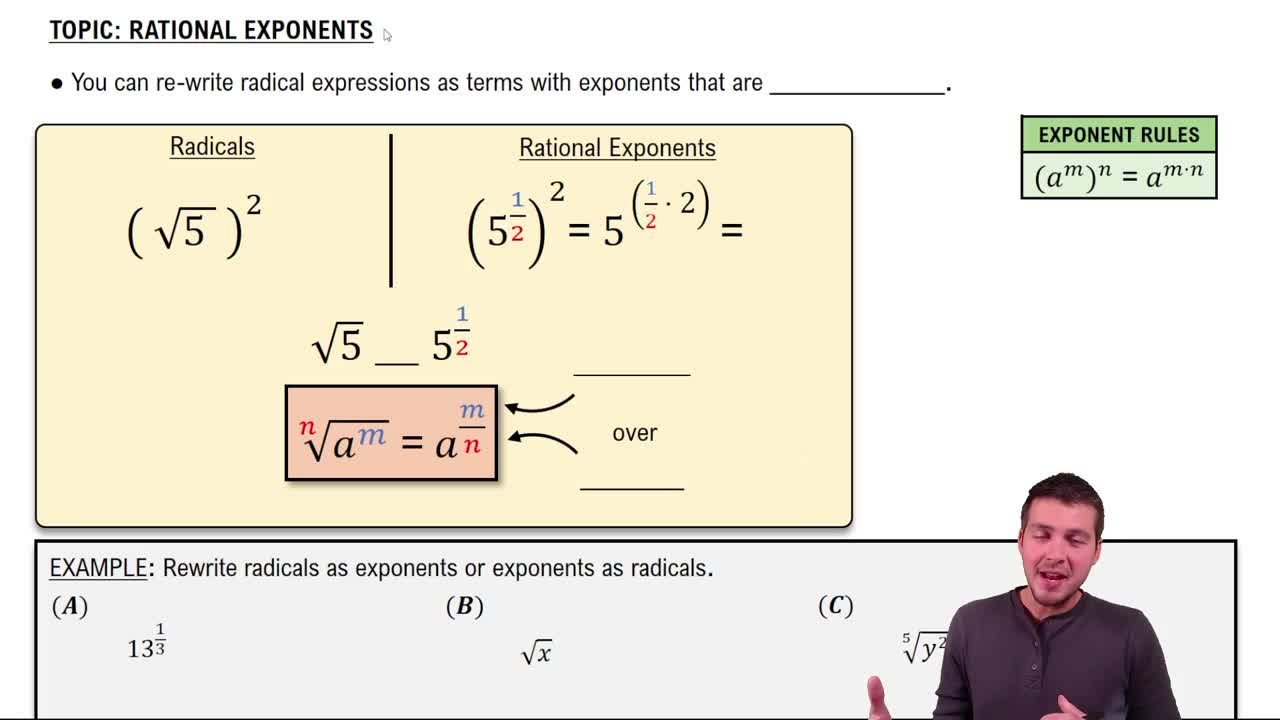
Recognize that the cube root of a number can be expressed using exponents as raising the number to the power of \( \frac{1}{3} \). So, \( \sqrt[3]{-125} = (-125)^{\frac{1}{3}} \).
Recall that \( -125 \) can be written as \( -(5^3) \) because \( 5^3 = 125 \). So rewrite the expression as \( (-(5^3))^{\frac{1}{3}} \).
Use the property of exponents \( (a^m)^n = a^{m \cdot n} \) to simplify the expression: \( (-(5^3))^{\frac{1}{3}} = - (5^{3 \cdot \frac{1}{3}}) \).
Simplify the exponent multiplication \( 3 \cdot \frac{1}{3} = 1 \), so the expression becomes \( -5^1 \).
Therefore, the cube root of \( -125 \) simplifies to \( -5 \).
Verified video answer for a similar problem:
This video solution was recommended by our tutors as helpful for the problem above
Video duration:
1m
Play a video:
0 Comments
Key Concepts
Here are the essential concepts you must grasp in order to answer the question correctly.
Cube Roots and Radicals
The cube root of a number is a value that, when multiplied by itself three times, gives the original number. It is denoted by the radical symbol with an index of 3, such as ∛x. For example, ∛-125 asks for a number which cubed equals -125.
Roots can be rewritten as fractional exponents, where the nth root of a number x is expressed as x^(1/n). For the cube root, ∛x is equivalent to x^(1/3). This allows the use of exponent rules to simplify and evaluate roots.
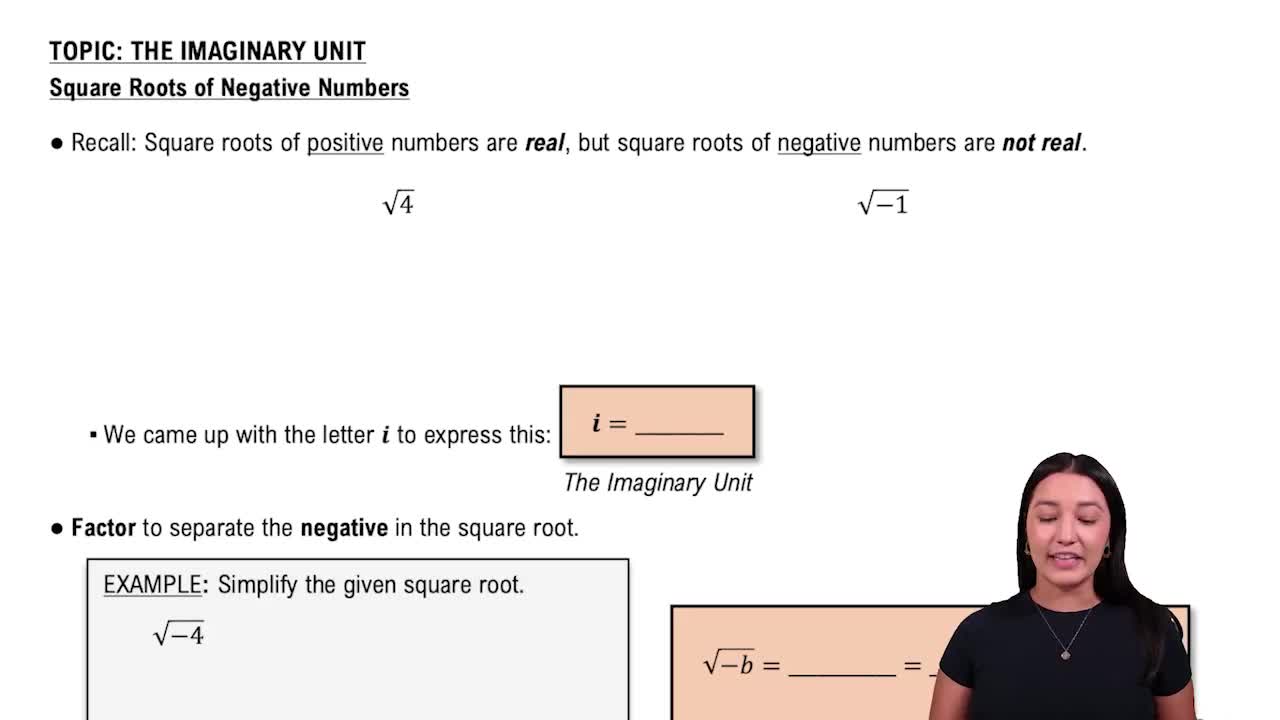
When taking an odd root (like a cube root) of a negative number, the result is also negative because an odd number of negative factors multiplied together remains negative. Thus, ∛-125 equals -5, since (-5)^3 = -125.

 1:06 minutes
 Verified step by step guidance
 05:20
05:20