In Exercises 45–66, divide and, if possible, simplify.______³√250x⁵y³³√2x³
Verified step by step guidance
1
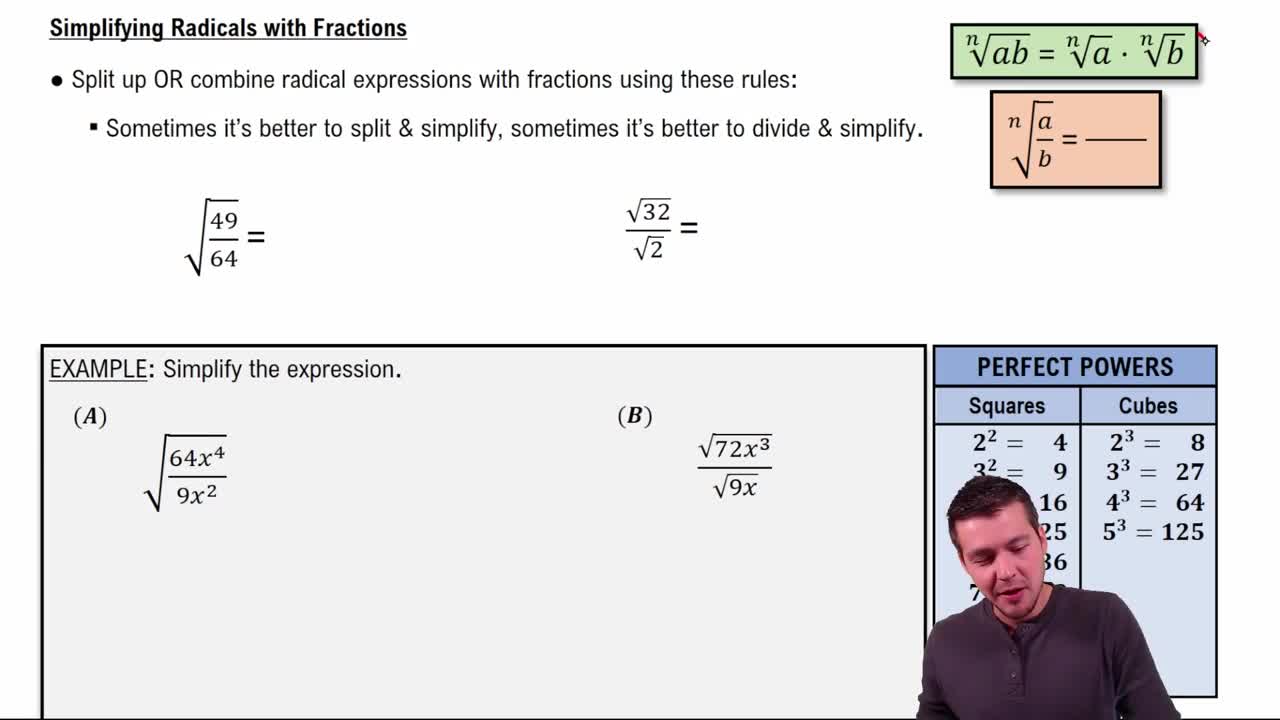
Step 1: Recognize that you are dividing two cube roots. The expression can be rewritten as a single cube root: \( \frac{\sqrt[3]{250x^5y^3}}{\sqrt[3]{2x^3}} = \sqrt[3]{\frac{250x^5y^3}{2x^3}} \).
Step 2: Simplify the fraction inside the cube root. Divide the coefficients and the variables separately: \( \frac{250}{2} = 125 \) and \( \frac{x^5}{x^3} = x^{5-3} = x^2 \).
Step 3: The expression inside the cube root now becomes \( 125x^2y^3 \).
Step 4: Recognize that 125 is a perfect cube, as \( 125 = 5^3 \).
This video solution was recommended by our tutors as helpful for the problem above
Video duration:
3m
Play a video:
Was this helpful?
Key Concepts
Here are the essential concepts you must grasp in order to answer the question correctly.
Radical Expressions
Radical expressions involve roots, such as square roots or cube roots. In this context, we are dealing with cube roots, which are denoted by the radical symbol with a small '3' indicating the root's degree. Understanding how to manipulate and simplify these expressions is crucial for solving problems involving radicals.
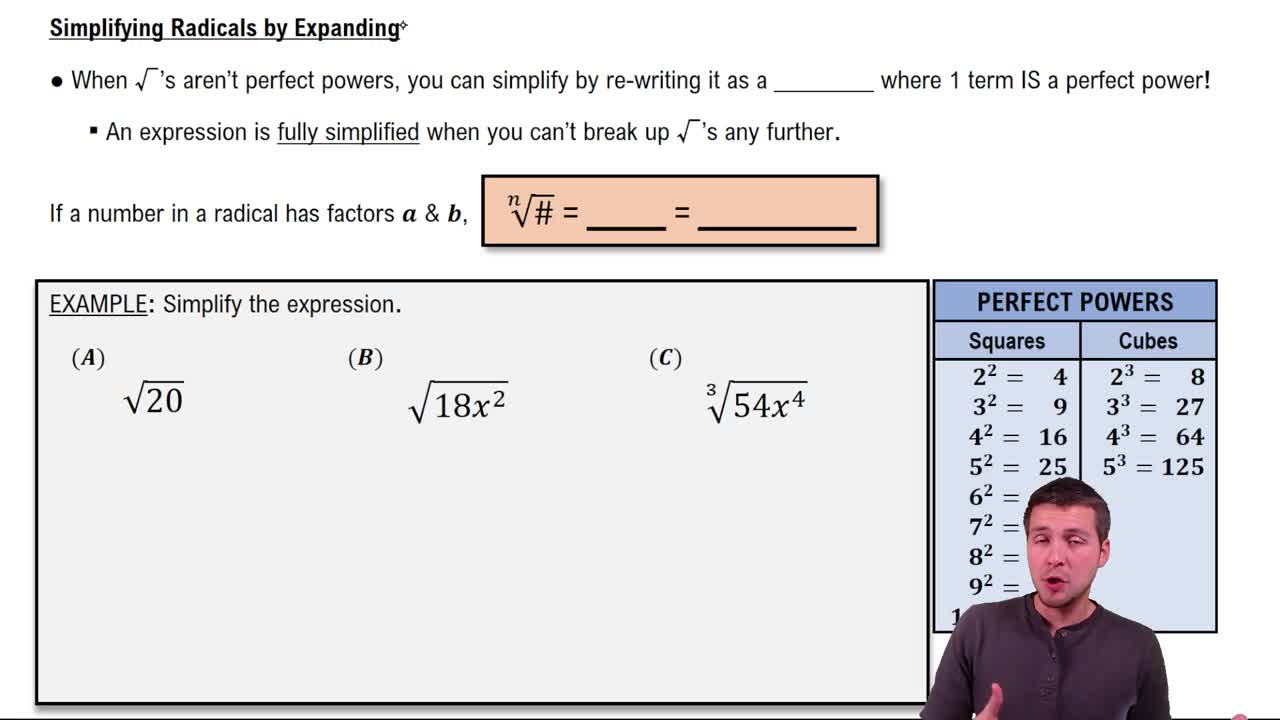
Simplifying radicals involves breaking down the expression under the radical sign into its prime factors and identifying perfect cubes (or squares, depending on the root). This process allows us to express the radical in a simpler form, making it easier to perform operations like division or addition with other radicals.
Adding & Subtracting Unlike Radicals by Simplifying
Dividing Radicals
Dividing radicals requires applying the property that states the cube root of a quotient is the quotient of the cube roots. This means that when dividing two radical expressions, we can separately simplify the numerator and the denominator before combining them. Mastery of this property is essential for effectively solving problems that involve dividing radical expressions.