Solve each polynomial inequality. Give the solution set in interval notation. See Examples 2 and 3. (2x - 1)(5x - 9)(x - 4) < 0
Table of contents
- 0. Review of Algebra4h 18m
- 1. Equations & Inequalities3h 18m
- 2. Graphs of Equations1h 43m
- 3. Functions2h 17m
- 4. Polynomial Functions1h 44m
- 5. Rational Functions1h 23m
- 6. Exponential & Logarithmic Functions2h 28m
- 7. Systems of Equations & Matrices4h 5m
- 8. Conic Sections2h 23m
- 9. Sequences, Series, & Induction1h 22m
- 10. Combinatorics & Probability1h 45m
1. Equations & Inequalities
Linear Inequalities
Problem 33
Textbook Question
Solve each polynomial inequality. Give the solution set in interval notation. (x + 3)3(2x - 1)(x + 4) ≥ 0
Verified step by step guidance1
First, identify the critical points by setting each factor equal to zero: \( (x + 3)^3 = 0 \), \( 2x - 1 = 0 \), and \( x + 4 = 0 \). Solve each to find the values of \( x \) where the expression equals zero.
The critical points divide the number line into intervals. List these intervals based on the critical points found: \( (-\infty, -4) \), \( (-4, -3) \), \( (-3, \frac{1}{2}) \), and \( (\frac{1}{2}, \infty) \).
Choose a test point from each interval and substitute it into the inequality \( (x + 3)^3 (2x - 1)(x + 4) \geq 0 \) to determine whether the expression is positive or negative on that interval.
Remember that \( (x + 3)^3 \) is a cubic factor, so it changes sign differently compared to even powers. Consider the behavior of the cubic factor when determining the sign on each interval.
Combine the intervals where the expression is greater than or equal to zero, including the points where the expression equals zero, to write the solution set in interval notation.
Verified video answer for a similar problem:This video solution was recommended by our tutors as helpful for the problem above
Video duration:
11mPlay a video:
Was this helpful?
Key Concepts
Here are the essential concepts you must grasp in order to answer the question correctly.
Polynomial Inequalities
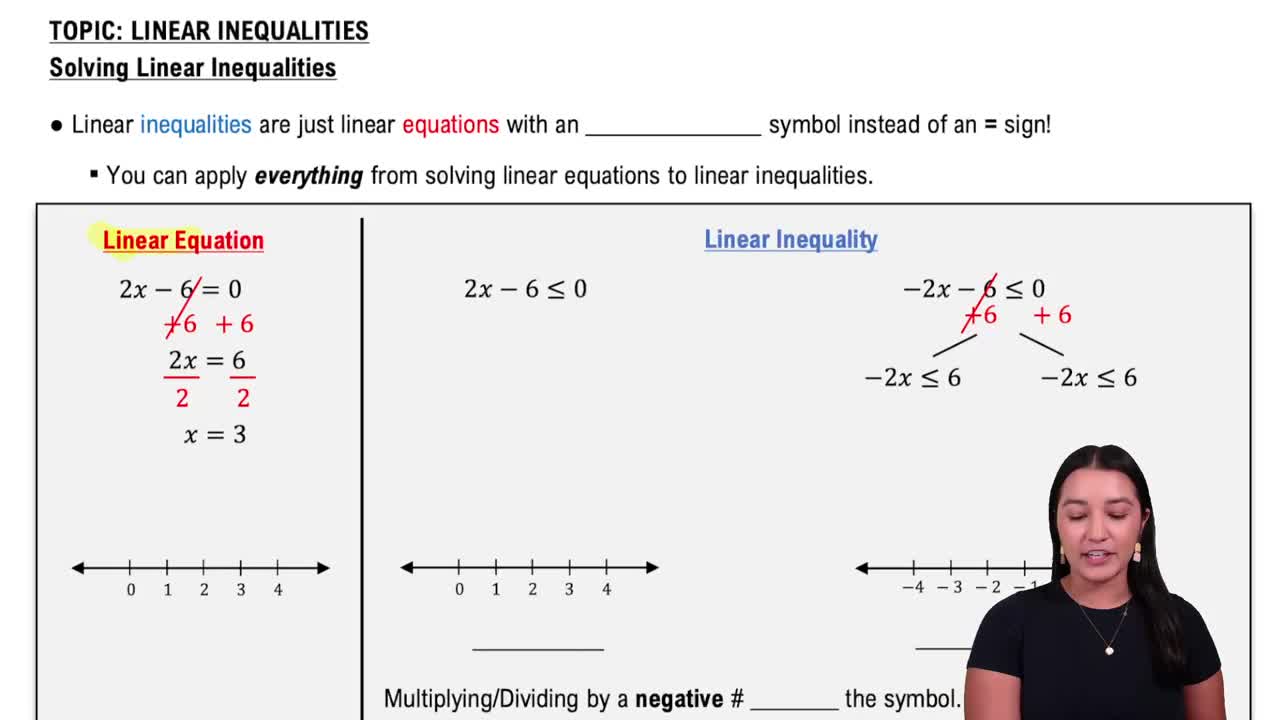
Polynomial inequalities involve expressions where a polynomial is compared to zero or another value using inequality signs (>, <, ≥, ≤). Solving them requires finding the values of the variable that make the inequality true, often by analyzing the sign of the polynomial over different intervals.
Recommended video:
Linear Inequalities
Critical Points and Sign Analysis
Critical points are values of the variable where the polynomial equals zero, found by setting each factor equal to zero. These points divide the number line into intervals. By testing values in each interval, you determine whether the polynomial is positive or negative there, which helps identify the solution set.
Recommended video:
Guided course
Point-Slope Form
Interval Notation
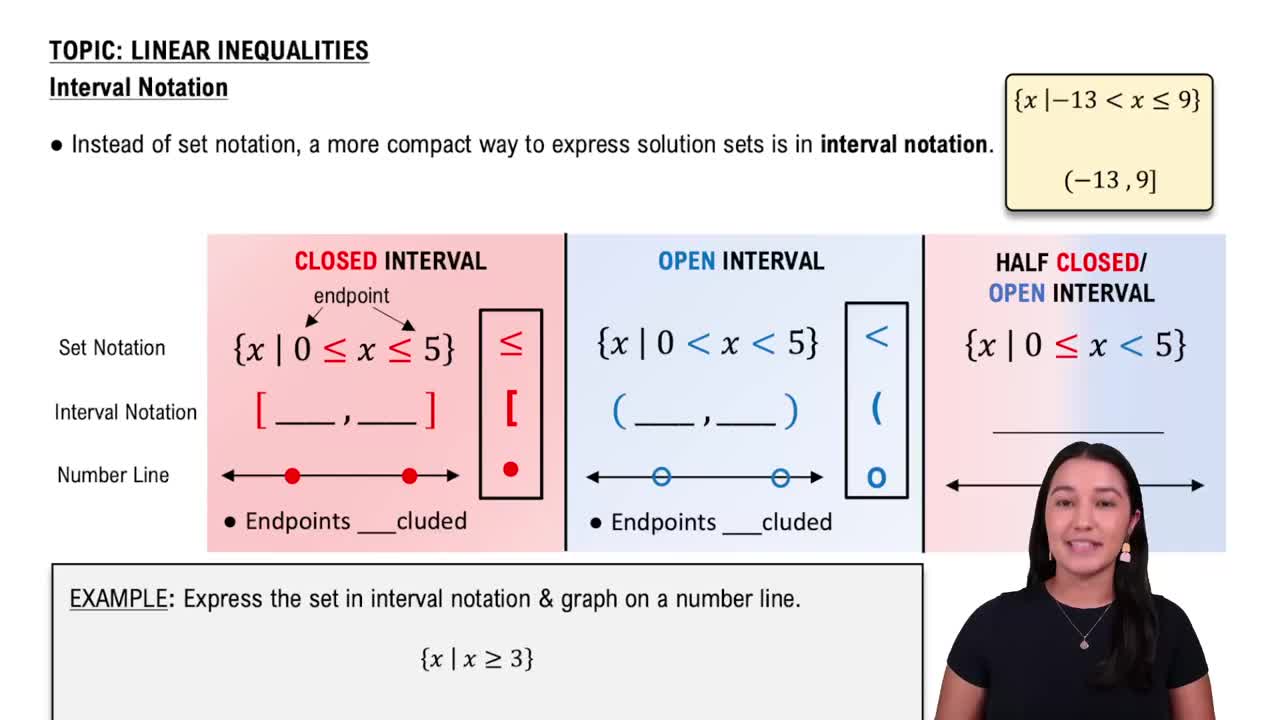
Interval notation is a concise way to express sets of real numbers, using parentheses for excluded endpoints and brackets for included endpoints. It is used to represent the solution set of inequalities, clearly showing which intervals satisfy the given condition.
Recommended video:
Interval Notation
Related Videos
Related Practice
Textbook Question
504
views