Table of contents
- 0. Review of Algebra4h 18m
- 1. Equations & Inequalities3h 18m
- 2. Graphs of Equations1h 43m
- 3. Functions2h 17m
- 4. Polynomial Functions1h 44m
- 5. Rational Functions1h 23m
- 6. Exponential & Logarithmic Functions2h 28m
- 7. Systems of Equations & Matrices4h 5m
- 8. Conic Sections2h 23m
- 9. Sequences, Series, & Induction1h 22m
- 10. Combinatorics & Probability1h 45m
6. Exponential & Logarithmic Functions
Solving Exponential and Logarithmic Equations
Problem 105
Textbook Question
Use the properties of inverses to determine whether ƒ and g are inverses. ƒ(x) = 5^x, g(x) = log↓5 x
Verified step by step guidance1
Recall that two functions \( f \) and \( g \) are inverses if and only if \( f(g(x)) = x \) and \( g(f(x)) = x \) for all \( x \) in the domains of \( g \) and \( f \), respectively.
Start by finding the composition \( f(g(x)) \). Substitute \( g(x) = \log_5 x \) into \( f \): \[ f(g(x)) = f(\log_5 x) = 5^{\log_5 x} \].
Use the property of logarithms and exponents that \( a^{\log_a x} = x \) to simplify \( 5^{\log_5 x} \) to \( x \). This shows that \( f(g(x)) = x \).
Next, find the composition \( g(f(x)) \). Substitute \( f(x) = 5^x \) into \( g \): \[ g(f(x)) = g(5^x) = \log_5 (5^x) \].
Use the logarithm property \( \log_a (a^x) = x \) to simplify \( \log_5 (5^x) \) to \( x \). This shows that \( g(f(x)) = x \). Since both compositions simplify to \( x \), \( f \) and \( g \) are inverses.
Verified video answer for a similar problem:This video solution was recommended by our tutors as helpful for the problem above
Video duration:
4mPlay a video:
Was this helpful?
Key Concepts
Here are the essential concepts you must grasp in order to answer the question correctly.
Inverse Functions
Inverse functions undo each other's operations. If f and g are inverses, then applying f followed by g (or vice versa) returns the original input, i.e., g(f(x)) = x and f(g(x)) = x for all x in the domains. This property is essential to verify if two functions are inverses.
Recommended video:
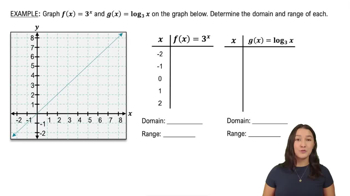
Graphing Logarithmic Functions
Exponential Functions
An exponential function has the form f(x) = a^x, where a is a positive constant not equal to 1. It grows rapidly and is one-to-one, meaning it passes the horizontal line test, which allows it to have an inverse function. Understanding its behavior helps in analyzing its inverse.
Recommended video:
Exponential Functions
Logarithmic Functions
A logarithmic function is the inverse of an exponential function and is defined as g(x) = log_a(x), where a is the base. It satisfies the property that log_a(a^x) = x and a^(log_a x) = x. Recognizing this relationship is key to determining if two functions are inverses.
Recommended video:
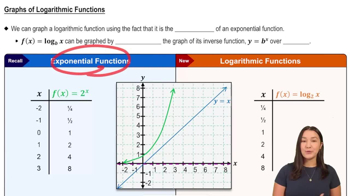
Graphs of Logarithmic Functions
Watch next
Master Solving Exponential Equations Using Like Bases with a bite sized video explanation from Patrick
Start learningRelated Videos
Related Practice
Textbook Question
In Exercises 93–102, solve each equation. 5^(x^2−12)=25^2x
564
views