To solve each problem, refer to the formulas for compound interest. A = P (1 + r/n)tn and A = Pert At what interest rate, to the nearest hundredth of a percent, will \$16,000 grow to \$20,000 if invested for 7.25 yr and interest is compounded quarterly?
Table of contents
- 0. Review of Algebra4h 18m
- 1. Equations & Inequalities3h 18m
- 2. Graphs of Equations1h 43m
- 3. Functions2h 17m
- 4. Polynomial Functions1h 44m
- 5. Rational Functions1h 23m
- 6. Exponential & Logarithmic Functions2h 28m
- 7. Systems of Equations & Matrices4h 5m
- 8. Conic Sections2h 23m
- 9. Sequences, Series, & Induction1h 22m
- 10. Combinatorics & Probability1h 45m
6. Exponential & Logarithmic Functions
Solving Exponential and Logarithmic Equations
Problem 111
Textbook Question
Write an equation for the inverse function of each one-to-one function given. ƒ(x) = 3x
Verified step by step guidance1
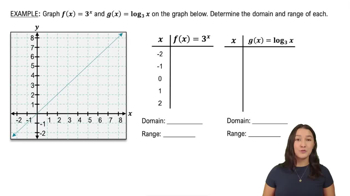
Start with the given function: \(f(x) = 3^x\). To find the inverse function, we first replace \(f(x)\) with \(y\), so we have \(y = 3^x\).
Next, interchange the roles of \(x\) and \(y\) to find the inverse. This means we write \(x = 3^y\).
To solve for \(y\), apply the logarithm with base 3 to both sides of the equation. This gives \(\log_3(x) = \log_3(3^y)\).
Using the logarithmic identity \(\log_b(b^k) = k\), simplify the right side to get \(\log_3(x) = y\).
Finally, rewrite \(y\) as the inverse function notation: \(f^{-1}(x) = \log_3(x)\). This is the equation for the inverse function.
Verified video answer for a similar problem:This video solution was recommended by our tutors as helpful for the problem above
Video duration:
2mPlay a video:
Was this helpful?
Key Concepts
Here are the essential concepts you must grasp in order to answer the question correctly.
One-to-One Functions
A one-to-one function is a function where each output corresponds to exactly one input, ensuring the function passes the horizontal line test. This property is essential for a function to have an inverse because it guarantees that the inverse will also be a function.
Recommended video:
Decomposition of Functions
Inverse Functions
An inverse function reverses the effect of the original function, swapping inputs and outputs. If f(x) maps x to y, then its inverse f⁻¹(x) maps y back to x. Finding the inverse involves solving the equation y = f(x) for x in terms of y.
Recommended video:
Graphing Logarithmic Functions
Logarithmic Functions as Inverses of Exponential Functions
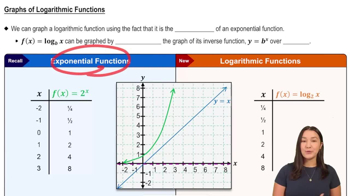
The inverse of an exponential function f(x) = a^x (where a > 0 and a ≠ 1) is the logarithmic function with base a, written as f⁻¹(x) = log_a(x). This relationship allows us to express the inverse of 3^x as log base 3 of x.
Recommended video:
Graphs of Logarithmic Functions
Watch next
Master Solving Exponential Equations Using Like Bases with a bite sized video explanation from Patrick
Start learningRelated Videos
Related Practice
Textbook Question
599
views