To solve each problem, refer to the formulas for compound interest. A = P (1 + r/n)tn and A = Pert At what interest rate, to the nearest hundredth of a percent, will \$16,000 grow to \$20,000 if invested for 7.25 yr and interest is compounded quarterly?
Table of contents
- 0. Review of Algebra4h 18m
- 1. Equations & Inequalities3h 18m
- 2. Graphs of Equations1h 43m
- 3. Functions2h 17m
- 4. Polynomial Functions1h 44m
- 5. Rational Functions1h 23m
- 6. Exponential & Logarithmic Functions2h 28m
- 7. Systems of Equations & Matrices4h 5m
- 8. Conic Sections2h 23m
- 9. Sequences, Series, & Induction1h 22m
- 10. Combinatorics & Probability1h 45m
6. Exponential & Logarithmic Functions
Solving Exponential and Logarithmic Equations
Problem 109
Textbook Question
Use the properties of inverses to determine whether ƒ and g are inverses. ƒ(x) = log↓4 (x+3), g(x) = 4x + 3
Verified step by step guidance1
Recall that two functions \( f \) and \( g \) are inverses if and only if \( f(g(x)) = x \) and \( g(f(x)) = x \) for all \( x \) in the domains of the compositions.
Start by finding the composition \( f(g(x)) \). Substitute \( g(x) = 4^x + 3 \) into \( f(x) = \log_4 (x + 3) \), so \( f(g(x)) = \log_4 ((4^x + 3) + 3) \).
Simplify the expression inside the logarithm: \( (4^x + 3) + 3 = 4^x + 6 \). So, \( f(g(x)) = \log_4 (4^x + 6) \).
Next, find the composition \( g(f(x)) \). Substitute \( f(x) = \log_4 (x + 3) \) into \( g(x) = 4^x + 3 \), so \( g(f(x)) = 4^{\log_4 (x + 3)} + 3 \).
Simplify \( 4^{\log_4 (x + 3)} \) using the property that \( a^{\log_a b} = b \), so \( g(f(x)) = (x + 3) + 3 = x + 6 \). Compare both compositions to \( x \) to determine if \( f \) and \( g \) are inverses.
Verified video answer for a similar problem:This video solution was recommended by our tutors as helpful for the problem above
Video duration:
2mPlay a video:
Was this helpful?
Key Concepts
Here are the essential concepts you must grasp in order to answer the question correctly.
Inverse Functions
Inverse functions reverse each other's operations, meaning if f and g are inverses, then f(g(x)) = x and g(f(x)) = x for all x in their domains. Understanding this relationship is essential to verify if two functions are inverses.
Recommended video:
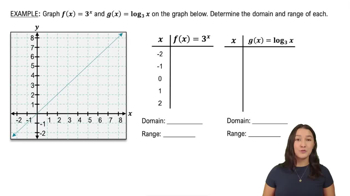
Graphing Logarithmic Functions
Logarithmic and Exponential Functions
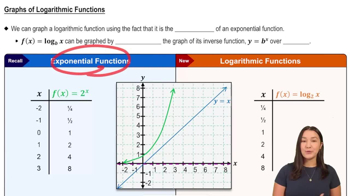
Logarithmic functions are the inverses of exponential functions with the same base. For example, log base 4 and 4 raised to a power undo each other, which is key to analyzing the given functions f(x) = log₄(x+3) and g(x) = 4^x + 3.
Recommended video:
Graphs of Logarithmic Functions
Function Composition
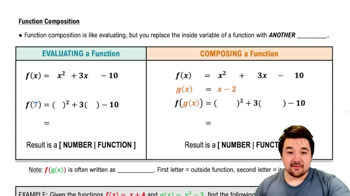
Function composition involves applying one function to the result of another, denoted as f(g(x)) or g(f(x)). To check if two functions are inverses, you compose them in both orders and verify if the result simplifies to the identity function x.
Recommended video:
Function Composition
Watch next
Master Solving Exponential Equations Using Like Bases with a bite sized video explanation from Patrick
Start learningRelated Videos
Related Practice
Textbook Question