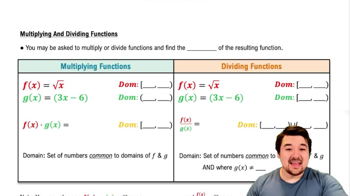
In Exercises 82–84, find f + g, f - g, fg, and f/g. Determine the domain for each function. f(x) = 3x - 1, g(x) = x - 5
Verified step by step guidance
1
Step 1: To find f + g, add the two functions f(x) and g(x). This means combining their expressions: f(x) + g(x) = (3x - 1) + (x - 5). Simplify the resulting expression by combining like terms.
Step 2: To find f - g, subtract g(x) from f(x). This means: f(x) - g(x) = (3x - 1) - (x - 5). Distribute the negative sign and simplify the resulting expression by combining like terms.
Step 3: To find fg, multiply the two functions f(x) and g(x). This means: fg(x) = (3x - 1)(x - 5). Use the distributive property (FOIL method) to expand the product and simplify the resulting expression.
Step 4: To find f/g, divide f(x) by g(x). This means: f/g(x) = (3x - 1) / (x - 5). Simplify the expression if possible. Note that the domain of this function excludes any value of x that makes the denominator zero, so x ≠ 5.
Step 5: Determine the domain for each function. For f + g, f - g, and fg, the domain is all real numbers because there are no restrictions (no division by zero or square roots of negative numbers). For f/g, the domain excludes x = 5 because division by zero is undefined.
Verified video answer for a similar problem:
This video solution was recommended by our tutors as helpful for the problem above
Video duration:
3m
Play a video:
Was this helpful?
Key Concepts
Here are the essential concepts you must grasp in order to answer the question correctly.
Function Operations
Function operations involve combining two functions through addition, subtraction, multiplication, or division. For example, if f(x) and g(x) are two functions, then f + g is defined as (f + g)(x) = f(x) + g(x). Understanding how to perform these operations is essential for solving problems that require the manipulation of multiple functions.
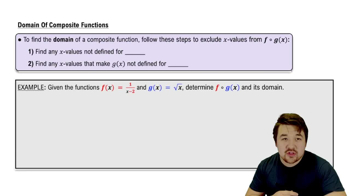
The domain of a function is the set of all possible input values (x-values) for which the function is defined. When performing operations on functions, it is crucial to determine the domain of the resulting function, as it may differ from the domains of the individual functions. For instance, in division, the denominator cannot be zero, which can restrict the domain.
Linear functions are polynomial functions of degree one, represented in the form f(x) = mx + b, where m is the slope and b is the y-intercept. In the given problem, both f(x) = 3x - 1 and g(x) = x - 5 are linear functions. Understanding their properties, such as slope and intercepts, is important for analyzing their behavior and performing operations on them.