Let ƒ(x)=x2+3 and g(x)=-2x+6. Find each of the following. (ƒg)(4)
Verified step by step guidance
1
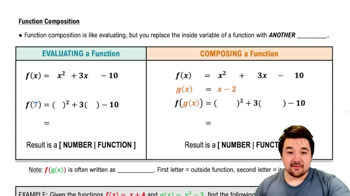
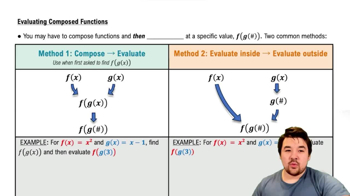
Understand that (ƒg)(4) means the composition of functions ƒ and g evaluated at 4, which is written as ƒ(g(4)). This means you first find g(4), then substitute that result into ƒ(x).
Calculate g(4) by substituting 4 into the function g(x) = -2x + 6. So, compute g(4) = -2(4) + 6.
Simplify the expression for g(4) to find its value. This will give you the input for the next step.
Substitute the value of g(4) into the function ƒ(x) = x^2 + 3. This means you replace x in ƒ(x) with the value you found for g(4).
Simplify the expression ƒ(g(4)) by squaring the value from g(4) and then adding 3, which will give you the final expression for (ƒg)(4).
Verified video answer for a similar problem:
This video solution was recommended by our tutors as helpful for the problem above
Video duration:
5m
Play a video:
Was this helpful?
Key Concepts
Here are the essential concepts you must grasp in order to answer the question correctly.
Function Composition
Function composition involves applying one function to the result of another, denoted as (f∘g)(x) = f(g(x)). It means you first evaluate g at x, then use that output as the input for f. This concept is essential for understanding how to combine functions and evaluate them at specific values.
Evaluating a function at a given input means substituting the input value into the function's formula and simplifying to find the output. For example, to find g(4), replace x with 4 in g(x) = -2x + 6 and simplify. This step is crucial before composing functions.
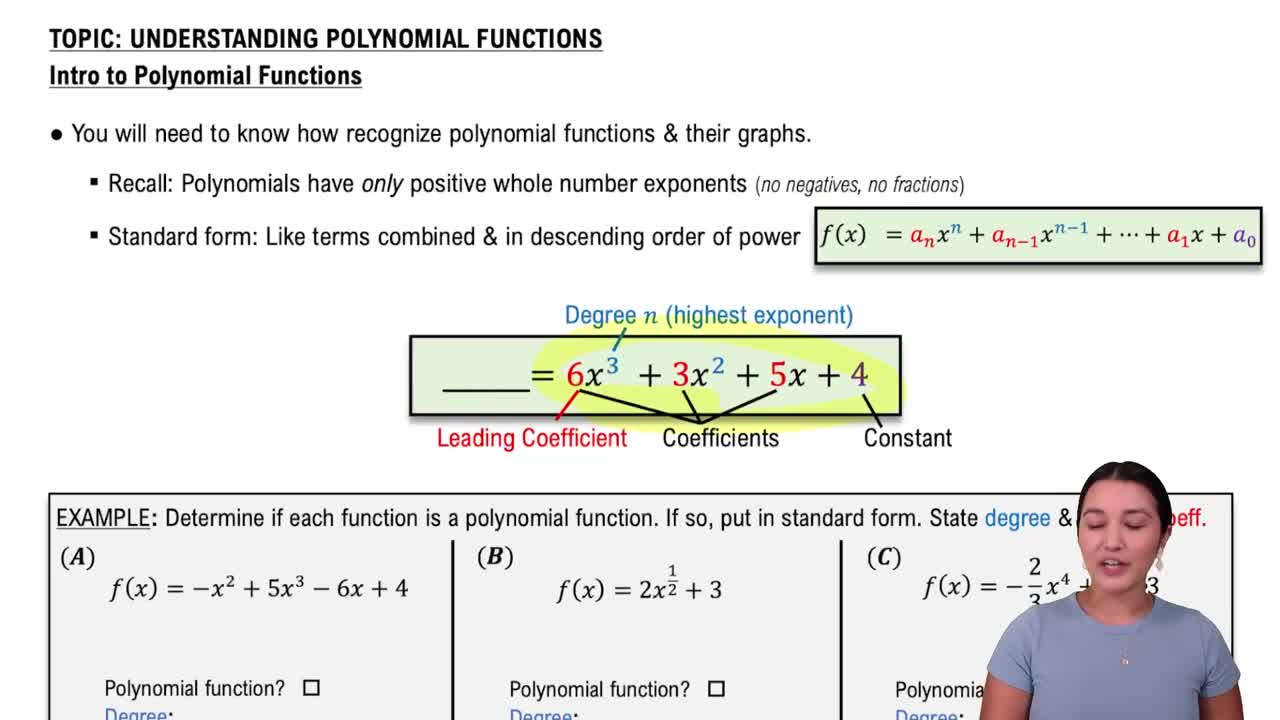
Understanding the forms of polynomial functions like f(x) = x² + 3 and linear functions like g(x) = -2x + 6 helps in correctly substituting and simplifying expressions. Recognizing these types aids in performing arithmetic operations and function evaluations accurately.