Find f+g, f−g, fg, and gf. Determine the domain for each function. f(x)=x, g(x)=x−5
Verified step by step guidance
1
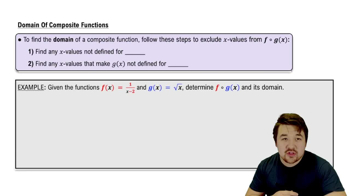
To find \( (f+g)(x) \), add the functions: \( f(x) + g(x) = \sqrt{x} + (x - 5) \). Simplify the expression to get \( \sqrt{x} + x - 5 \). The domain of \( f(x) = \sqrt{x} \) is \( x \geq 0 \), and the domain of \( g(x) = x - 5 \) is all real numbers. Therefore, the domain of \( f+g \) is \( x \geq 0 \).
To find \( (f-g)(x) \), subtract the functions: \( f(x) - g(x) = \sqrt{x} - (x - 5) \). Simplify the expression to get \( \sqrt{x} - x + 5 \). The domain is the same as \( f+g \), which is \( x \geq 0 \).
To find \( (fg)(x) \), multiply the functions: \( f(x) \cdot g(x) = \sqrt{x} \cdot (x - 5) \). This simplifies to \( x\sqrt{x} - 5\sqrt{x} \). The domain is \( x \geq 0 \) because \( \sqrt{x} \) is only defined for non-negative \( x \).
To find \( \left(\frac{f}{g}\right)(x) \), divide the functions: \( \frac{f(x)}{g(x)} = \frac{\sqrt{x}}{x - 5} \). The domain is \( x \geq 0 \) and \( x \neq 5 \) because the denominator cannot be zero.
Summarize the domains: \( f+g \) and \( f-g \) have domain \( x \geq 0 \), \( fg \) has domain \( x \geq 0 \), and \( \frac{f}{g} \) has domain \( x \geq 0 \) and \( x \neq 5 \).
Verified video answer for a similar problem:
This video solution was recommended by our tutors as helpful for the problem above
Video duration:
2m
Play a video:
Was this helpful?
Key Concepts
Here are the essential concepts you must grasp in order to answer the question correctly.
Domain of a Function
The domain of a function refers to the set of all possible input values (x-values) for which the function is defined. Understanding the domain is crucial because it determines the values that can be used in the function without resulting in undefined expressions, such as division by zero or taking the square root of a negative number.
The square root function, denoted as f(x) = √x, is defined only for non-negative values of x. This means that the input must be greater than or equal to zero (x ≥ 0) to yield a real number output. Recognizing this restriction is essential when determining the domain of functions involving square roots.
A linear function, such as g(x) = x - 5, is defined for all real numbers. This means there are no restrictions on the input values, and the domain is all real numbers (−∞, ∞). Understanding the nature of linear functions helps in identifying their domains and how they interact with other functions in operations like addition or subtraction.