For each equation, solve for x in terms of y. 4x2 - 2xy + 3y2 = 2
Table of contents
- 0. Review of Algebra4h 18m
- 1. Equations & Inequalities3h 18m
- 2. Graphs of Equations1h 43m
- 3. Functions2h 17m
- 4. Polynomial Functions1h 44m
- 5. Rational Functions1h 23m
- 6. Exponential & Logarithmic Functions2h 28m
- 7. Systems of Equations & Matrices4h 5m
- 8. Conic Sections2h 23m
- 9. Sequences, Series, & Induction1h 22m
- 10. Combinatorics & Probability1h 45m
1. Equations & Inequalities
The Square Root Property
Problem 98
Textbook Question
Answer each question. Find the values of a, b, and c for which the quadratic equation. ax2 + bx + c = 0 has the given numbers as solutions. (Hint: Use the zero-factor property in reverse.) i, -i
Verified step by step guidance1
Recall that if a quadratic equation has solutions (roots) \( r_1 \) and \( r_2 \), then it can be written as \( a(x - r_1)(x - r_2) = 0 \), where \( a \) is a nonzero constant.
Given the solutions \( i \) and \( -i \), write the factored form of the quadratic as \( a(x - i)(x + i) = 0 \).
Use the difference of squares formula to expand \( (x - i)(x + i) \): \( (x - i)(x + i) = x^2 - (i)^2 \).
Since \( i^2 = -1 \), substitute this into the expression to get \( x^2 - (-1) = x^2 + 1 \).
Therefore, the quadratic equation can be written as \( a(x^2 + 1) = 0 \). From this, identify \( a \), \( b \), and \( c \) by comparing to the standard form \( ax^2 + bx + c = 0 \).
Verified video answer for a similar problem:This video solution was recommended by our tutors as helpful for the problem above
Video duration:
3mPlay a video:
Was this helpful?
Key Concepts
Here are the essential concepts you must grasp in order to answer the question correctly.
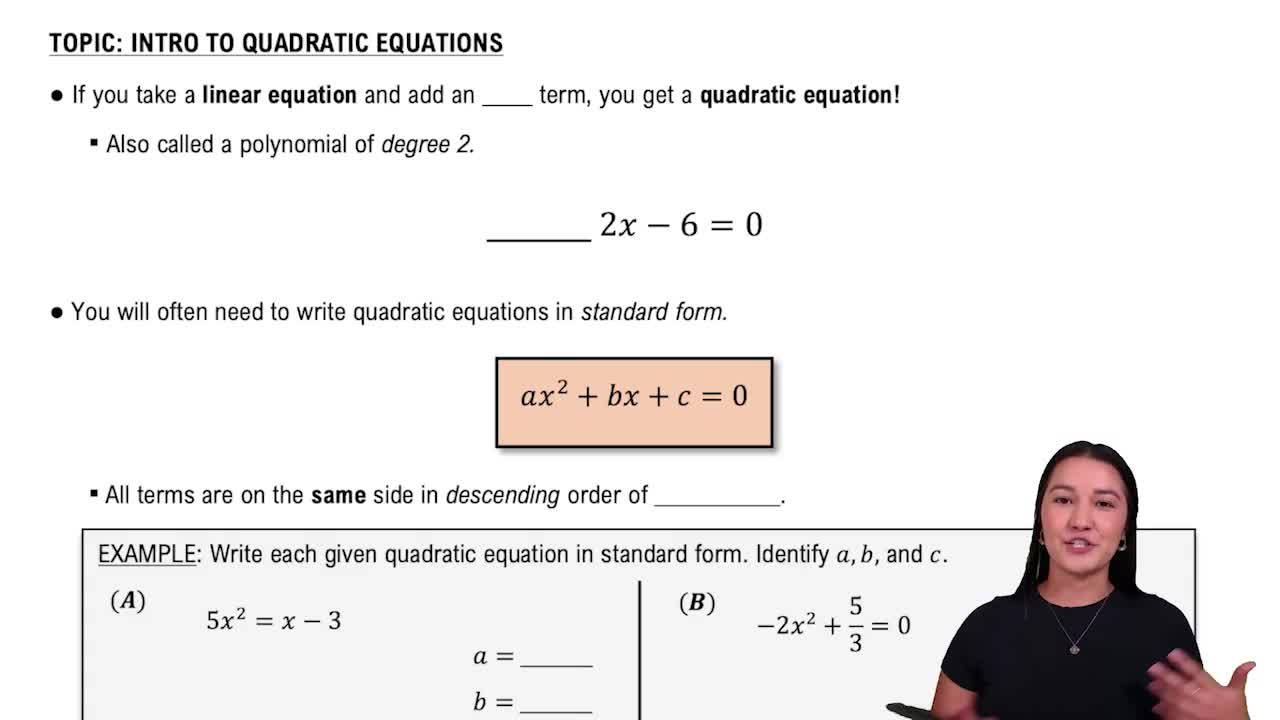
Quadratic Equations
A quadratic equation is a second-degree polynomial equation of the form ax^2 + bx + c = 0, where a, b, and c are constants and a ≠ 0. The solutions (roots) of the equation are the values of x that satisfy it. Understanding the structure of quadratic equations is essential for finding coefficients given roots.
Recommended video:
Introduction to Quadratic Equations
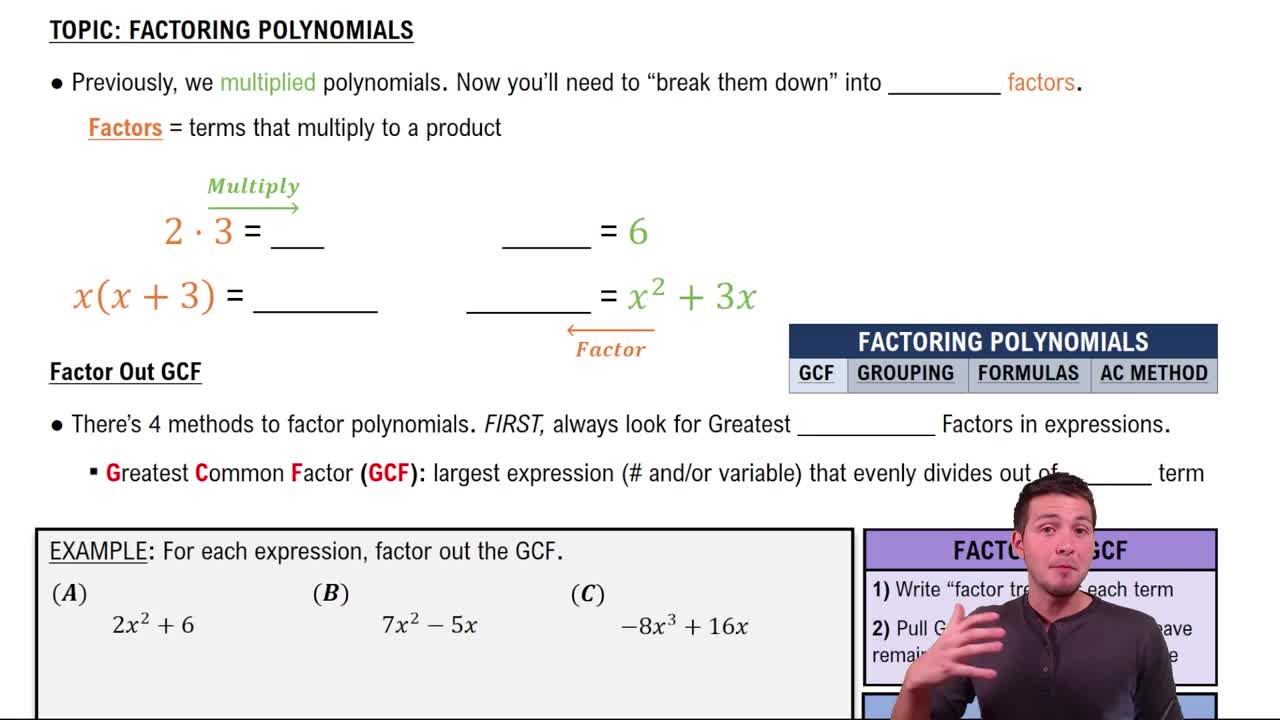
Zero-Factor Property
The zero-factor property states that if the product of two factors equals zero, then at least one of the factors must be zero. In reverse, if the solutions of a quadratic are known, the equation can be written as a product of factors set to zero, such as (x - r1)(x - r2) = 0, where r1 and r2 are roots.
Recommended video:
Guided course
Introduction to Factoring Polynomials
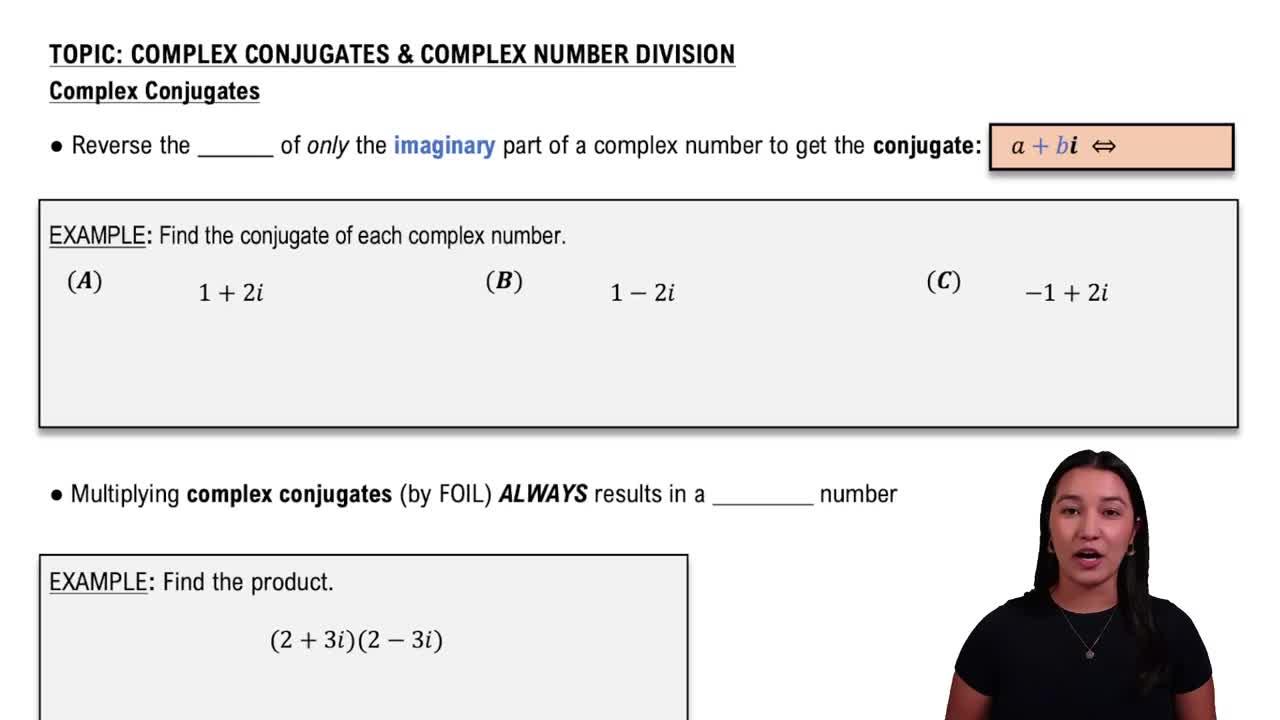
Complex Conjugate Roots
When a quadratic equation with real coefficients has complex roots, they occur in conjugate pairs like i and -i. This means the quadratic can be expressed as (x - i)(x + i) = 0, which expands to x^2 + 1 = 0. Recognizing this helps in determining the coefficients a, b, and c.
Recommended video:
Complex Conjugates
Watch next
Master Solving Quadratic Equations by the Square Root Property with a bite sized video explanation from Patrick
Start learningRelated Videos
Related Practice
Textbook Question
712
views