Determine the different possibilities for the numbers of positive, negative, and nonreal complex zeros of each function. See Example 7. ƒ(x)=11x5-x3+7x-5
Table of contents
- 0. Review of Algebra4h 18m
- 1. Equations & Inequalities3h 18m
- 2. Graphs of Equations1h 43m
- 3. Functions2h 17m
- 4. Polynomial Functions1h 44m
- 5. Rational Functions1h 23m
- 6. Exponential & Logarithmic Functions2h 28m
- 7. Systems of Equations & Matrices4h 5m
- 8. Conic Sections2h 23m
- 9. Sequences, Series, & Induction1h 22m
- 10. Combinatorics & Probability1h 45m
4. Polynomial Functions
Zeros of Polynomial Functions
Problem 111
Textbook Question
Find all complex zeros of each polynomial function. Give exact values. List multiple zeros as necessary.* ƒ(x)=x4-6x3+7x2
Verified step by step guidance1
Start by writing down the polynomial function: \(f(x) = x^4 - 6x^3 + 7x^2\).
Factor out the greatest common factor (GCF) from all terms. Since each term contains \(x^2\), factor it out: \(f(x) = x^2(x^2 - 6x + 7)\).
Set the factored form equal to zero to find the zeros: \(x^2(x^2 - 6x + 7) = 0\). This implies either \(x^2 = 0\) or \(x^2 - 6x + 7 = 0\).
Solve the first equation \(x^2 = 0\) to find the zeros from this factor. Then, solve the quadratic equation \(x^2 - 6x + 7 = 0\) using the quadratic formula: \(x = \frac{-b \pm \sqrt{b^2 - 4ac}}{2a}\), where \(a=1\), \(b=-6\), and \(c=7\).
Simplify the solutions from the quadratic formula to find the exact complex zeros. Combine these with the zeros from \(x^2=0\) to list all complex zeros of the polynomial.
Verified video answer for a similar problem:This video solution was recommended by our tutors as helpful for the problem above
Video duration:
4mPlay a video:
Was this helpful?
Key Concepts
Here are the essential concepts you must grasp in order to answer the question correctly.
Polynomial Zeros
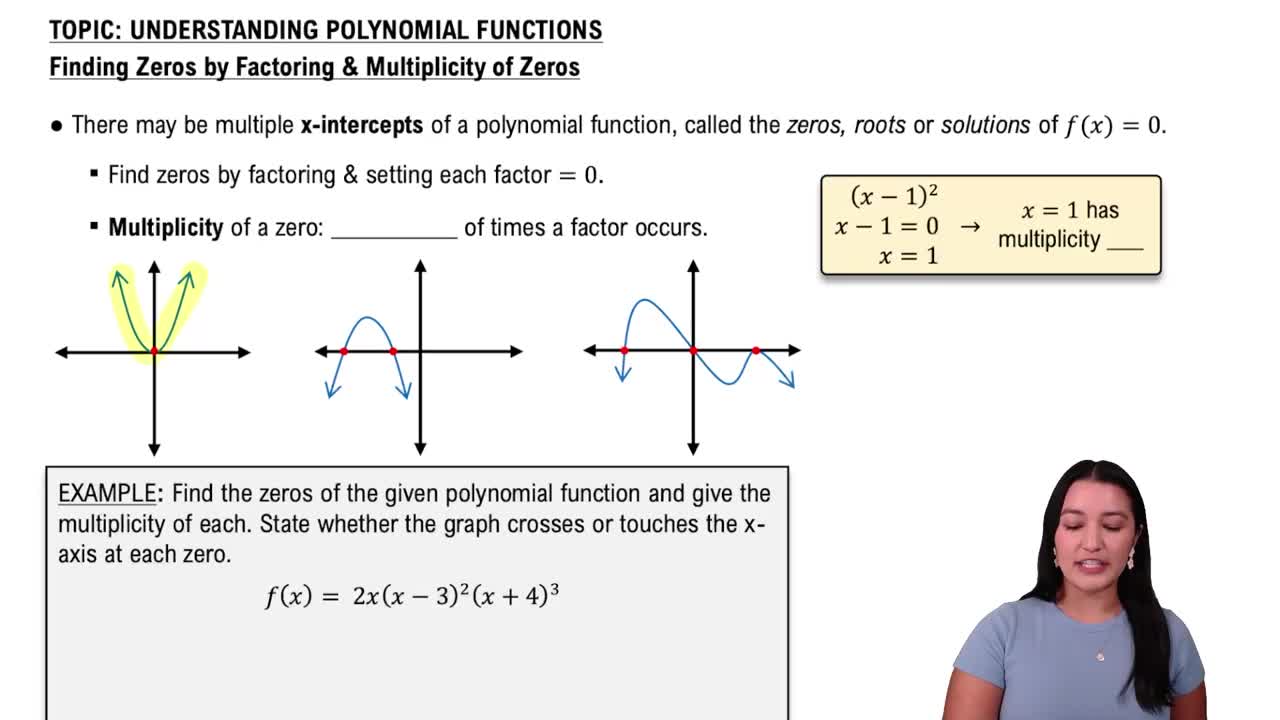
Polynomial zeros are the values of x for which the polynomial equals zero. Finding zeros involves solving the equation f(x) = 0. These zeros can be real or complex numbers and represent the roots of the polynomial function.
Recommended video:
Finding Zeros & Their Multiplicity
Factoring Polynomials
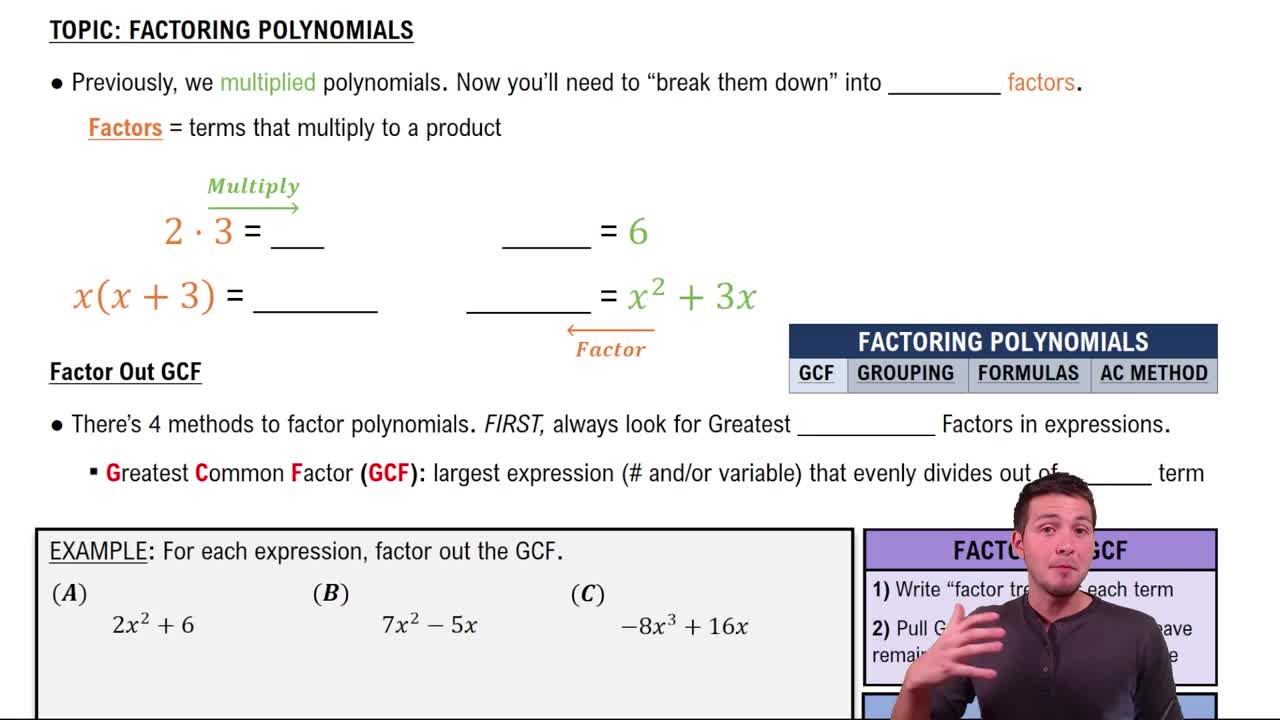
Factoring is the process of expressing a polynomial as a product of simpler polynomials. It helps in finding zeros by setting each factor equal to zero. Techniques include factoring out common terms, grouping, or using special formulas like difference of squares.
Recommended video:
Guided course
Introduction to Factoring Polynomials
Complex Numbers and the Fundamental Theorem of Algebra
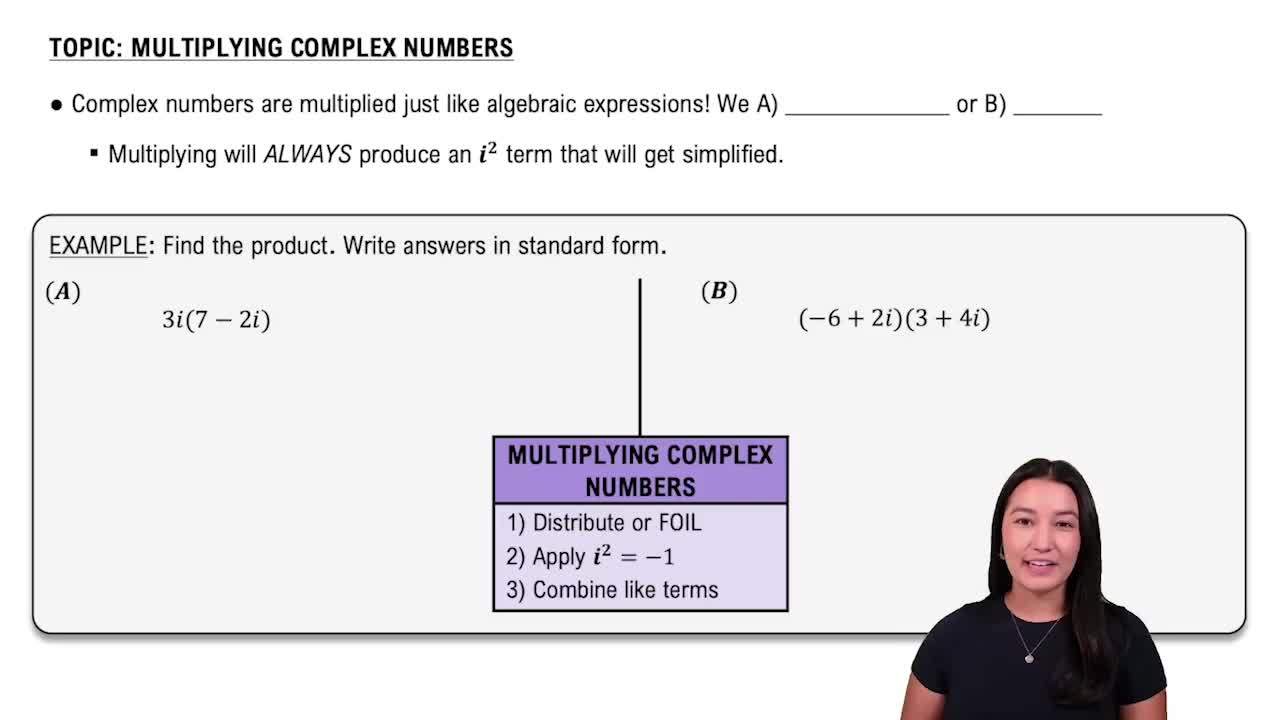
The Fundamental Theorem of Algebra states that a polynomial of degree n has exactly n roots in the complex number system, counting multiplicities. Complex numbers include real and imaginary parts, allowing solutions beyond real zeros when factoring over the reals is not possible.
Recommended video:
Multiplying Complex Numbers
Related Videos
Related Practice
Textbook Question
271
views