Find all complex zeros of each polynomial function. Give exact values. List multiple zeros as necessary.* ƒ(x)=x4+2x2+1
Table of contents
- 0. Review of Algebra4h 18m
- 1. Equations & Inequalities3h 18m
- 2. Graphs of Equations1h 43m
- 3. Functions2h 17m
- 4. Polynomial Functions1h 44m
- 5. Rational Functions1h 23m
- 6. Exponential & Logarithmic Functions2h 28m
- 7. Systems of Equations & Matrices4h 5m
- 8. Conic Sections2h 23m
- 9. Sequences, Series, & Induction1h 22m
- 10. Combinatorics & Probability1h 45m
4. Polynomial Functions
Zeros of Polynomial Functions
Problem 6
Textbook Question
Determine whether each statement is true or false. If false, explain why. The polynomial function has three variations in sign.
Verified step by step guidance1
Understand what "variations in sign" means: it refers to the number of times the signs of the coefficients of consecutive terms in the polynomial change when written in standard form.
Write down the polynomial function and list the signs of its coefficients in order: \(f(x) = 2x^5 + 3x^4 - 8x^3 - 5x + 6\); the coefficients are \$2\(, \)3\(, \)-8\(, \)-5\(, and \)6\( with signs \)+, +, -, -, +$ respectively.
Count the number of sign changes between consecutive coefficients: from \(+\) to \(+\) (no change), from \(+\) to \(-\) (one change), from \(-\) to \(-\) (no change), from \(-\) to \(+\) (second change). So, there are 2 sign changes.
Compare the counted number of sign changes (2) with the statement's claim (3): since they are not equal, the statement is false.
Explain why the statement is false: the polynomial has only 2 variations in sign, not 3, because the signs of the coefficients change only twice when moving from the highest degree term to the constant term.
Verified video answer for a similar problem:This video solution was recommended by our tutors as helpful for the problem above
Video duration:
2mPlay a video:
Was this helpful?
Key Concepts
Here are the essential concepts you must grasp in order to answer the question correctly.
Polynomial Function and Degree
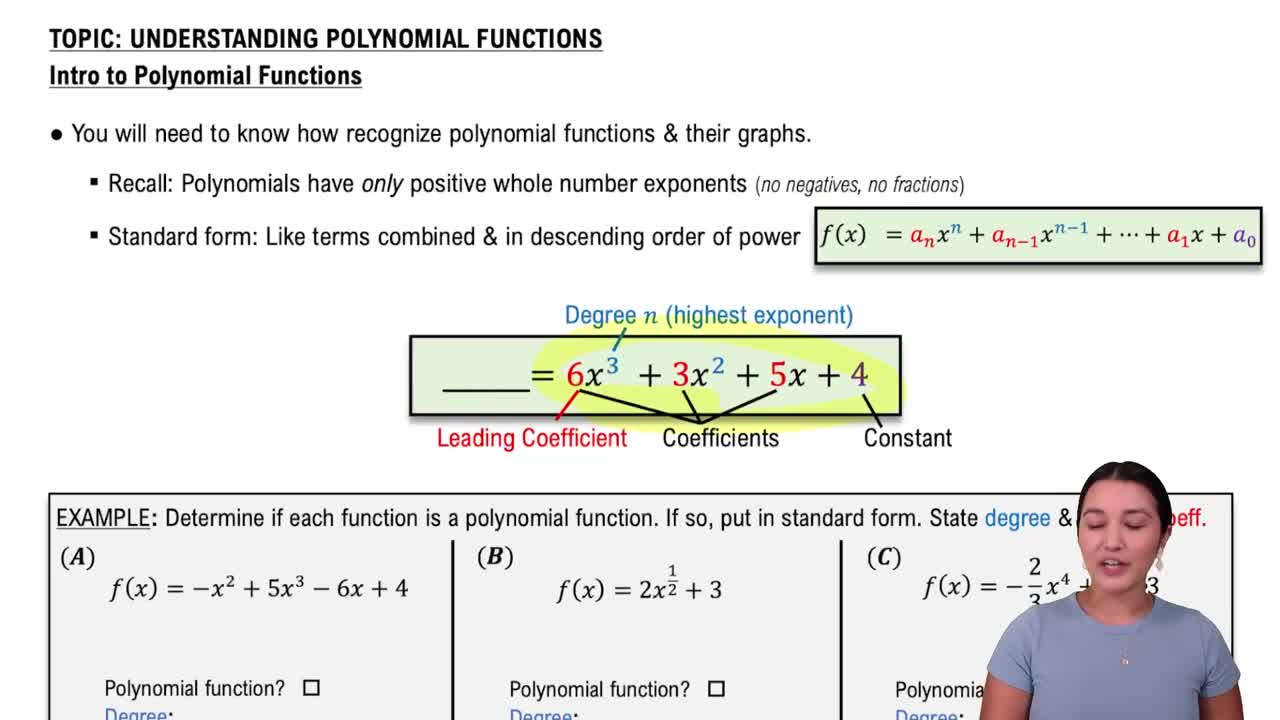
A polynomial function is an expression consisting of variables raised to whole-number exponents and coefficients. The degree of the polynomial is the highest exponent of the variable, which determines the general shape and behavior of the graph. For example, ƒ(x) = 2x^5 + 3x^4 - 8x^3 - 5x + 6 is a fifth-degree polynomial.
Recommended video:
Introduction to Polynomial Functions
Sign Variation of Polynomial Functions
Sign variation refers to the number of times the values of a polynomial change from positive to negative or vice versa as x varies. This is related to the number of real roots and the behavior of the function between those roots. Counting sign variations helps in understanding the number of times the graph crosses or touches the x-axis.
Recommended video:
Introduction to Polynomial Functions
Descartes' Rule of Signs
Descartes' Rule of Signs is a method to estimate the number of positive and negative real roots of a polynomial by counting the number of sign changes in the sequence of its coefficients. The maximum number of positive real roots equals the number of sign variations, and the number of negative real roots is found by applying the rule to ƒ(-x).
Recommended video:
Guided course
Cramer's Rule - 2 Equations with 2 Unknowns
Related Videos
Related Practice
Textbook Question
212
views