Table of contents
- 0. Review of Algebra4h 18m
- 1. Equations & Inequalities3h 18m
- 2. Graphs of Equations1h 43m
- 3. Functions2h 17m
- 4. Polynomial Functions1h 44m
- 5. Rational Functions1h 23m
- 6. Exponential & Logarithmic Functions2h 28m
- 7. Systems of Equations & Matrices4h 5m
- 8. Conic Sections2h 23m
- 9. Sequences, Series, & Induction1h 22m
- 10. Combinatorics & Probability1h 45m
4. Polynomial Functions
Zeros of Polynomial Functions
Problem 109
Textbook Question
Find all complex zeros of each polynomial function. Give exact values. List multiple zeros as necessary.* ƒ(x)=x4+2x2+1
Verified step by step guidance1
Recognize that the polynomial ƒ(x) = x^4 + 2x^2 + 1 is a quartic polynomial, but it can be treated as a quadratic in terms of x^2. To do this, let \( y = x^2 \). Then rewrite the polynomial as \( y^2 + 2y + 1 \).
Notice that the quadratic in \( y \) is \( y^2 + 2y + 1 \), which can be factored or recognized as a perfect square trinomial. Factor it as \( (y + 1)^2 \).
Set the factored form equal to zero to find the zeros in terms of \( y \): \( (y + 1)^2 = 0 \) which implies \( y + 1 = 0 \). Solve for \( y \) to get \( y = -1 \).
Recall that \( y = x^2 \), so substitute back to get \( x^2 = -1 \). To find \( x \), take the square root of both sides, remembering to include both positive and negative roots: \( x = \pm \sqrt{-1} \).
Since \( \sqrt{-1} = i \) (the imaginary unit), the complex zeros are \( x = i \) and \( x = -i \). Because the factor was squared, each zero has multiplicity 2, so list each zero twice.
Verified video answer for a similar problem:This video solution was recommended by our tutors as helpful for the problem above
Video duration:
4mPlay a video:
Was this helpful?
Key Concepts
Here are the essential concepts you must grasp in order to answer the question correctly.
Complex Zeros of Polynomial Functions
Complex zeros are values of x, possibly including imaginary numbers, that make the polynomial equal to zero. Finding all complex zeros involves solving the polynomial equation, which may require factoring or using formulas, and includes real and non-real solutions.
Recommended video:
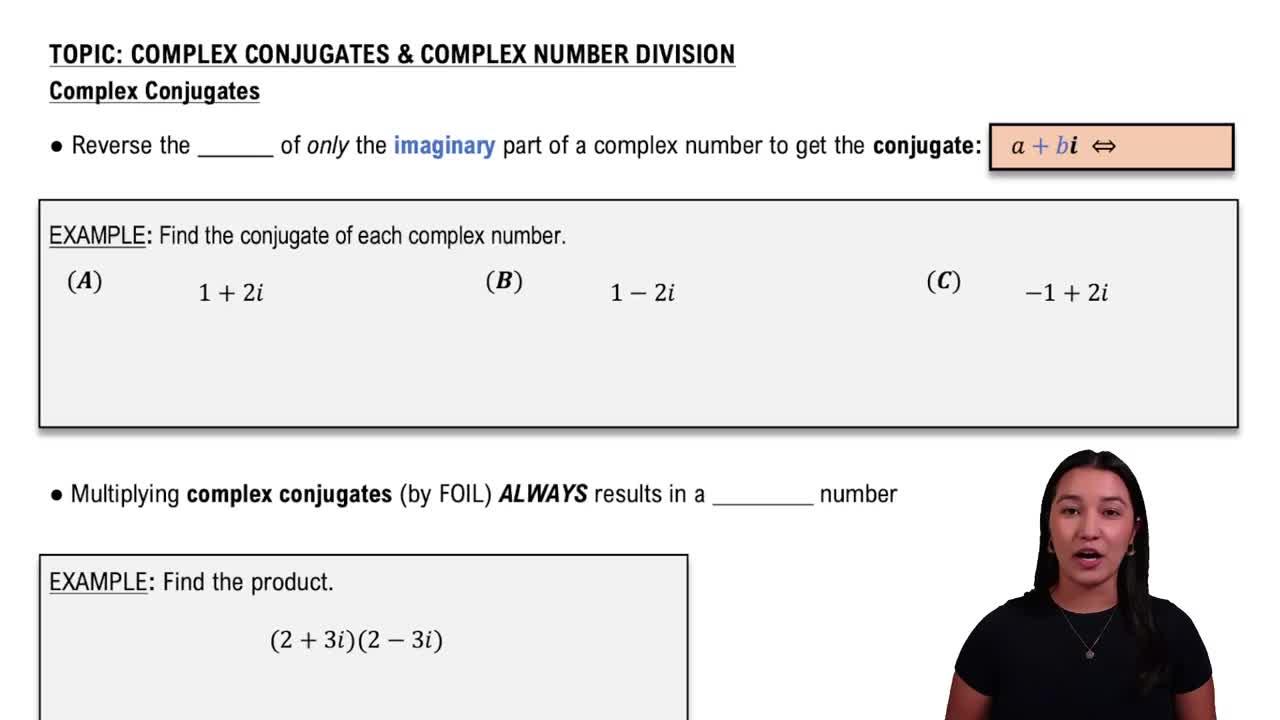
Complex Conjugates
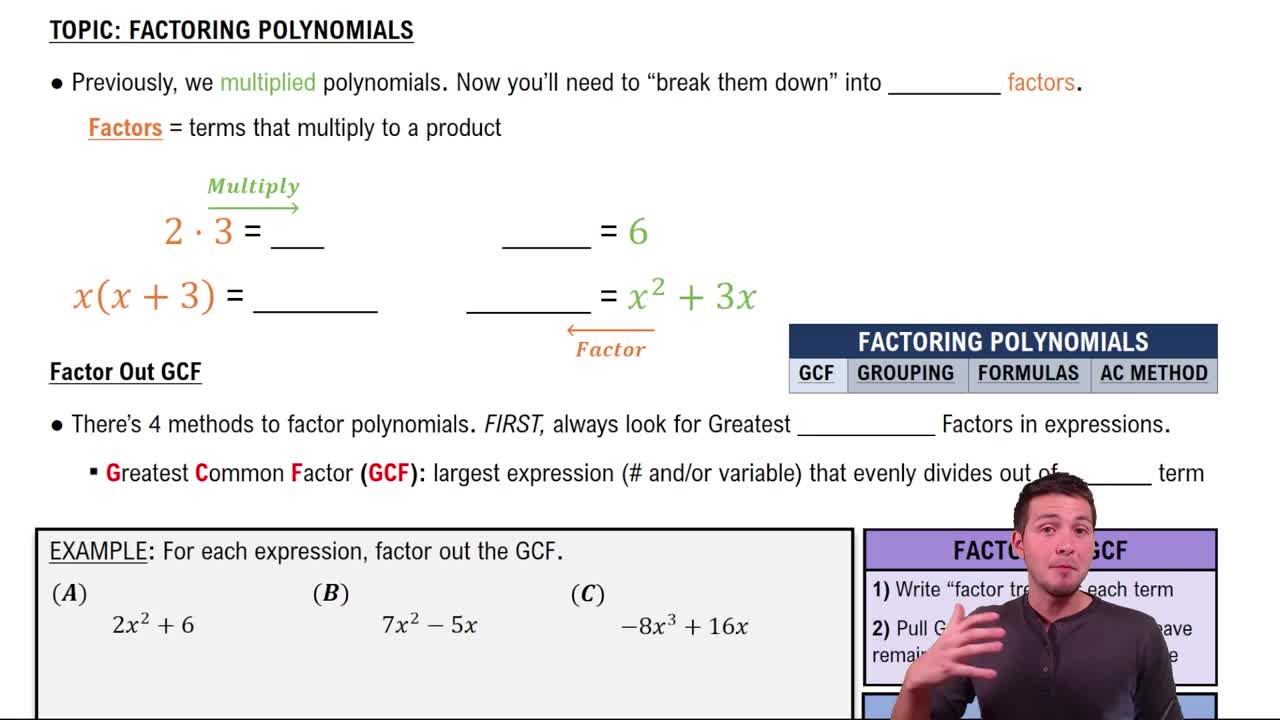
Factoring Polynomials
Factoring breaks down a polynomial into simpler polynomials whose product equals the original. For quartic polynomials like x⁴ + 2x² + 1, recognizing patterns such as quadratic forms or perfect squares helps simplify the problem and find zeros more easily.
Recommended video:
Guided course
Introduction to Factoring Polynomials
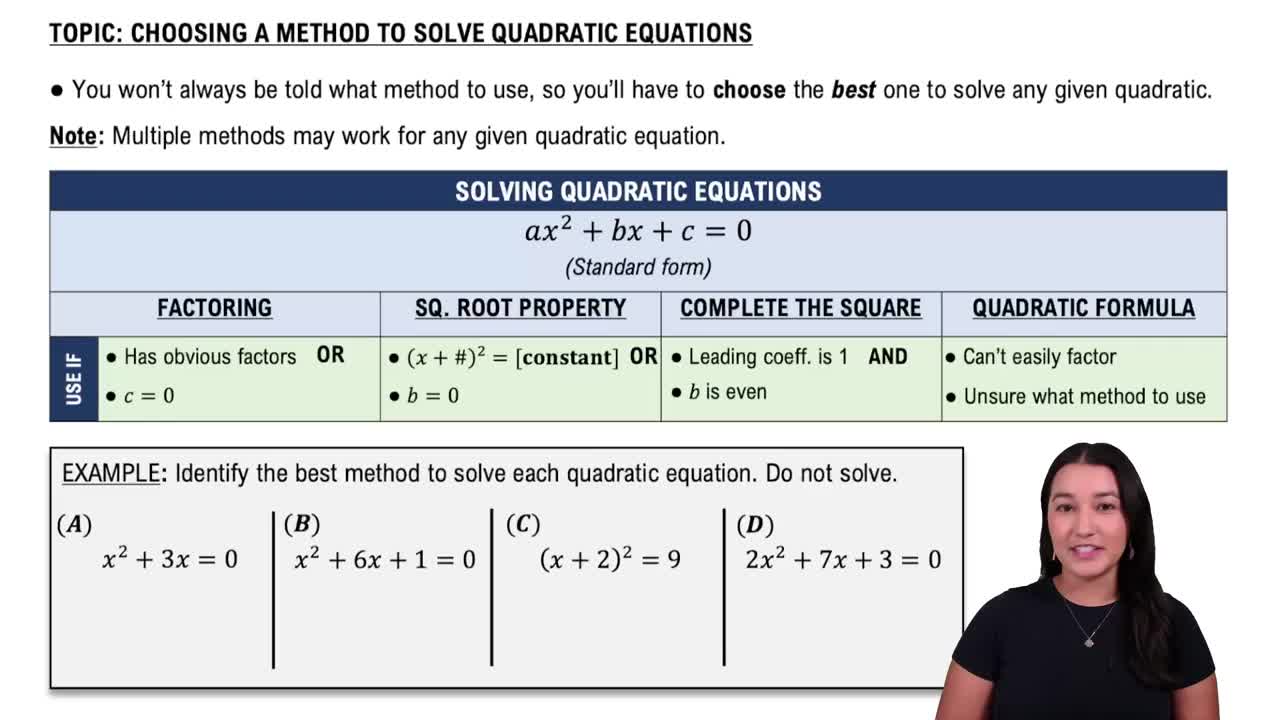
Quadratic Substitution Method
This method involves substituting a variable (e.g., y = x²) to transform a higher-degree polynomial into a quadratic form. Solving the quadratic in y and then back-substituting helps find the original variable's zeros, including complex ones.
Recommended video:
Choosing a Method to Solve Quadratics
Related Videos
Related Practice
Textbook Question
Determine the different possibilities for the numbers of positive, negative, and nonreal complex zeros of each function. See Example 7. ƒ(x)=-8x^4+3x^3-6x^2+5x-7
276
views