In Exercises 25–34, use mathematical induction to prove that each statement is true for every positive integer n. 6 is a factor of n(n + 1)(n + 2).
Table of contents
- 0. Review of Algebra4h 18m
- 1. Equations & Inequalities3h 18m
- 2. Graphs of Equations1h 43m
- 3. Functions2h 17m
- 4. Polynomial Functions1h 44m
- 5. Rational Functions1h 23m
- 6. Exponential & Logarithmic Functions2h 28m
- 7. Systems of Equations & Matrices4h 5m
- 8. Conic Sections2h 23m
- 9. Sequences, Series, & Induction1h 22m
- 10. Combinatorics & Probability1h 45m
9. Sequences, Series, & Induction
Sequences
Problem 33
Textbook Question
In Exercises 25–34, use mathematical induction to prove that each statement is true for every positive integer n. (ab)n = an bn
Verified step by step guidance1
Step 1: Understand the statement to prove: For every positive integer n, (ab)^n = a^n b^n. This means that raising the product of a and b to the power n is the same as raising each factor to the power n and then multiplying.
Step 2: Base Case: Verify the statement for n = 1. Substitute n = 1 into the equation to check if (ab)^1 = a^1 b^1 holds true.
Step 3: Inductive Hypothesis: Assume the statement is true for some positive integer k, that is, assume (ab)^k = a^k b^k.
Step 4: Inductive Step: Use the inductive hypothesis to prove the statement for n = k + 1. Express (ab)^{k+1} as (ab)^k * (ab) and then apply the inductive hypothesis to rewrite (ab)^k as a^k b^k.
Step 5: Simplify the expression (ab)^{k+1} = a^k b^k * ab = a^k * a * b^k * b = a^{k+1} b^{k+1}, which completes the inductive step and proves the statement for all positive integers n.
Verified video answer for a similar problem:This video solution was recommended by our tutors as helpful for the problem above
Video duration:
5mPlay a video:
Was this helpful?
Key Concepts
Here are the essential concepts you must grasp in order to answer the question correctly.
Mathematical Induction
Mathematical induction is a proof technique used to establish that a statement holds for all positive integers. It involves two steps: proving the base case (usually n=1) is true, and then proving that if the statement holds for an arbitrary integer k, it also holds for k+1. This creates a chain of truth for all n.
Recommended video:
Guided course
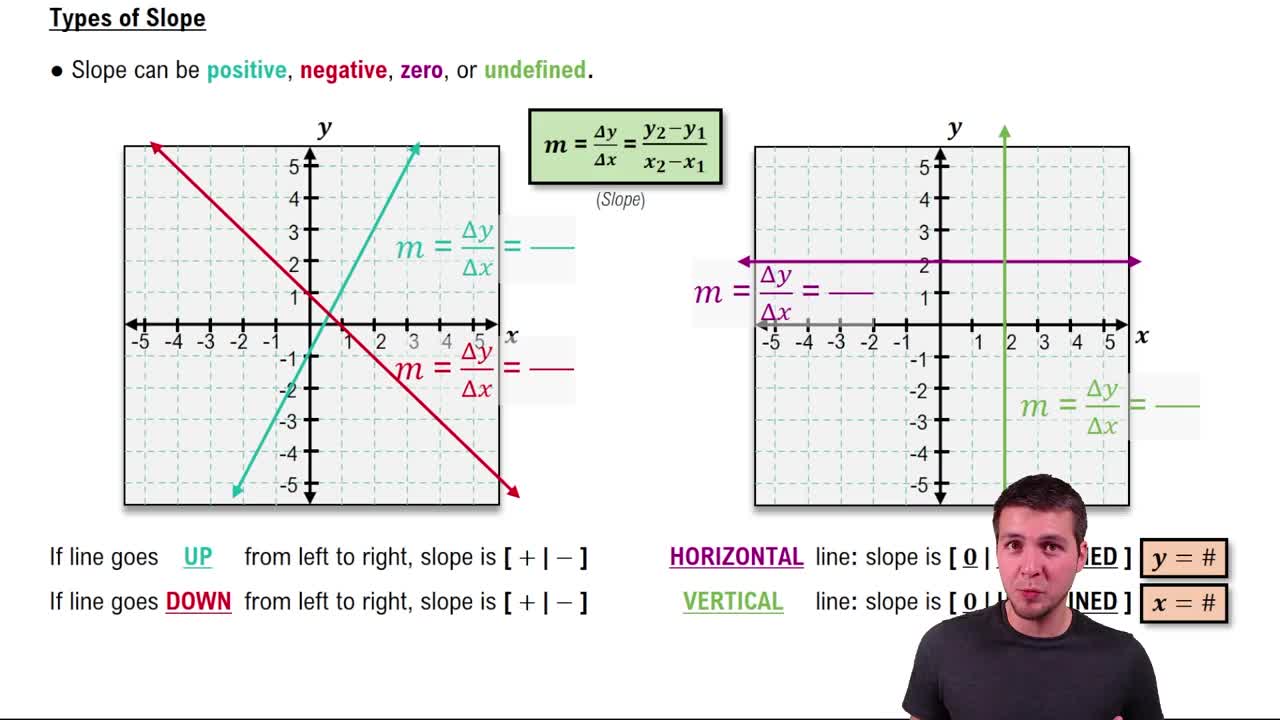
Types of Slope
Properties of Exponents
Properties of exponents describe how powers behave under multiplication and other operations. For example, (ab)^n = a^n b^n means raising a product to a power is the same as raising each factor to that power separately. Understanding these rules is essential to manipulate and simplify expressions involving exponents.
Recommended video:
Guided course
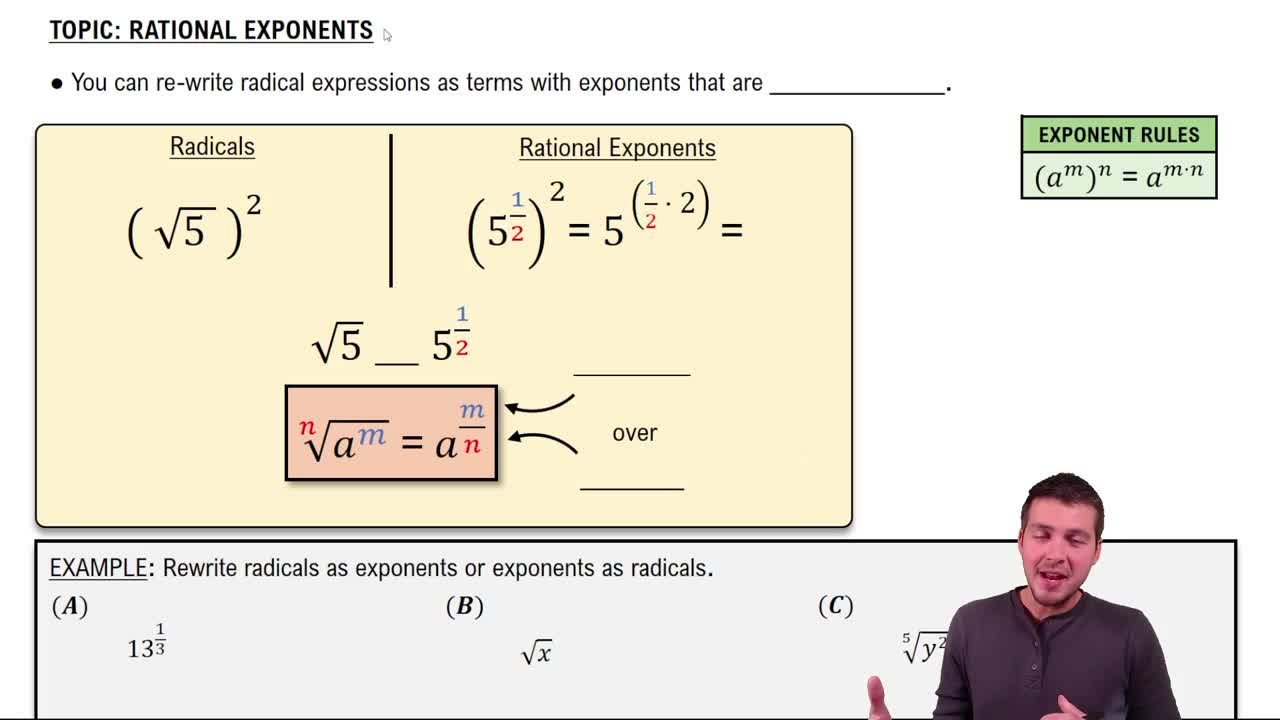
Rational Exponents
Algebraic Manipulation
Algebraic manipulation involves rearranging and simplifying expressions using algebraic rules. In this proof, it is important to correctly apply multiplication and exponent rules to show the inductive step holds. Careful manipulation ensures the logical flow from the assumption to the conclusion.
Recommended video:
Guided course
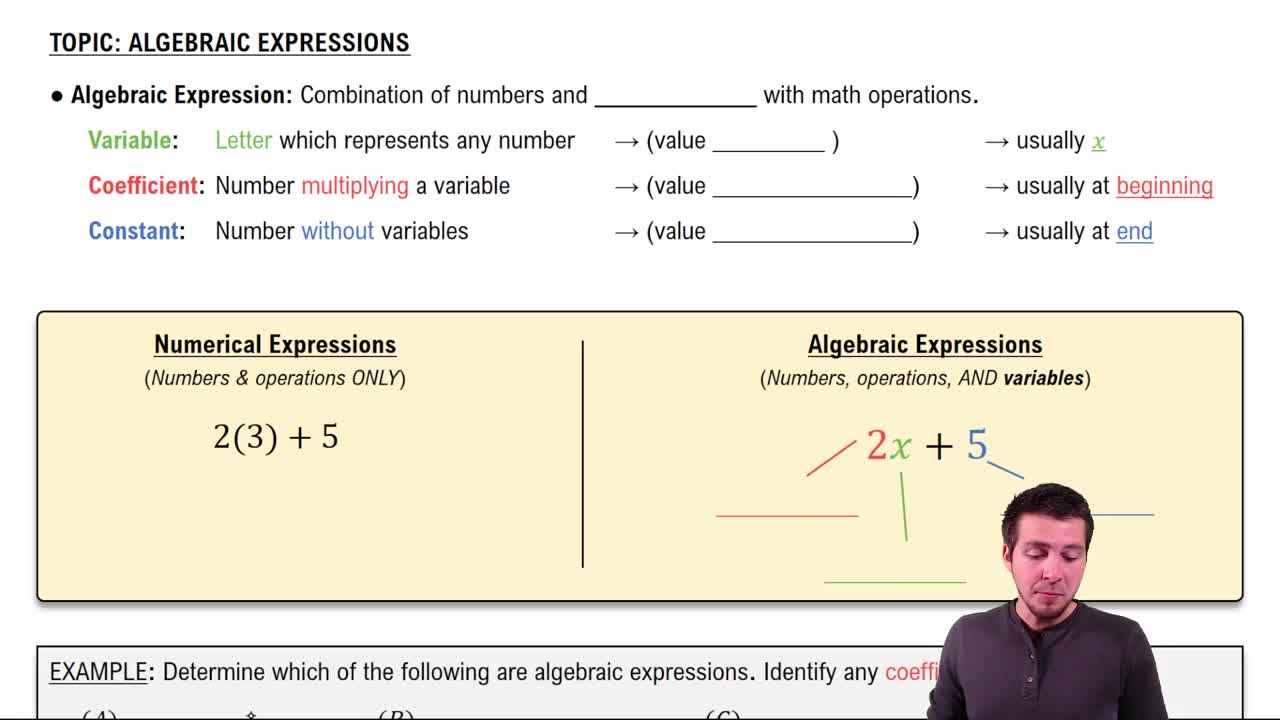
Introduction to Algebraic Expressions
Watch next
Master Introduction to Sequences with a bite sized video explanation from Patrick
Start learningRelated Videos
Related Practice
Textbook Question
486
views