In Exercises 77–92, use the graph to determine a. the function's domain; b. the function's range; and e. the missing function values, indicated by question marks, below each graph.
Table of contents
- 0. Review of Algebra4h 18m
- 1. Equations & Inequalities3h 18m
- 2. Graphs of Equations1h 43m
- 3. Functions2h 17m
- 4. Polynomial Functions1h 44m
- 5. Rational Functions1h 23m
- 6. Exponential & Logarithmic Functions2h 28m
- 7. Systems of Equations & Matrices4h 5m
- 8. Conic Sections2h 23m
- 9. Sequences, Series, & Induction1h 22m
- 10. Combinatorics & Probability1h 45m
3. Functions
Intro to Functions & Their Graphs
Problem 60
Textbook Question
Complete the square and write the equation in standard form. Then give the center and radius of each circle and graph the equation. x² + y² - 6y -7=0
Verified step by step guidance1
Start with the given equation: \(x^{2} + y^{2} - 6y - 7 = 0\).
Group the \(y\) terms together and isolate the constant on the other side: \(x^{2} + (y^{2} - 6y) = 7\).
Complete the square for the \(y\) terms. Take half of the coefficient of \(y\), which is \(-6\), divide by 2 to get \(-3\), then square it to get \$9\(. Add \)9\( to both sides to keep the equation balanced: \)x^{2} + (y^{2} - 6y + 9) = 7 + 9$.
Rewrite the perfect square trinomial as a binomial squared: \(x^{2} + (y - 3)^{2} = 16\).
Identify the center and radius of the circle from the standard form \((x - h)^{2} + (y - k)^{2} = r^{2}\). Here, the center is \((0, 3)\) and the radius is \(\sqrt{16}\).
Verified video answer for a similar problem:This video solution was recommended by our tutors as helpful for the problem above
Video duration:
5mPlay a video:
Was this helpful?
Key Concepts
Here are the essential concepts you must grasp in order to answer the question correctly.
Completing the Square
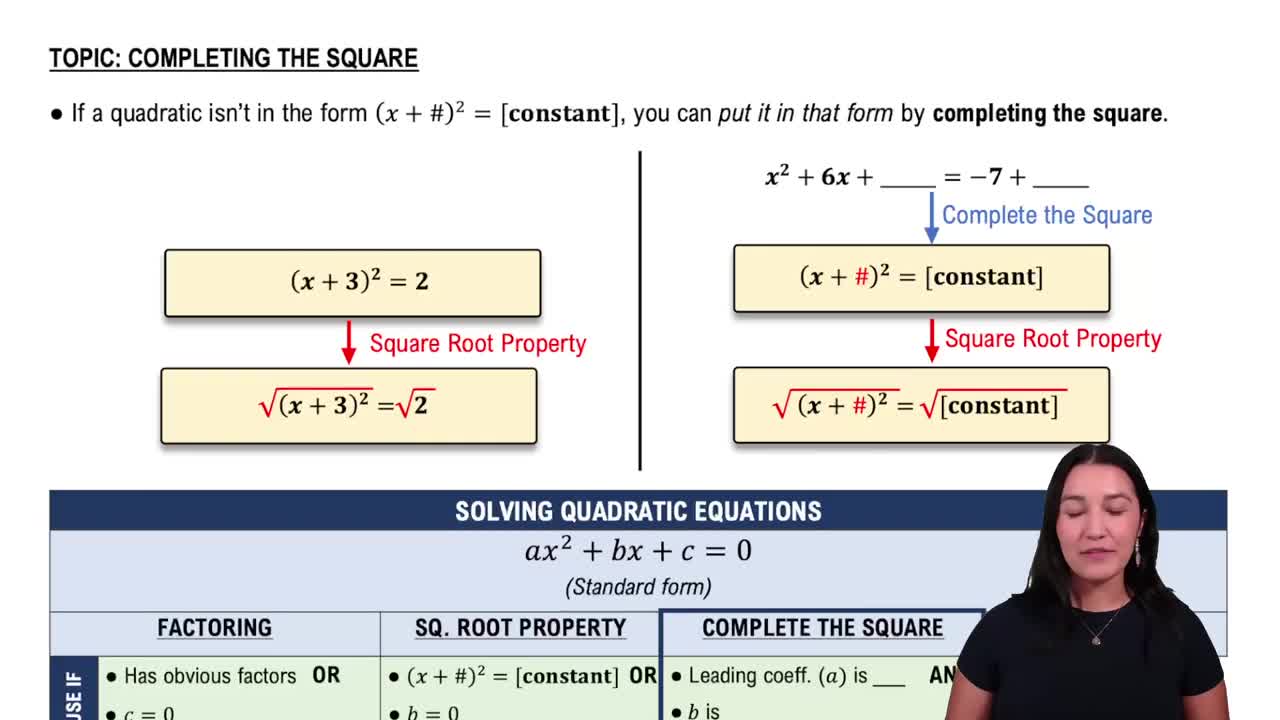
Completing the square is a method used to rewrite quadratic expressions in the form (x - h)² or (y - k)² by adding and subtracting a constant. This technique helps transform the equation of a circle into its standard form, making it easier to identify key features like the center and radius.
Recommended video:
Solving Quadratic Equations by Completing the Square
Standard Form of a Circle
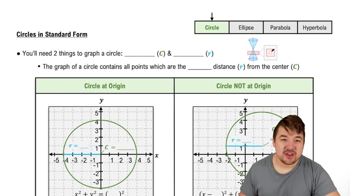
The standard form of a circle's equation is (x - h)² + (y - k)² = r², where (h, k) is the center and r is the radius. Writing the equation in this form allows direct identification of the circle's center coordinates and radius, which are essential for graphing.
Recommended video:
Circles in Standard Form
Graphing Circles
Graphing a circle involves plotting its center (h, k) on the coordinate plane and using the radius r to mark points equidistant from the center. Understanding how to interpret the standard form equation enables accurate sketching of the circle's shape and position.
Recommended video:
Circles in Standard Form
Watch next
Master Relations and Functions with a bite sized video explanation from Patrick
Start learningRelated Videos
Related Practice
Textbook Question
577
views