Show that each polynomial function has a real zero as described in parts (a) and (b). In Exercises 31 and 32, also work part (c). ƒ(x)=4x^3-37x^2+50x+60 Find the zero in part (b) to three decimal places.
Table of contents
- 0. Review of Algebra4h 18m
- 1. Equations & Inequalities3h 18m
- 2. Graphs of Equations1h 43m
- 3. Functions2h 17m
- 4. Polynomial Functions1h 44m
- 5. Rational Functions1h 23m
- 6. Exponential & Logarithmic Functions2h 28m
- 7. Systems of Equations & Matrices4h 5m
- 8. Conic Sections2h 23m
- 9. Sequences, Series, & Induction1h 22m
- 10. Combinatorics & Probability1h 45m
4. Polynomial Functions
Zeros of Polynomial Functions
Problem 47
Textbook Question
In Exercises 47–48, find an nth-degree polynomial function with real coefficients satisfying the given conditions. Verify the real zeros and the given function value. n = 3; 2 and 2 - 3i are zeros; f(1) = -10
Verified step by step guidance1
Identify the given zeros of the polynomial. Since the polynomial has real coefficients and one zero is complex (2 - 3i), its complex conjugate (2 + 3i) must also be a zero. So, the zeros are 2, 2 - 3i, and 2 + 3i.
Write the polynomial in factored form using the zeros: \(f(x) = a(x - 2)(x - (2 - 3i))(x - (2 + 3i))\), where \(a\) is a real number coefficient to be determined.
Simplify the product of the complex conjugate factors: \((x - (2 - 3i))(x - (2 + 3i))\) can be expanded using the difference of squares formula for complex conjugates: \((x - 2)^2 - (3i)^2\).
Calculate the simplified quadratic factor: \((x - 2)^2 - (3i)^2 = (x - 2)^2 - (-9) = (x - 2)^2 + 9\). So the polynomial becomes \(f(x) = a(x - 2)((x - 2)^2 + 9)\).
Use the given function value \(f(1) = -10\) to find \(a\). Substitute \(x = 1\) into the polynomial and solve for \(a\): \(f(1) = a(1 - 2)((1 - 2)^2 + 9) = -10\).
Verified video answer for a similar problem:This video solution was recommended by our tutors as helpful for the problem above
Video duration:
11mPlay a video:
Was this helpful?
Key Concepts
Here are the essential concepts you must grasp in order to answer the question correctly.
Polynomial Zeros and Their Multiplicity
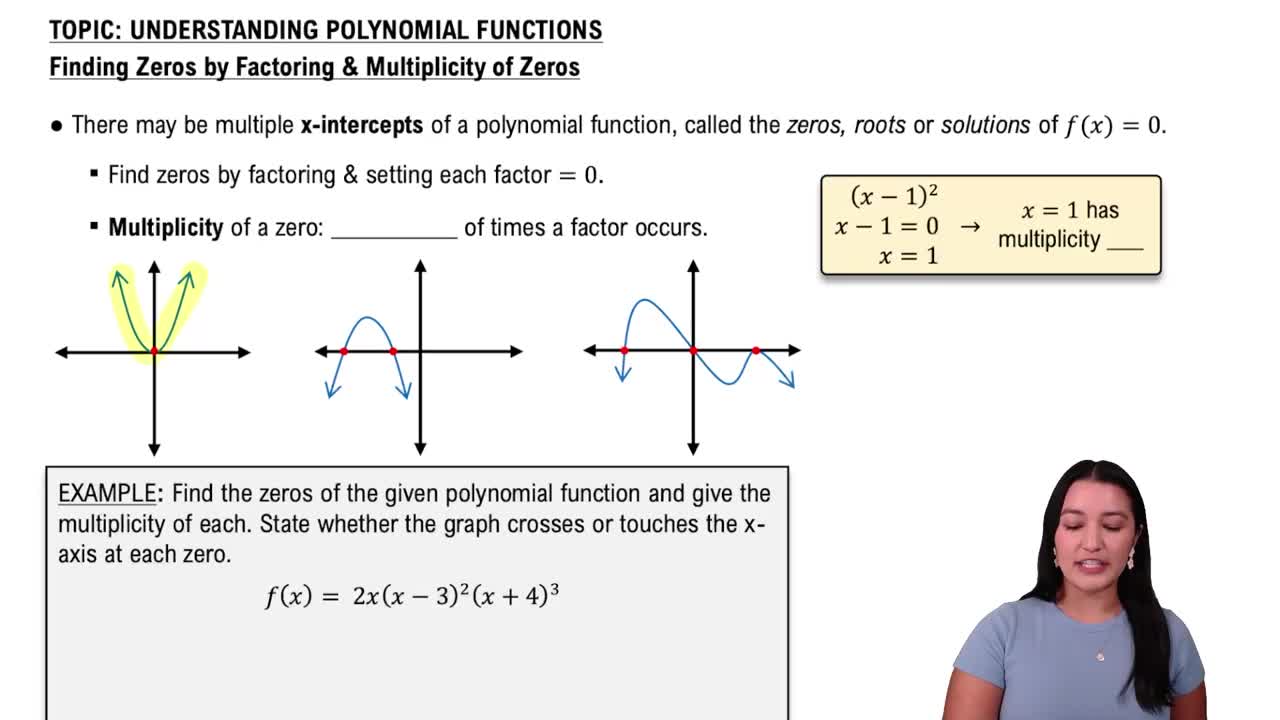
Zeros of a polynomial are the values of x that make the polynomial equal to zero. For an nth-degree polynomial, there are n zeros (counting multiplicities). Understanding zeros helps in constructing the polynomial by forming factors like (x - zero).
Recommended video:
Finding Zeros & Their Multiplicity
Complex Conjugate Root Theorem
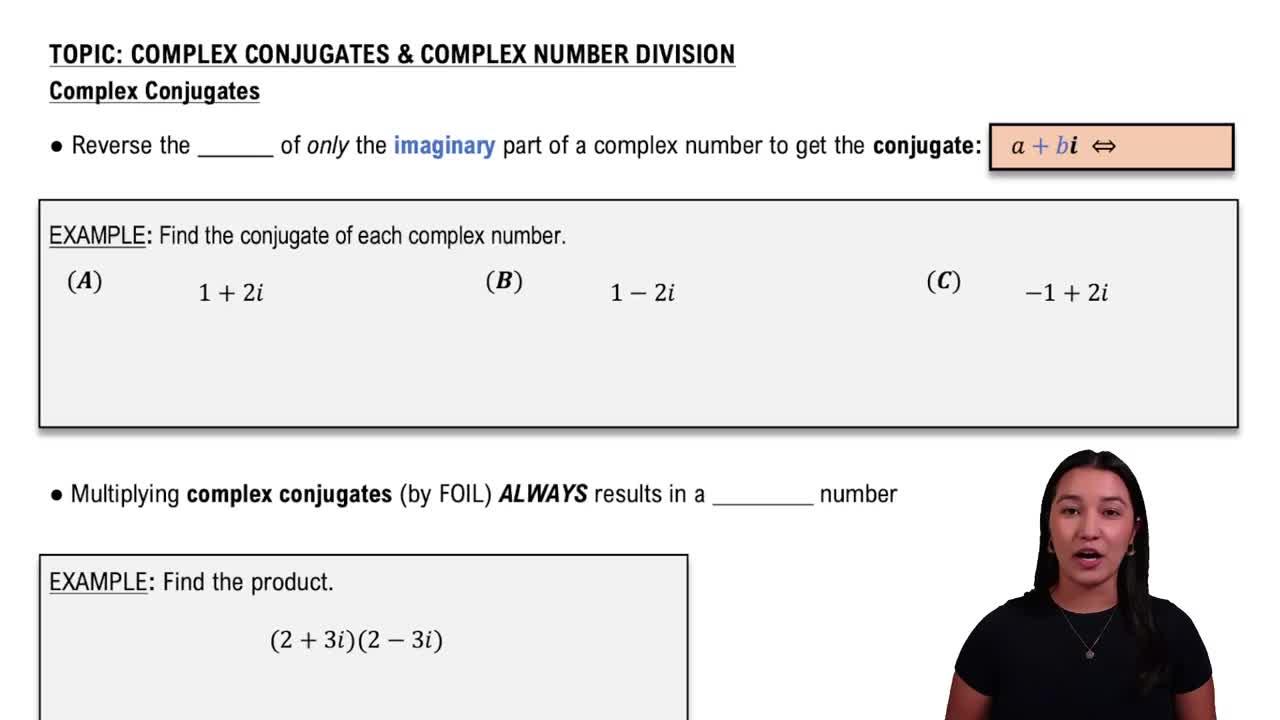
If a polynomial has real coefficients and a complex zero a + bi, then its conjugate a - bi is also a zero. This ensures the polynomial remains with real coefficients. For example, if 2 - 3i is a zero, then 2 + 3i must also be a zero.
Recommended video:
Complex Conjugates
Using Given Function Values to Find Leading Coefficient
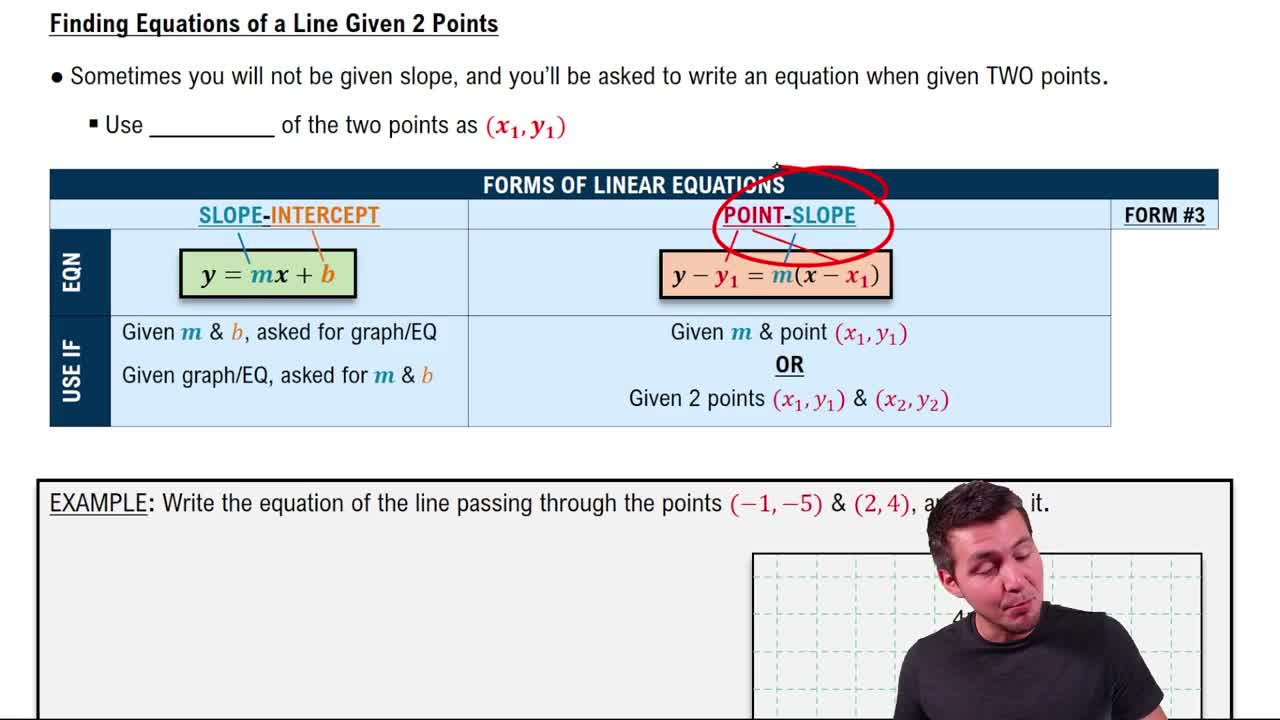
After forming the polynomial from its zeros, the leading coefficient can be found by substituting a given x-value and its corresponding function value into the polynomial. This step ensures the polynomial satisfies all given conditions.
Recommended video:
Guided course
Finding Equations of Lines Given Two Points
Related Videos
Related Practice
Textbook Question
250
views
