Find the inverse of f(x)=(x−10)/(x+10).
Table of contents
- 0. Review of Algebra4h 18m
- 1. Equations & Inequalities3h 18m
- 2. Graphs of Equations1h 43m
- 3. Functions2h 17m
- 4. Polynomial Functions1h 44m
- 5. Rational Functions1h 23m
- 6. Exponential & Logarithmic Functions2h 28m
- 7. Systems of Equations & Matrices4h 5m
- 8. Conic Sections2h 23m
- 9. Sequences, Series, & Induction1h 22m
- 10. Combinatorics & Probability1h 45m
3. Functions
Function Composition
Problem 15
Textbook Question
The functions in Exercises 11-28 are all one-to-one. For each function, a. Find an equation for f-1(x), the inverse function. b. Verify that your equation is correct by showing that f(ƒ-1 (x)) = = x and ƒ-1 (f(x)) = x. f(x) = 2x + 3
Verified step by step guidance1
Start with the given function: \(f(x) = 2x + 3\). To find the inverse function \(f^{-1}(x)\), first replace \(f(x)\) with \(y\): \(y = 2x + 3\).
Next, swap the roles of \(x\) and \(y\) to find the inverse: \(x = 2y + 3\). This means we are solving for \(y\) in terms of \(x\).
Isolate \(y\) by subtracting 3 from both sides: \(x - 3 = 2y\). Then, divide both sides by 2 to solve for \(y\): \(y = \frac{x - 3}{2}\).
Rewrite \(y\) as the inverse function notation: \(f^{-1}(x) = \frac{x - 3}{2}\). This is the formula for the inverse function.
To verify the inverse, compute \(f(f^{-1}(x))\) by substituting \(f^{-1}(x)\) into \(f(x)\) and simplify to check if it equals \(x\). Then compute \(f^{-1}(f(x))\) by substituting \(f(x)\) into \(f^{-1}(x)\) and simplify to check if it equals \(x\).
Verified video answer for a similar problem:This video solution was recommended by our tutors as helpful for the problem above
Video duration:
2mPlay a video:
Was this helpful?
Key Concepts
Here are the essential concepts you must grasp in order to answer the question correctly.
One-to-One Functions
A one-to-one function assigns each input a unique output and vice versa, ensuring that the function has an inverse. This property is essential because only one-to-one functions can be inverted, meaning each output corresponds to exactly one input.
Recommended video:
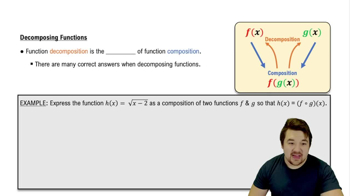
Decomposition of Functions
Finding the Inverse Function
To find the inverse of a function, swap the roles of x and y in the equation and solve for y. This process reverses the original function's operations, allowing you to express the inverse function f⁻¹(x) that 'undoes' f(x).
Recommended video:
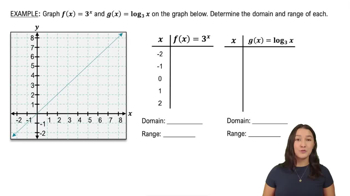
Graphing Logarithmic Functions
Verification of Inverse Functions
Verifying an inverse involves showing that composing the function and its inverse returns the original input: f(f⁻¹(x)) = x and f⁻¹(f(x)) = x. This confirms that the two functions are true inverses, effectively reversing each other's effects.
Recommended video:
Graphing Logarithmic Functions
Watch next
Master Function Composition with a bite sized video explanation from Patrick
Start learningRelated Videos
Related Practice
Textbook Question
414
views