The functions in Exercises 11-28 are all one-to-one. For each function, a. Find an equation for f-1(x), the inverse function. b. Verify that your equation is correct by showing that f(ƒ-1 (x)) = = x and ƒ-1 (f(x)) = x. f(x) = x³ +2
Table of contents
- 0. Review of Algebra4h 18m
- 1. Equations & Inequalities3h 18m
- 2. Graphs of Equations1h 43m
- 3. Functions2h 17m
- 4. Polynomial Functions1h 44m
- 5. Rational Functions1h 23m
- 6. Exponential & Logarithmic Functions2h 28m
- 7. Systems of Equations & Matrices4h 5m
- 8. Conic Sections2h 23m
- 9. Sequences, Series, & Induction1h 22m
- 10. Combinatorics & Probability1h 45m
3. Functions
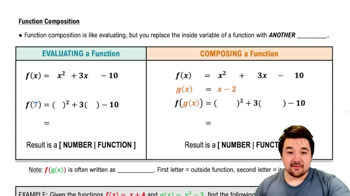
Function Composition
Problem 10
Textbook Question
Find f(g(x)) and g (f(x)) and determine whether each pair of functions ƒ and g are inverses of each other. f(x) = ∛(x − 4) and g(x) = x³ +4
Verified step by step guidance1
First, recall that the composition of functions f(g(x)) means substituting g(x) into f(x). So, write down f(g(x)) as f(g(x)) = \sqrt[3]{g(x) - 4}.
Next, substitute g(x) = x^3 + 4 into the expression for f(g(x)), giving f(g(x)) = \sqrt[3]{(x^3 + 4) - 4}.
Simplify the expression inside the cube root: (x^3 + 4) - 4 simplifies to x^3, so f(g(x)) = \sqrt[3]{x^3}.
Now, recall that the cube root of x cubed is just x, so f(g(x)) simplifies to x.
Next, find g(f(x)) by substituting f(x) into g(x). Write g(f(x)) = (f(x))^3 + 4, then substitute f(x) = \sqrt[3]{x - 4} to get g(f(x)) = (\sqrt[3]{x - 4})^3 + 4. Simplify this expression to check if it equals x.
Verified video answer for a similar problem:This video solution was recommended by our tutors as helpful for the problem above
Video duration:
1mPlay a video:
Was this helpful?
Key Concepts
Here are the essential concepts you must grasp in order to answer the question correctly.
Function Composition
Function composition involves applying one function to the result of another, denoted as f(g(x)) or g(f(x)). It requires substituting the entire expression of one function into the variable of the other, allowing us to analyze how functions combine and transform inputs.
Recommended video:
Function Composition
Inverse Functions
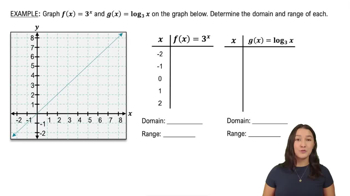
Inverse functions reverse the effect of each other, meaning f(g(x)) = x and g(f(x)) = x for all x in the domains. Identifying inverses involves checking if composing the functions in both orders returns the original input, confirming they undo each other's operations.
Recommended video:
Graphing Logarithmic Functions
Cube Roots and Cubes
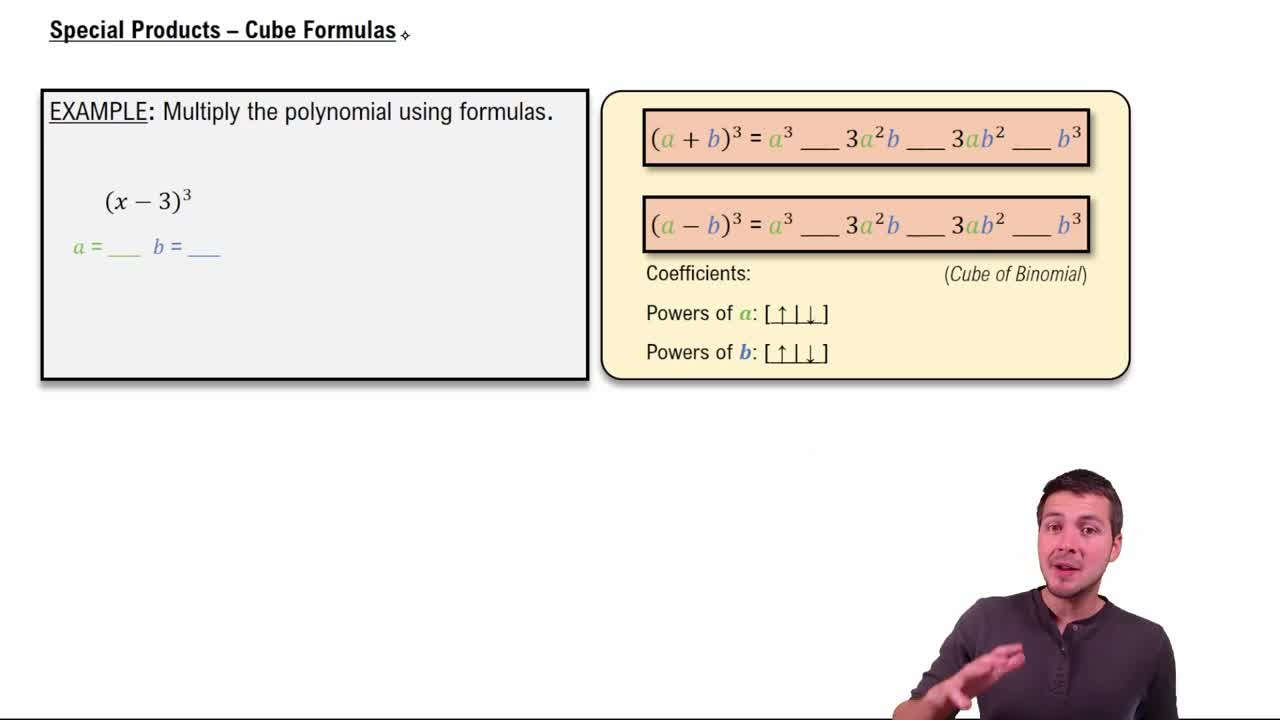
The cube root function, ∛x, and the cube function, x³, are inverse operations. Understanding how these functions interact, especially with shifts like (x - 4) or +4, is essential to correctly compose and verify if two functions are inverses.
Recommended video:
Guided course
Special Products - Cube Formulas
Watch next
Master Function Composition with a bite sized video explanation from Patrick
Start learningRelated Videos
Related Practice
Textbook Question
500
views