Evaluate each expression without using a calculator. log5 (1/5)
Verified step by step guidance
1
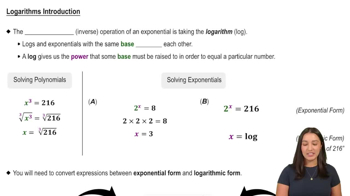
Recall the definition of logarithm: \(\log_b a = c\) means \(b^c = a\).
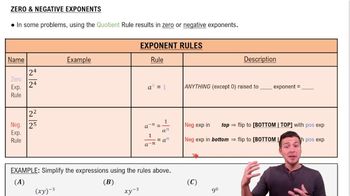
Rewrite the expression \(\log_5 \left( \frac{1}{5} \right)\) as \(\log_5 5^{-1}\) because \(\frac{1}{5}\) is the same as \$5^{-1}$.
Use the logarithm power rule: \(\log_b (a^n) = n \log_b a\) to rewrite \(\log_5 5^{-1}\) as \(-1 \cdot \log_5 5\).
Since \(\log_5 5 = 1\) (because \$5^1 = 5$), substitute this value back into the expression.
Multiply \(-1\) by \(1\) to find the value of the logarithm expression.
Verified video answer for a similar problem:
This video solution was recommended by our tutors as helpful for the problem above
Video duration:
2m
Play a video:
0 Comments
Key Concepts
Here are the essential concepts you must grasp in order to answer the question correctly.
Definition of Logarithms
A logarithm answers the question: to what exponent must the base be raised to produce a given number? For example, log_b(a) = c means b^c = a. Understanding this definition is essential to evaluate logarithmic expressions.
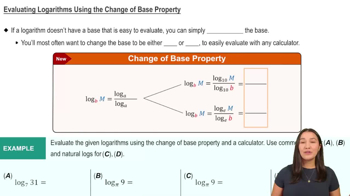
Logarithms have key properties such as log_b(1) = 0 because any base raised to 0 equals 1, and log_b(b) = 1 since the base raised to 1 is itself. These properties help simplify expressions without a calculator.
A fraction like 1/5 can be written as 5^(-1). Using this, log_5(1/5) becomes log_5(5^(-1)), which simplifies to -1 by the definition of logarithms. Recognizing negative exponents is key to evaluating such expressions.

 2:05 minutes
 Verified step by step guidance
 7:30
7:30