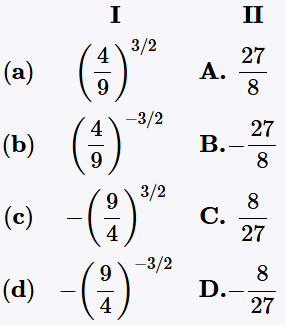
Match each expression in Column I with its equivalent expression in Column II.
Verified step by step guidance
1
Step 1: Understand that expressions with fractional exponents like \(a^{m/n}\) can be rewritten as \(\left(\sqrt[n]{a}\right)^m\) or \(\sqrt[n]{a^m}\). This helps simplify the expressions.
Step 2: For each expression in Column I, rewrite the base and exponent to identify its simplified form. For example, \((4/9)^{3/2}\) can be seen as \(\left(\sqrt{4/9}\right)^3\).
Step 3: Calculate the square root of the base inside the parentheses. For \((4/9)\), \(\sqrt{4/9} = 2/3\). Then raise this result to the power of 3: \((2/3)^3\).
Step 4: For negative exponents like \((4/9)^{-3/2}\), recall that \(a^{-m} = \frac{1}{a^m}\). So rewrite the expression as the reciprocal of the positive exponent form.
Step 5: Pay attention to the negative signs outside the expressions in parts c and d, which will affect the final sign of the simplified value. After simplifying the magnitude, apply the negative sign accordingly.
Verified video answer for a similar problem:
This video solution was recommended by our tutors as helpful for the problem above
Video duration:
13m
Play a video:
Key Concepts
Here are the essential concepts you must grasp in order to answer the question correctly.
Rational Exponents
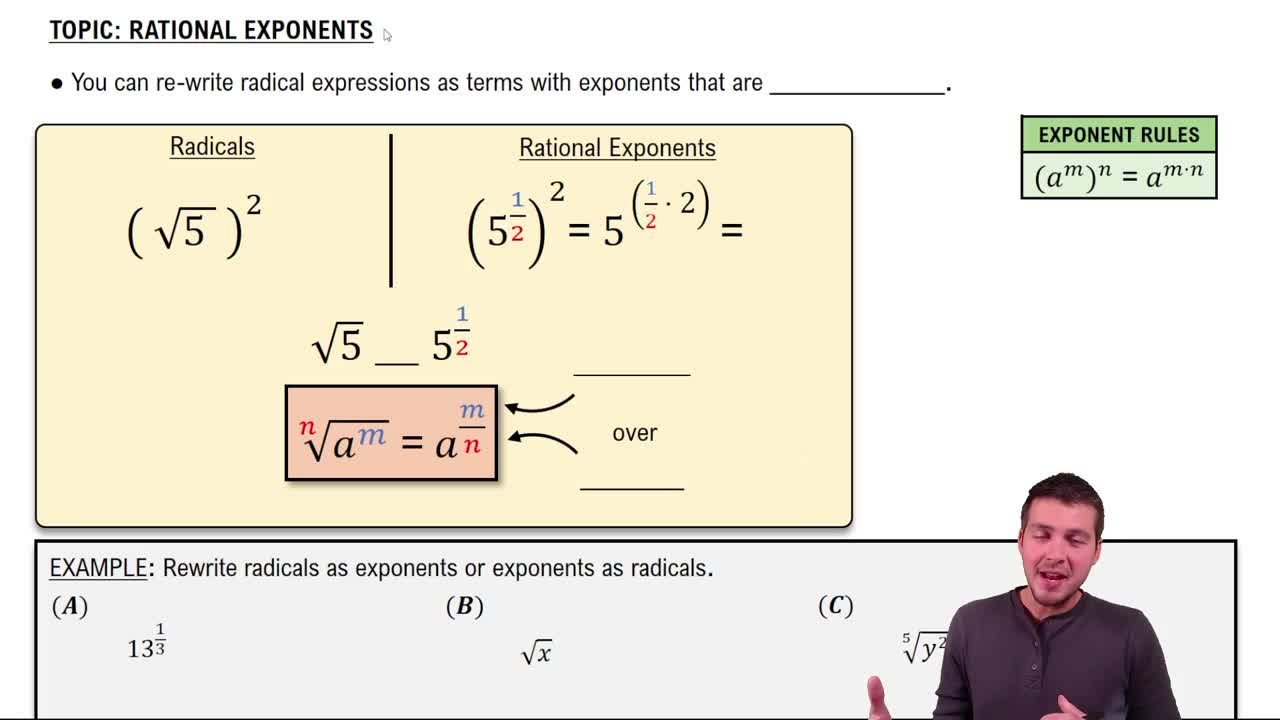
Rational exponents represent roots and powers simultaneously. For example, a^(m/n) means the nth root of a raised to the mth power. Understanding how to simplify expressions with fractional exponents is essential for matching equivalent forms.
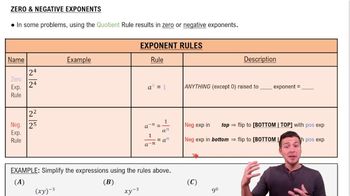
A negative exponent indicates the reciprocal of the base raised to the corresponding positive exponent. For instance, a^(-m) = 1/(a^m). Recognizing this helps convert expressions with negative exponents into more familiar fractional forms.
Applying exponent rules, such as (a/b)^m = a^m / b^m, allows simplification of complex expressions. Combining these with sign considerations (positive or negative) is crucial to correctly match expressions with their equivalents.