Among all pairs of numbers whose sum is 16, find a pair whose product is as large as possible. What is the maximum product?
Table of contents
- 0. Review of Algebra4h 18m
- 1. Equations & Inequalities3h 18m
- 2. Graphs of Equations1h 43m
- 3. Functions2h 17m
- 4. Polynomial Functions1h 44m
- 5. Rational Functions1h 23m
- 6. Exponential & Logarithmic Functions2h 28m
- 7. Systems of Equations & Matrices4h 5m
- 8. Conic Sections2h 23m
- 9. Sequences, Series, & Induction1h 22m
- 10. Combinatorics & Probability1h 45m
4. Polynomial Functions
Quadratic Functions
Problem 82
Textbook Question
For what values of a does y = ax2 - 8x + 4 have no x-intercepts?
Verified step by step guidance1
Recall that the x-intercepts of a quadratic function \(y = ax^2 + bx + c\) occur where \(y = 0\). So, set the equation equal to zero: \(ax^2 - 8x + 4 = 0\).
To determine the number of x-intercepts, analyze the discriminant of the quadratic equation, which is given by \(\Delta = b^2 - 4ac\).
Identify the coefficients: here, \(a = a\) (the parameter we want to find), \(b = -8\), and \(c = 4\). Substitute these into the discriminant formula: \(\Delta = (-8)^2 - 4 \cdot a \cdot 4\).
Simplify the discriminant expression: \(\Delta = 64 - 16a\).
For the quadratic to have no x-intercepts, the discriminant must be less than zero: \$64 - 16a < 0\(. Solve this inequality for \)a\( to find the values of \)a$ that make the parabola not cross the x-axis.
Verified video answer for a similar problem:This video solution was recommended by our tutors as helpful for the problem above
Video duration:
5mPlay a video:
Was this helpful?
Key Concepts
Here are the essential concepts you must grasp in order to answer the question correctly.
Quadratic Functions and Their Graphs
A quadratic function is a polynomial of degree two, typically written as y = ax^2 + bx + c. Its graph is a parabola that opens upward if a > 0 and downward if a < 0. Understanding the shape and position of the parabola helps analyze its intercepts and other properties.
Recommended video:
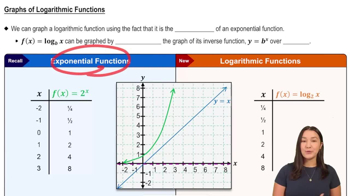
Graphs of Logarithmic Functions
X-Intercepts of a Quadratic Function
X-intercepts are points where the graph crosses the x-axis, found by setting y = 0 and solving the quadratic equation ax^2 + bx + c = 0. The number of x-intercepts depends on the nature of the roots of this equation, which can be two, one, or none.
Recommended video:
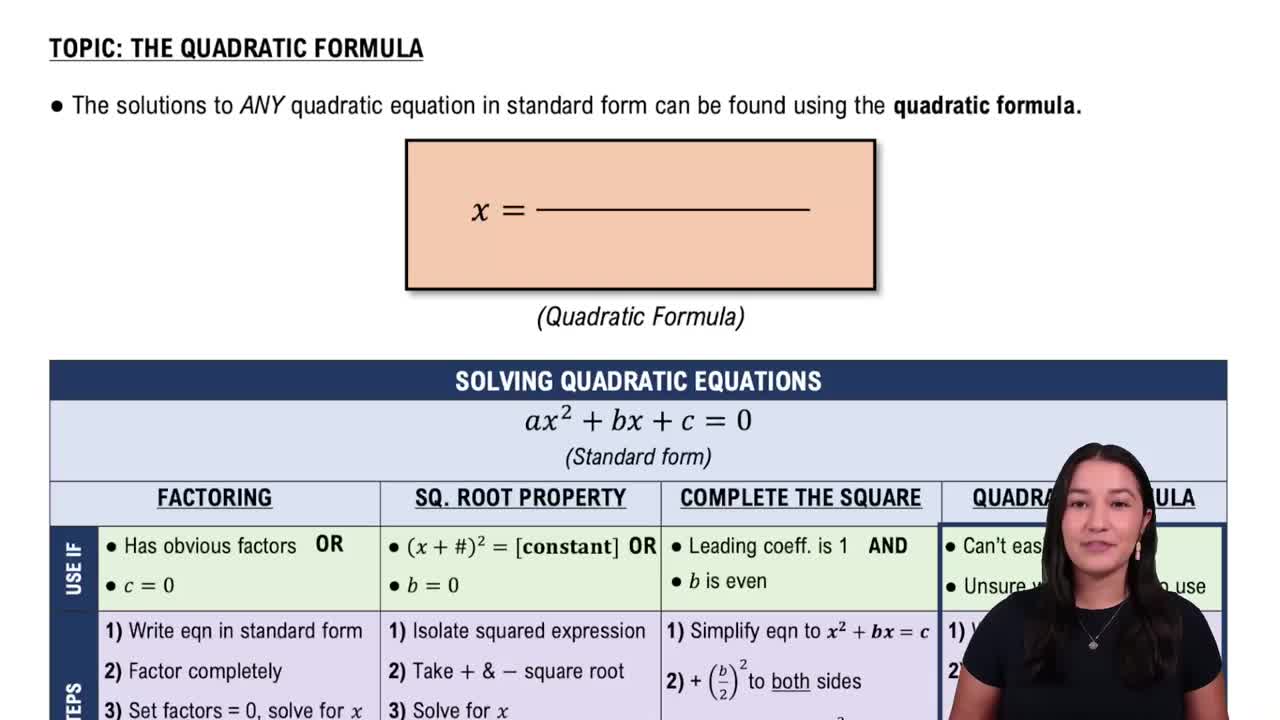
Solving Quadratic Equations Using The Quadratic Formula
Discriminant and Nature of Roots
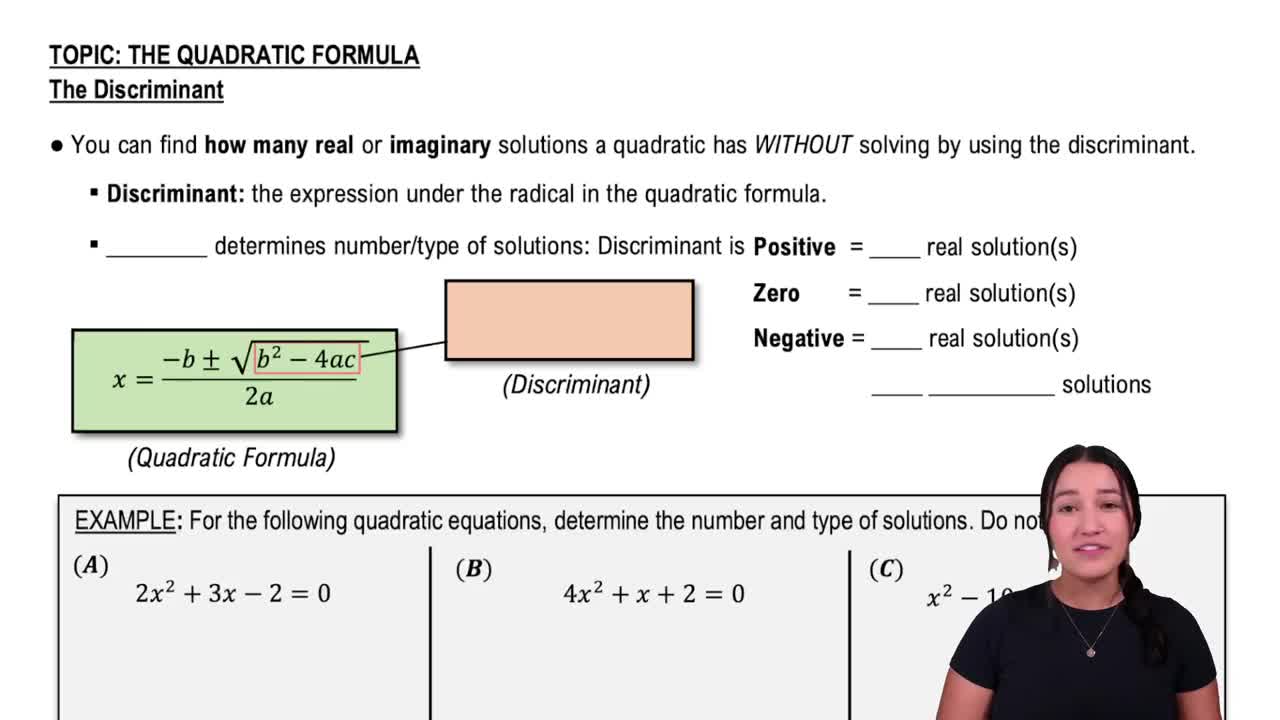
The discriminant, given by Δ = b^2 - 4ac, determines the number and type of roots of a quadratic equation. If Δ > 0, there are two distinct real roots; if Δ = 0, one real root; and if Δ < 0, no real roots, meaning the parabola does not cross the x-axis.
Recommended video:
The Discriminant
Watch next
Master Properties of Parabolas with a bite sized video explanation from Patrick
Start learningRelated Videos
Related Practice
Textbook Question
1138
views