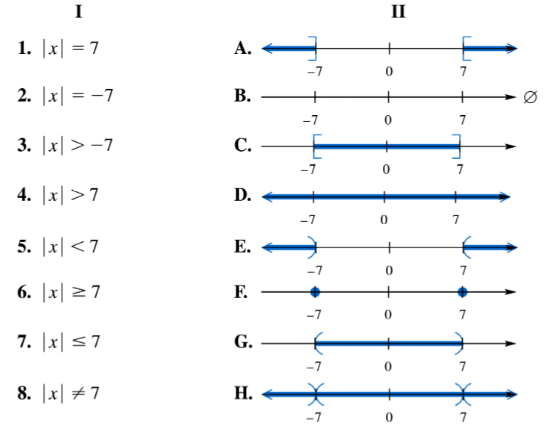
Match each equation or inequality in Column I with the graph ofits solution set in Column II. | x | = 7
Verified step by step guidance
1
Step 1: Understand the equation \(|x| = 7\). This is an absolute value equation, which means we are looking for all values of \(x\) that are 7 units away from 0 on the number line.
Step 2: Recall that the absolute value equation \(|x| = a\) can be split into two separate equations: \(x = a\) and \(x = -a\).
Step 3: Apply this to the given equation \(|x| = 7\), which gives us two equations: \(x = 7\) and \(x = -7\).
Step 4: These two equations represent two points on the number line, specifically at \(x = 7\) and \(x = -7\).
Step 5: The graph of the solution set will be two distinct points on the number line at \(x = 7\) and \(x = -7\).
Verified video answer for a similar problem:
This video solution was recommended by our tutors as helpful for the problem above
Video duration:
2m
Play a video:
Was this helpful?
Key Concepts
Here are the essential concepts you must grasp in order to answer the question correctly.
Absolute Value
The absolute value of a number is its distance from zero on the number line, regardless of direction. For example, |x| = 7 means that x can be either 7 or -7, as both values are 7 units away from zero. Understanding absolute value is crucial for solving equations and inequalities that involve it.
Graphing the solution set of an equation or inequality involves representing all possible solutions on a number line or coordinate plane. For |x| = 7, the solutions x = 7 and x = -7 would be represented as points on the number line. This visual representation helps in understanding the nature of the solutions.
Equations state that two expressions are equal, while inequalities express a relationship where one expression is greater than, less than, or not equal to another. In the context of |x| = 7, it is an equation, but understanding how to interpret inequalities like |x| < 7 or |x| > 7 is also important for broader applications in algebra.